
Soft-magnetic alloys: Fe–Si–Nb–B–Cu FINEMET-type amorphous alloys
Fe–Si–Nb–B–Cu “FINEMET-type” amorphous alloys can be driven into the canonical nanocrystalline soft-magnetic state within only a few seconds of annealing, yet end up in essentially the same final nanostructural topology that is classically obtained by tens of minutes of conventional heat treatment. The central message is that the governing physics of primary nanocrystallization is not set primarily by the macroscopic annealing time scale (seconds vs. minutes) but by a Cu-mediated, chemically pre-patterned nucleation landscape that forms already below the crystallization onset. Atom probe tomography (APT) is used here not merely as a compositional characterization tool but as a kinetic “witness” to the sequence: (i) Cu clustering begins well before Fe–Si crystallization; (ii) those Cu clusters restructure the amorphous matrix by producing local Fe–Si enrichment (chemical fluctuations); (iii) those heterogeneities are proposed to be the true nuclei for subsequent bcc Fe–Si (DO3-type) nanocrystals; and (iv) rapid annealing primarily suppresses growth (by limiting time at temperature) while maintaining very high nucleation rates, thereby yielding smaller grains at comparable crystalline volume fraction.
Material, processing concept, and why this alloy family is special
The alloy we work on is Fe73.5Si15.5Cu1Nb3B7 in ribbon form (~20 µm thick), initially fully amorphous after melt spinning. This chemistry is archetypal: Cu and Nb are the “functional” minor additions. Cu is used to induce nanoscale chemical decomposition that seeds dense primary crystallization, and Nb is the classical growth inhibitor that stabilizes the nanocrystalline grain size by retarding diffusion and by promoting solute partitioning into the remaining amorphous matrix. The target state is a two-phase composite: randomly oriented Fe–Si nanocrystals embedded in a residual amorphous matrix. In soft magnetism terms, the grain size is so small (order 10 nm) that the microstructural correlation length remains far below the ferromagnetic domain-wall width; consequently, magnetocrystalline anisotropies average out strongly, enabling very low coercivity when other anisotropy sources are controlled.

Atom probe tomography ultrahigh nanocrys[...]
PDF-Dokument [1.6 MB]
Morsdorf Pradeep et al J Appl Phys 119 ([...]
PDF-Dokument [583.2 KB]
Experimental design: two rapid annealing routes versus two conventional routes
The work compares “rapid annealing” (RA) to “conventional annealing” (CA) in a way that controls for crystallized volume fraction (not temperature), which is essential because RA shifts apparent crystallization temperatures upward. Two RA variants are used: (RA1) short-time furnace contact between pre-heated Cu blocks and ribbon (stress-free, ≥10 s feasible); and (RA2) continuous transport through a furnace hot zone (nitrogen atmosphere) with modest tensile stress (~50 MPa), giving ~4 s dwell for the stated hot-zone length. Two CA variants are used: (CA1) ~30 min and (CA2) ~5 min in a standard furnace without Cu blocks. The authors select conditions that yield comparable crystalline volume fractions at two key points: an initial primary-crystallization state of ~30 vol.% crystals, and a near-final primary-crystallization state of ~75–80 vol.% crystals (before secondary Fe–B compound formation).
Phase evolution and volume fraction are tracked by XRD with peak deconvolution separating amorphous and crystalline contributions; crystallite size is extracted by Scherrer broadening and cross-checked by TEM bright-field images and SAED ring patterns. Nanoscale chemical partitioning, Cu clustering, and the nanocrystal–matrix interfacial chemistry are quantified by APT (LEAP), with cluster statistics from a maximum-separation algorithm and interface composition profiles from proximity histograms (“proxigrams”) based on Cu isoconcentration surfaces.
Time–temperature trajectory: rapid annealing shifts the window but not the endpoint topology
In RA2, a sequence of 4 s treatments over increasing temperature shows that the ribbon remains XRD-amorphous up to ~535 °C. The onset of primary crystallization appears at ~555 °C via emergence of bcc Fe–Si diffraction (their key peak is the {220} reflection near 2θ ≈ 53°), corresponding to ~30 vol.% crystalline fraction and a mean crystallite size of ~7 nm at that point. With increasing RA2 temperature, the crystalline fraction rises toward ~80 vol.% and grain size approaches ~10 nm before secondary crystallization (Fe–B compounds) becomes detectable at substantially higher temperature (secondary crystallization onset is reflected in magnetic-property degradation and new XRD peaks at the highest annealing temperatures).
A key aspect is that RA produces similar phase constitution and similar ultimate volume fraction limits within primary crystallization, but it requires temperatures roughly ~100 °C higher than CA to reach equivalent crystallized fractions on the seconds time scale. This is consistent with the general kinetic expectation: short dwell times demand higher temperatures to achieve comparable transformation extent. Importantly, the authors do not interpret the higher RA temperatures as implying a different mechanism; instead, they use APT to show that the same Cu-driven preconditioning and Fe–Si nucleation pathway operates, but compressed in time and shifted in temperature.
Cu clustering begins before crystallization and already “writes” the nucleation map
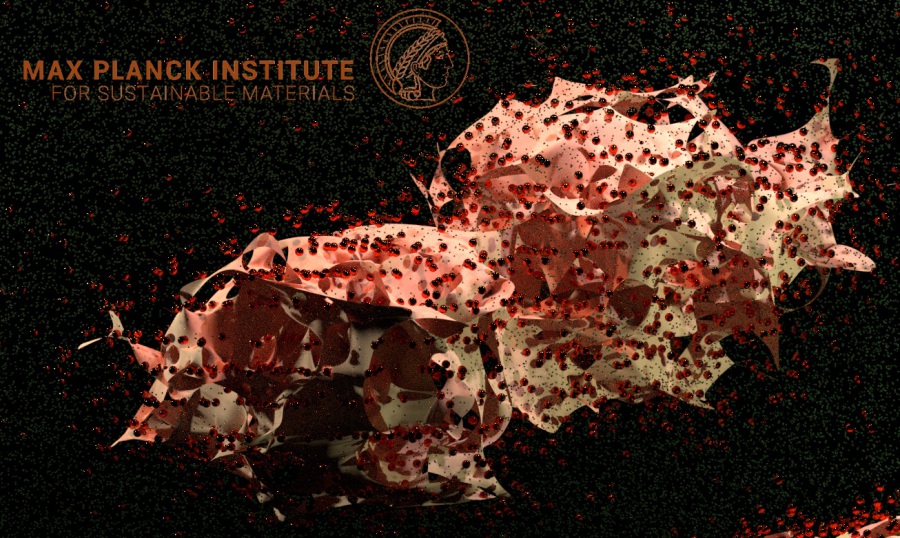
The APT temperature series (RA2, 4 s) is the mechanistic heart of the paper. The as-spun amorphous state shows essentially random elemental distributions. The earliest trace of Cu clustering is detected near ~450 °C (though too embryonic for their chosen statistical threshold requiring a minimum number of Cu atoms per cluster); by ~535 °C, distinct Cu-rich clusters are evident and can be contoured by a Cu isoconcentration surface. The authors quantify two key kinetic signatures:
-
Cu clustering precedes primary crystallization by at least ~50 °C in the RA2 schedule (onset of obvious clustering vs. crystallization at ~555 °C).
-
Cluster number density exhibits a maximum before crystallization onset and then decreases as temperature increases toward and beyond primary crystallization. Simultaneously, cluster mean size grows strongly with temperature.
Quantitatively, the mean Cu-cluster diameter grows from roughly ~1 nm in the low-temperature clustering regime to ~9.5 nm near the highest temperatures explored, while the number density decreases correspondingly. This “number density peak followed by coarsening” matters because it implies that a significant fraction of the potential heterogeneous nucleation sites is already being lost to coarsening before Fe–Si crystallization begins. In other words, Cu is active early, and it is already dynamically optimizing (and partially degrading) its own nucleation-site population before the transformation that it is meant to catalyze.
A second major quantitative result concerns cluster composition. At the initial crystallization stage (near ~30 vol.% crystals), proxigrams show Cu clusters with core composition around ≥95 at.% Cu under both RA and CA conditions, i.e., very Cu-pure clusters with strong rejection of Fe and other solutes. This indicates that once clusters have matured, they are not “Cu-rich amorphous fluctuations” but rather nearly pure Cu regions from a compositional standpoint. At later primary-crystallization stages (~75–80 vol.% crystals), the cluster cores approach ~100 at.% Cu, consistent with progressive purification and/or improved phase separation as temperature increases.
Why rapid annealing yields smaller grains: nucleation remains high; growth is time-limited
At equal crystalline fraction (~30 vol.% at the onset stage), TEM and XRD show that RA produces Fe–Si grains about 30% smaller than CA: RA yields ~7 ± 2 nm vs. CA ~10 ± 3 nm at comparable volume fraction. At the near-final primary stage (~75–80 vol.% crystals), RA yields ~10 ± 2 nm, whereas CA yields ~15 ± 3 nm, i.e., a 30–50% reduction in grain size under RA for similar crystalline fraction. The paper’s interpretation is physically coherent: if nucleation can proceed at very high rates while growth is truncated by the short time at temperature, the microstructure shifts toward a higher number density of smaller crystals.
To support this, the authors estimate the number density of Fe–Si nanocrystals from the measured crystal size and volume fraction using a spherical approximation N=6V/(πD3)N = 6V/(\pi D^3)=6V/(πD3). At the ~30 vol.% stage, they obtain Fe–Si nanocrystal number densities on the order of 10²⁴ m⁻³, and show that RA produces an increase of roughly 60–80% in nanocrystal number density compared with CA. Crucially, a similar increase (up to ~80%) is also found in the number density of Cu clusters at this stage under RA relative to CA. This near one-to-one scaling is presented as strong evidence that Cu-cluster statistics set the nucleation density of Fe–Si crystals in the early stages: more clusters (or more effective cluster-derived heterogeneities) correlate with more nanocrystals, and the smaller grain size is then a geometric consequence at fixed volume fraction.
In the final stage of primary crystallization, the relationship becomes more subtle. Cu-cluster number densities in RA and CA become similar (and low) due to extensive coarsening, yet the Fe–Si nanocrystal number density remains higher under RA. The authors interpret this as a hallmark of nucleation-dominated transformation during RA: nucleation continues to occur progressively at higher temperatures, while growth remains limited by the short dwell time, in contrast to CA where prolonged annealing time facilitates coarsening and growth of existing nanocrystals (reducing number density). In CA1, the longer anneal shows signs consistent with more growth at the expense of number density.
Two coarsening regimes for Cu clusters: early coagulation vs. later Ostwald ripening
A particularly instructive contribution is the mechanistic separation of Cu-cluster coarsening into two regimes, controlled by the evolving topology of the surrounding medium.
In the early stage (before substantial crystallization), the material is a quasi-continuous amorphous matrix hosting a high density of Cu clusters with small inter-cluster spacings. APT reveals instances where neighboring clusters are connected by Cu-enriched “necks.” A one-dimensional concentration profile across such a neck demonstrates substantial Cu enrichment relative to the matrix (tens-fold). This is interpreted as evidence for a diffusion–coagulation mechanism: overlapping diffusion fields, cluster migration/impingement, and coalescence in an effectively continuous amorphous medium.
In the later stage (after significant Fe–Si crystallization, ≥~50 vol.% crystals), the topology changes: Fe–Si nanocrystals partition space and separate clusters from one another, reducing the probability of direct coagulation. In this regime, coarsening is instead proposed to proceed by classical evaporation–condensation (Ostwald ripening): smaller clusters dissolve, Cu diffuses through the remaining amorphous regions, and redeposits on larger clusters. Experimentally, this is consistent with increasing average cluster size and decreasing number density as annealing temperature increases, even though direct cluster contact becomes rare.
This dual-mechanism framing matters because it connects coarsening kinetics to microstructural percolation: the mode of coarsening is not intrinsic only to Cu diffusivity and interfacial energy, but strongly dependent on whether the amorphous matrix remains a continuous diffusion reservoir or is segmented by a dense nanocrystalline network.
Mechanism of Fe–Si nanocrystallization: from “Cu as a structural nucleus” to “Cu as a chemical fluctuation generator”
The authors position their mechanism carefully relative to existing nucleation pictures. In classic heterogeneous-nucleation interpretations, Fe–Si crystals nucleate on (structurally) fcc-like Cu clusters through favorable interfacial-energy and orientation-relationship arguments, and Cu clusters are often observed near the nanocrystal–matrix interface. This paper confirms that Cu clusters exist prior to crystallization and that, after primary crystallization, many clusters reside at nanocrystal/amorphous interfaces rather than being engulfed, consistent with a model where nanocrystals do not necessarily envelope clusters during growth.
However, the paper’s distinctive mechanistic claim is that, especially under rapid annealing, the decisive trigger for Fe–Si nucleation is chemical fluctuation-induced: Cu clustering rejects Fe and Si locally and thereby creates Fe–Si enriched regions in the amorphous matrix. Those enriched pockets are proposed as the “actual nuclei” for Fe–Si nanocrystallization. In this view, Cu clusters are indirect nucleation agents: they create the chemical inhomogeneity landscape; crystallization then occurs within this chemically patterned matrix. Under rapid annealing, where temperatures are higher and diffusion lengths become larger within the short time, these enriched regions can crystallize effectively even if not every nanocrystal nucleates strictly on the surface of a structurally well-developed Cu cluster. The authors describe this as a pseudo-homogeneous nucleation scenario: nucleation appears homogeneous with respect to visible Cu clusters, but it is in fact guided by a chemically decomposed matrix created by Cu.
Two observations support this: (i) at late primary crystallization, many Fe–Si nanocrystals are topologically remote from Cu clusters, and (ii) despite extensive reduction in Cu-cluster number density at late stages, the Fe–Si nanocrystal number density remains very high (order 10²⁴ m⁻³). On a seconds time scale, it is implausible that all nanocrystals nucleate on Cu clusters and then detach and migrate; rather, crystallization of pre-enriched regions throughout the amorphous matrix is kinetically more consistent.
Diffusion argument: rapid annealing enables much higher effective Fe transport
To provide kinetic plausibility, the authors estimate minimum Fe diffusivities using a growth-length scaling r=aDtr = a\sqrt{D t}=aDt
with spherical crystals and an interface-dependent constant. They infer minimum Fe diffusivities in the range of ~10⁻¹⁷ m²·s⁻¹ under RA at the onset and late stages (values given are ~1.3 × 10⁻¹⁷ m²·s⁻¹ at ~555 °C and ~2.5 × 10⁻¹⁷ m²·s⁻¹ at ~695 °C). These are orders of magnitude higher than diffusivities associated with CA at ~490 °C (they discuss values in the ~10⁻²⁰ m²·s⁻¹ range). The essential implication is that RA temperatures, even for seconds, provide diffusion lengths sufficient for Fe redistribution into (and crystallization of) the chemically enriched regions created during clustering. This diffusion-based argument reinforces the notion that rapid annealing shifts the system into a regime where chemical-fluctuation-driven nucleation becomes highly effective across the matrix.
Consequences for alloy design and processing control
From an alloy-design perspective, the most actionable insight is that Cu clustering starts early and coarsens even before crystallization onset. That means that, for a fixed Cu content (here 1 at.%), the maximum density of Cu clusters does not coincide automatically with the onset of Fe–Si crystallization under rapid heating; a fraction of clusters has already coarsened, reducing the count of potential nucleation sites. Yet, despite that pre-crystallization coarsening, rapid annealing still produces a substantially higher Cu-cluster number density at the onset stage than conventional annealing, which directly translates into higher nanocrystal number density and smaller grain size. This creates an explicit optimization problem: if one wants to maximize nucleation-site density precisely at the onset of crystallization under RA schedules, it may be beneficial to adjust Cu content and/or the thermal trajectory (ramp/hold) such that clustering is promoted but pre-crystallization coarsening is minimized.
We also were able to clarify a practical boundary condition: because soft-magnetic performance in this alloy family can be dominated by macroscopic anisotropy sources (magneto-elastic and processing-induced anisotropy) once the grain size is already in the ~10–15 nm regime, a further reduction in grain size under RA does not automatically guarantee markedly lower coercivity in real ribbon processing. In the continuous RA2 route, the necessary transport stress introduces a creep-induced anisotropy that can dominate over random anisotropy contributions, limiting the observable magnetic benefit of smaller grains. This is a technically important reminder that microstructural refinement is necessary but not sufficient; process-induced anisotropies must be engineered in parallel.
Our work shows that the nanocrystalline state in Fe–Si–Nb–B–Cu alloys is “pre-encoded” by early Cu clustering. Rapid annealing achieves ultrahigh nanocrystallization rates not by inventing a new pathway but by exploiting the same Cu-driven chemical decomposition at elevated temperature and short time, in a regime where nucleation remains prolific and growth is time-starved. Cu clusters evolve through a topology-dependent coarsening sequence (early coagulation, later Ostwald ripening), and they act primarily as chemical fluctuation generators that create Fe–Si enriched regions that subsequently crystallize. The net result is a nanocrystalline microstructure with essentially identical phase constitution, volume fraction, and crystal chemistry compared with conventional annealing, but with a systematically reduced grain size and increased nanocrystal number density—quantitatively on the order of 10²⁴ m⁻³—demonstrating a clear nucleation-dominated transformation under rapid annealing.
 Druckversion