
Crystal Plasticity Finite Element Method
Crystal plasticity modeling is a continuum-scale computational approach used to predict the deformation behavior of crystalline materials by explicitly considering their crystallographic anisotropy and microscale slip mechanisms.
At its core, the method links the macroscopic mechanical response (e.g., stress–strain curves, texture evolution, strain localization) to the microscale physics of dislocation glide on specific crystallographic slip systems.
Core Principles of Crystal Plasticity
-
Kinematics: The total deformation gradient F is decomposed multiplicatively into the elastic lattice distortion and remaining rotation, a consequence of irreversible plastic slip.
-
Slip System Activity: Plastic deformation occurs by shear on discrete slip systems, characterized by a slip direction and a slip plane normal
-
Constitutive Laws: Slip rates are typically modeled by viscoplastic or physics-based flow rules.
-
Hardening: Captures dislocation interactions and work hardening through laws such as latent hardening or particle dislocation hardening.
Implementation
Crystal plasticity can be implemented in:
Applications
-
Predicting texture evolution during rolling, extrusion, or additive manufacturing.
-
Studying anisotropy in single crystals and polycrystals.
-
Modeling micromechanical fields such as local stress, strain, or dislocation density.
-
Integrating with phase-field or dislocation-density models for multiscale coupling.
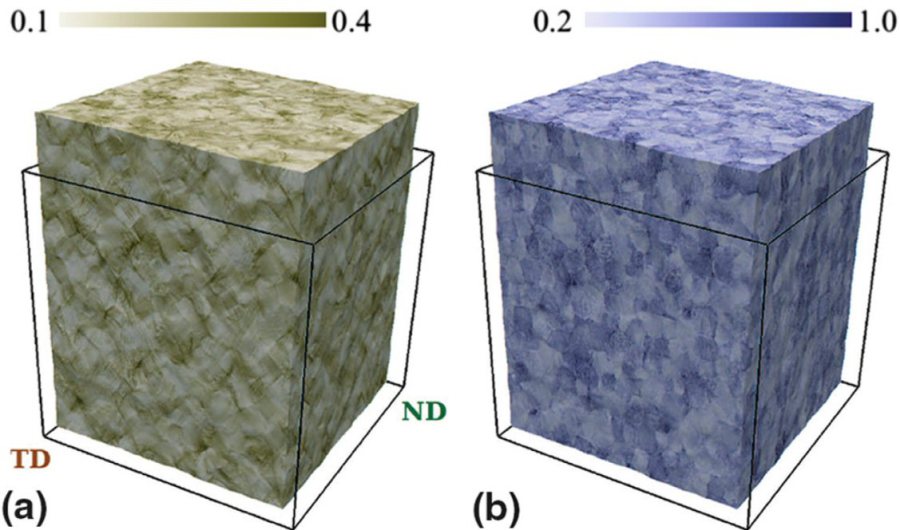 Crystal plasticity modeling is a continuum-scale computational approach used to predict the deformation behavior of crystalline materials by explicitly considering their crystallographic anisotropy and microscale slip mechanisms.
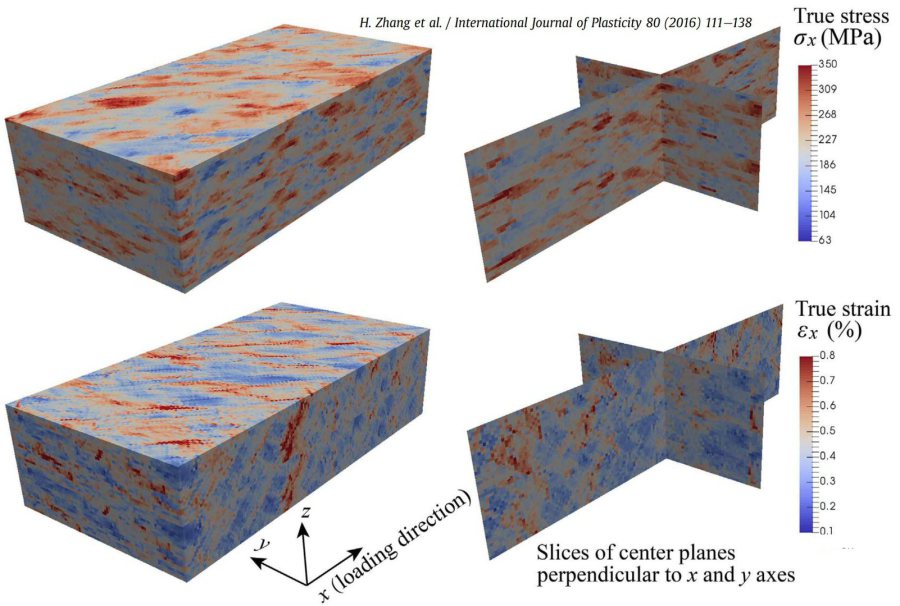 Crystal plasticity modeling is a continuum-scale computational approach used to predict the deformation behavior of crystalline materials by explicitly considering their crystallographic anisotropy and microscale slip mechanisms.
Crystal Plasticity Modeling: Physics, Scale, and Complexity
The Continuum-Mechanics Paradigm for Crystalline Matter
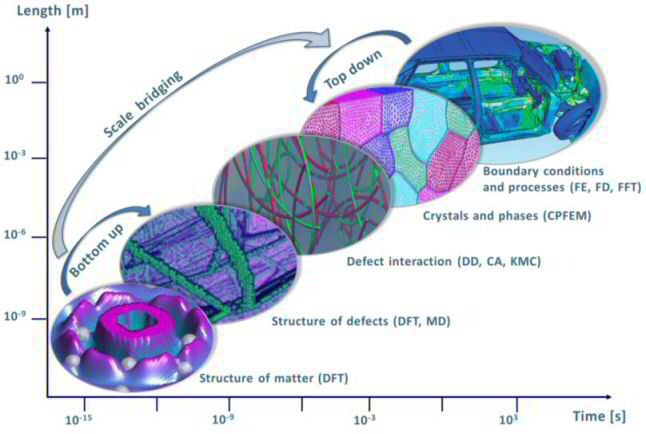
The mechanical response of metallic materials is intrinsically governed by the anisotropic nature of crystallographic slip. Crystal Plasticity (CP) modeling provides a rigorous variational framework for describing the elastic-plastic deformation of heterogeneous crystalline matter. By integrating the kinematics of dislocation glide, twinning, and phase transformations with advanced homogenization schemes, CP-based simulations bridge the gap between microscopic lattice defects and macroscopic component performance.
Constitutive Fundamentals and Dislocation Kinematics
At the material point level, CP models decompose the total deformation gradient into elastic and plastic portions. The plastic velocity gradient is formulated as the sum of shear contributions from all active slip systems.
-
Flow Rules and Hardening: While empirical power laws are common, physics-based models increasingly utilize internal state variables—primarily dislocation densities—to describe the evolution of slip resistance.
-
BCC vs. FCC Plasticity:
-
FCC: Resistance is dominated by passing and cutting stresses from other dislocations.
-
BCC: Screw dislocations experience high lattice friction due to non-planar core structures, requiring thermal activation to overcome the Peierls barrier via kink-pair nucleation.
-
Temperature and Strain Rate Sensitivity: Physics-based models are uniquely suited to predict behavior over wide temperature ranges (e.g., IF steel from 173K to 1073K) by incorporating the waiting time for thermal activation into the dislocation velocity formulation.
2. The Multi-Scale Challenge: Homogenization and RVEs
A central task in CP modeling is the determination of macroscopic materials descriptions from microscopic structures.
-
Representative Volume Elements (RVEs): RVEs must be constructed based on statistical quantities (texture, phase fractions, grain morphology) to accurately represent the bulk material.
-
Homogenization Schemes:
-
Full Constraints (Taylor): Assumes local strain matches global strain, satisfying strain equilibrium but not stress equilibrium.
-
Relaxed Constraints: Drops certain strain constraints to allow for local interactions.
-
Self-Consistent Models: Treat grains as inclusions in an effective medium, particularly useful for semi-crystalline polymers.
-
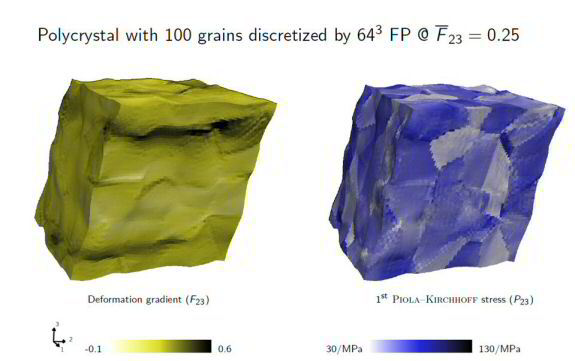
Full-Field Methods: Solve the boundary value problem directly using Finite Element (CP-FEM) or Spectral Methods.
Numerical Solvers and Efficiency
The choice of numerical solver is critical for balancing accuracy and computational cost.
-
Spectral Solvers (FFT-based): Utilize Fast Fourier Transforms to solve mechanical equilibrium for periodic RVEs. They are significantly faster than FEM for high-resolution, full-field simulations.
-
Finite Element Method (CP-FEM): Offers greater flexibility for complex geometries and non-periodic boundary conditions.
-
Coupled FE-FFT Approaches: A multiscale strategy where a spectral solver provides the homogenized response for each integration point in a macroscopic FE model.
-
Surrogate Modeling: Recent developments use Artificial Neural Networks (tCNNs) to reproduce stress fields 500 times faster than numerical solvers, though they require massive training datasets.
Twinning, Damage, and Chemo-Mechanics
Modern CP frameworks must account for non-linear couplings between various microstructural evolution processes.
-
Twinning-Induced Plasticity (TWIP): Critical for hexagonal materials (Mg, Ti) and high-Mn steels, where re-orientation and shear strains from twin growth dominate.
-
Phase Transformations (TRIP): Coupled models track the conversion of phases (e.g., austenite to martensite) and the resulting transformation-induced plasticity.
-
Phase-Field Coupling: The integration of Phase-Field (PF) methods with CP allows for spatially resolved simulations of:
-
Fracture and Damage: Modeling crack initiation and propagation around voids or along crystallographic planes (cleavage).
-
Grain Boundary Migration: Describing strain-induced migration driven by stored energy heterogeneity.
-
Chemo-Mechanical Interactions: Simulating solute segregation, hydrogen embrittlement, or iron oxide reduction.
Validation through "Digital Twins"
Validation requires high-resolution experimental data to compare against simulation predictions.
-
3D Microstructure Mapping: Techniques like EBSD-tomography (serial sectioning with FIB-SEM) provide the 3D grain topology and orientation data needed to initialize high-fidelity models.
-
In-Situ Testing: Combining Digital Image Correlation (DIC) with EBSD allows for the concurrent tracking of local strain and orientation evolution during deformation.
-
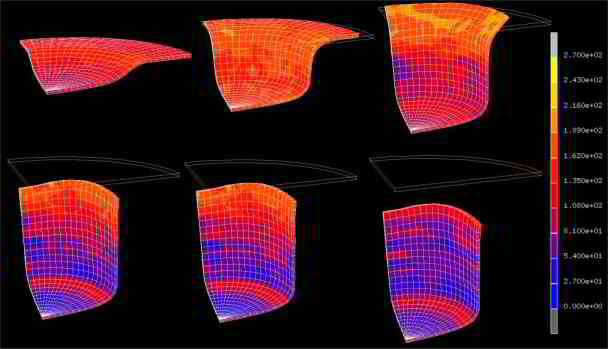
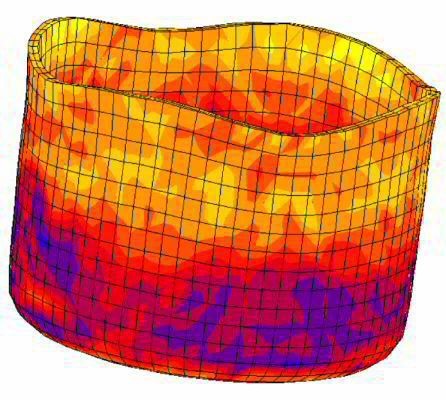
Parameter Identification: Automated optimization (e.g., Genetic Algorithms) is used to identify the large number of constitutive parameters from macroscopic stress-strain curves or nanoindentation pile-up patterns.
Critical Challenges and Perspectives
Despite its power, CP modeling faces persistent scientific hurdles:
-
Uniqueness of Parameters: The large number of adjustable parameters can lead to underdetermined systems; prior physical knowledge and multi-condition fitting are essential.
-
Size Effects: Traditional local CP models fail to capture size-dependent strengthening (smaller-is-stronger). Non-local models incorporating Geometrically Necessary Dislocations (GNDs) are required to account for strain gradients.
-
Extreme Environments: Capturing high-temperature instabilities and complex damage nucleation at grain boundaries remains computationally intensive.
Quellen:
-
Intern J Plasticity 80 (2016) 111 Zhang yield surface DAMASK.pdf
-
Procedia IUTAM 3 ( 2012 ) 3 MPIE DAMASK Introduction crystal plasticity.pdf
-
Cereceda et al 2015 GAMM Mitteilungen vol 38 page 213 – 227 (2015) crystal plasticity tungsten.pdf
-
Int J Plasticity bcc crystal plasticity dislocation based model 2014.pdf
-
Acta Materialia 50 (2002) 421 theory orientation gradients.pdf
-
Crystal plasticity study stress strain partitioning 3D EBSD dual phase steel microstructure.pdf
-
crystal plasticity spectral RVE simulations yield surface polycrystal.pdf
-
IJP 2018 crystal plasticity phase field model twin hexagonal.pdf
-
Acta Mater 2019 interaction precipitates tensile twins Mg alloys.pdf
-
2021 Acta Materialia mechanisms stress-induced phase transformation NiTi.pdf
-
Crystal Plasticity Phase Field Fracture Simulation at void.pdf
-
JMPS 2017 Elasto-viscoplastic phase field modelling of anisotropic cleavage.pdf
-
IJP 2017 crystal plasticity and phase-field grain growth.pdf
-
2020 Multi-component chemo-mechanics based on transport relations for the chemical potential.pdf
-
Acta Mater 2022 Chemo-mechanical phase-field modeling of iron oxide reduction with hydrogen.pdf
-
Acta Materialia 60 (2012) 1623 3D crystal plasticity 3D EBSD.pdf
-
Tasan Acta Materialia vol 91 (2014) Crystal plastiicty DIC ICME analysis Dual Phase steels.pdf
-
Int J Plasticity 2018 strain stress partitioning in bainitic martensitic austenitic steels 2.pdf
-
2012_Orientation informed nanoindentation of alpha-titanium.pdf
-
Acta Materialia 58 (2010) 1876 single crystal beam bending.pdf
-
International Journal of Plasticity 25 (2009) 1655 damage nucleation at interfaces.pdf
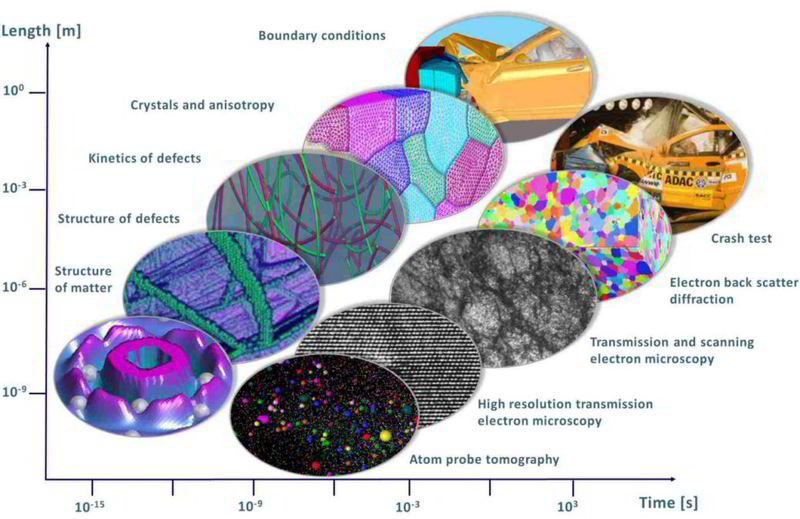
The elastic-plastic deformation of crystalline multiphase aggregates depends on the direction of loading, i.e. crystals are mechanically
anisotropic.
The directionality or orientation dependence of the mechanical response of crystals under load is due to the anisotropy of the elastic tensor and
to the orientation dependence of the activation of certain crystallographic deformation mechanisms (dislocations, twins,
martensite).
A consequence of crystalline anisotropy is that the associated mechanical phenomena such as shape change, crystallographic texture
evolution, strength, strain hardening, deformation-induced surface roughening, damage, and fracture are also orientation dependent. This is not a
trivial statement since it implies that mechanical parameters of crystalline matter are tensor quantities.
An example is the uniaxial stress-strain curve, which is the most important mechanical measure in structural materials design. The statement above means that such flow curves represent an
incomplete measure since they reduce a 6-dimensional yield surface and its change upon loading to a 1-dimensional (scalar) yield curve.
Another consequence of this statement is that crystallographic texture and its evolution during forming is a quantity that is
inherently connected with plasticity theory. The texture describes the orientation distribution of a crystalline portion of matter. It can, therefore, be used to describe the integral anisotropy
of polycrystals in terms of the individual tensorial behavior of each grain and the orientation dependent
boundary conditions among the crystals.
Formally, the connection between crystallographic shear and texture evolution becomes also clear from the fact that any deformation gradient can be expressed as the product of its skew-symmetric
portion, which represents a pure rotation leading to texture changes if not exactly matched by the rotation implied by plastic shear, and a symmetric tensor that is a measure of pure
stretching. This means that plastic shear creates, as a rule both shape changes and orientation changes, except for certain highly symmetric shears. Hence, a theory of the mechanical properties
of crystals must include first, the crystallographic and anisotropic nature of those mechanisms that create shear and second, the orientation(s) of the crystal(s) studied relative to the
applied boundary conditions (e.g. loading axis, rolling plane).
Early approaches to describe anisotropic plasticity under simple boundary conditions have considered these aspects, such as for instance the Sachs, Taylor, Bishop-Hill, or Kröner
formulations.
However, these approaches were neither designed for considering explicitly the complex mechanical interactions among the crystals in a polycrystal nor for responding to complex internal or
external boundary conditions.
Instead, they are built on certain assumptions of strain or stress homogeneity to cope with the intricate interactions within a
polycrystal. For that reason variational methods in the form of
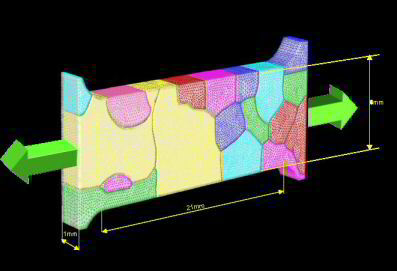
finite element approximations have gained enormous momentum in the field of crystal plasticity. These methods, which
are referred to as crystal plasticity finite element (CPFE) models, are based on the variational solution of the equilibrium
of the forces and the compatibility of the displacements using a weak form of the principle of virtual work in a given finite
volume element. The entire sample volume under consideration is discretized into such elements. The essential step which renders the deformation kinematics of this approach a crystal
plasticity formulation is the fact that the velocity gradient is written in dyadic form. This
reflects the tensorial crystallographic nature of the underlying defects that lead to shear and consequently, to both shape changes (symmetric part) and lattice rotations
(skew-symmetric part). This means that the CPFE method has evolved as an attempt to employ some of the extensive knowledge gained from experimental and theoretical studies of single crystal
deformation and dislocations to inform the further development of continuum field theories of deformation. The
general framework supplied by variational crystal plasticity formulations provides an attractive vehicle for developing a comprehensive theory of plasticity that incorporates existing knowledge of
the physics of deformation processes with the conceptual and computational tools of continuum mechanics to develop advanced and physically based design tools for engineering applications.
One main advantage of CPFE models lies in their capability of solving crystal mechanical problems under complicated internal and/or external boundary conditions. This aspect is not a mere computational advantage but it is an inherent part of the physics of crystal mechanics since it enables one to tackle those boundary conditions that are imposed by inter- and intra-grain micro-mechanical interactions.
However, the success of CPFE methods is not alone built on their efficiency in dealing with complicated boundary conditions. They also offer high flexibility with respect to including various constitutive formulations for the flow and hardening behavior at the elementary shear system level. The corresponding constitutive flow laws that were suggested during the last decades have gradually developed from empirical viscoplastic formulations into physics-based multiscale internal-variable models of plasticity including a variety of size-dependent and interface mechanical effects.
In this context it should be emphasized that the finite element method is in itself not the actual model but the variational solver for the underlying constitutive equations mapping the anisotropy of elastic-plastic shears associated with the various types of lattice defects.
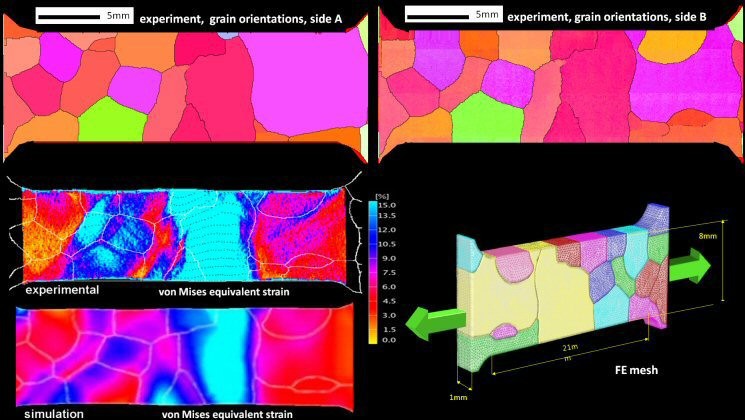 Crystal plasticity modeling is a continuum-scale computational approach used to predict the deformation behavior of crystalline materials by explicitly considering their crystallographic anisotropy and microscale slip mechanisms.

Computational Materials Science 158 (2019) 420–478
DAMASK – Duesseldorf Advanced Material S[...]
PDF-Dokument [10.5 MB]
Acta Materialia 58 (2010) 1152–1211
Crystal Plasticity Finite Element Method[...]
PDF-Dokument [6.3 MB]
Acta Materialia 81 (2014) 386–400
Acta Mater 81 (2014) 386 stress strain p[...]
PDF-Dokument [1.6 MB]
Acta Materialia 54 (2006) 1863–1876
Acta Materialia 54 (2006) 1863 3D indent[...]
PDF-Dokument [948.4 KB]
International Journal of Plasticity 20 (2004) 339–361
International Journal Plasticity 20 (200[...]
PDF-Dokument [841.7 KB]
Materials Science and Engineering A336 (2002) 81–87
Mater Sc Engin A336 (2002) 81 interactio[...]
PDF-Dokument [682.0 KB]
Acta Materialia 71 (2014) 333–348
Acta Materialia 71 (2014) 333 crystal pl[...]
PDF-Dokument [1.4 MB]
JOM, April 2011
2011-overview-microstructure-models-JOM.[...]
PDF-Dokument [1.5 MB]
Computational Materials Science 46 (2009) 383–392
Computational Materials Science 46 (2009[...]
PDF-Dokument [2.5 MB]
Acta Materialia 50 (2002) 421–440
Acta Materialia 50 (2002) 421 crystal pl[...]
PDF-Dokument [728.5 KB]
Acta Materialia 81 (2014) 386–400
Acta Mater 81 (2014) 386 dual phase stee[...]
PDF-Dokument [1.6 MB]
International Journal of Plasticity 52 (2014) 18–32
Int J Plasticity bcc crystal plasticity [...]
PDF-Dokument [6.3 MB]
Acta Materialia 59 (2011) 7003–7009
Acta Materialia 59 (2011) 7003 titanium [...]
PDF-Dokument [337.4 KB]
Scripta Materialia 50 (2004) 1085–1090
Scripta Mater vol 50 (2004) 1085 stabili[...]
PDF-Dokument [530.7 KB]

 Druckversion