
Biomaterials: the nature of chitin

Chitin structure and properties, insects, lobster, shrimp, squid
Acta Materialia 53 (2005) 4281–4292 biol[...]
PDF-Dokument [908.1 KB]
Biological photonic structures evolved by insects provide inspiring examples
for the design and fabrication of synthetic photonic crystals. The small scales
covering the beetle Entimus imperialis are
Adv Funct Materials Wu chitin photonik c[...]
PDF-Dokument [13.5 MB]
Adv. Mater. 2010, 22, 519–526 Multiscale[...]
PDF-Dokument [905.2 KB]
Adv. Funct. Mater. 18 (2008) 3307–3314 c[...]
PDF-Dokument [584.4 KB]
chitin, structure, properties, insect, lobster
J_Mech_Behav_Bio_Mater_2011_129.pdf
PDF-Dokument [2.6 MB]
Journal of Structural Biology 155 (2006)[...]
PDF-Dokument [1.3 MB]
A 3-D jigsaw structure in brachiopod shells
Acta Biomaterialia 7 (2011) 2237 Brachio[...]
PDF-Dokument [2.0 MB]
Thermochimica Acta 463 (2007) 65–68 Lobs[...]
PDF-Dokument [300.8 KB]
J. Mater. Res. Vol. 21 2006 lobster hard[...]
PDF-Dokument [1.2 MB]
Acta Biomaterialia 3 (2007) 882–texture-[...]
PDF-Dokument [3.0 MB]
Materials Science and Engineering A 421 [...]
PDF-Dokument [1.5 MB]
Acta Biomaterialia 3 (2007) 301–309 smar[...]
PDF-Dokument [1.7 MB]
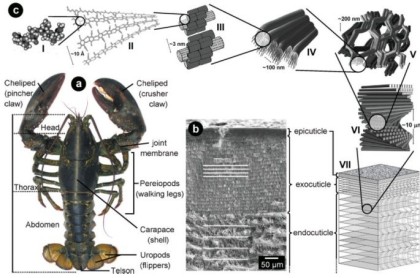
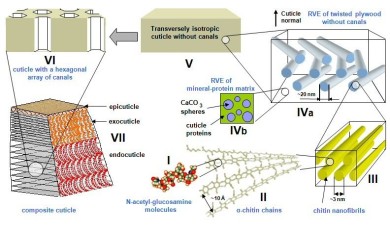
The cuticle of the lobster Homarus americanus is a nanocomposite, such as
most structural biological materials. It consists of a matrix of chitin-protein
fibers associated with various amounts of crystalline and amorphous calcium
carbonate in the rigid parts of the body, and is organized hierarchically at all
length scales. One prominent design principle found in the hierarchical
structure of such biological fibrous composite materials is the twisted plywood
structure. In the lobster cuticle, it is formed by superimposing and
gradually rotating planes of parallel aligned chitin-protein fibers. To adjust the
mechanical properties to the requirements on the macroscopic level, the
spatial arrangement and the grade of mineralization of the fibers can be
modified. A second design principle of lobster cuticle is its honeycomb-like
structure, generated by the well-developed pore canal system, whose twisted
ribbon-shaped canals penetrate the cuticle perpendicular to its surface. Due
to the hierarchical structure, the mechanical properties of the lobster cuticle
have to be investigated at different length scales, which is essential for the
understanding of the structure–mechanical function relations of mineralized
tissues (e.g., potentially also bone and teeth). In order to investigate the
influence of the structural principles on the mechanical properties on the
macroscopic scale miniaturized tensile, compression, and shear tests were
carried out to obtain integral mechanical data. Characterization of the
microstructure included scanning electron microscopy (SEM) combined with
energy dispersive X-ray (EDX) measurements.
 Druckversion