
Machine Learning and Artificial Intelligence in Metallurgy, Sustainable Materials and Alloy Design
The Intelligent Alloy: How AI and Machine Learning Can Support Alloy Design and the Future of Sustainable Metallurgy
For millennia, metallurgy advanced through the patient art of trial and error—the blacksmith’s hammer, the furnace’s glow, the metallographer’s etched micrograph. Today, that same human quest for stronger, lighter, and more durable materials is being transformed by a new kind of heat: the computational fire of machine learning and artificial intelligence. Far from replacing the metallurgist, AI is amplifying our ability to see patterns hidden in terabytes of data, to predict properties before a single ingot is cast, and to design alloys that are not only high-performing but genuinely sustainable. This convergence of physical insight and data-driven intelligence is reshaping alloy design, accelerating the discovery of eco-friendly materials, and redefining what it means to be a materials scientist in the 21st century.
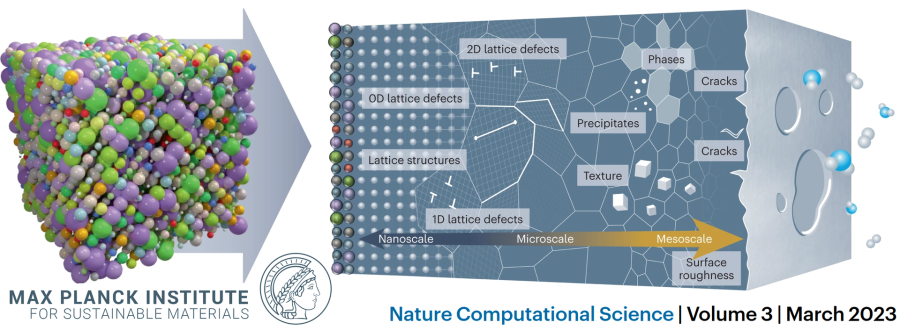 a, Chemically complex solid solutions mix many atom types, stabilised by configurational entropy. Their high‑component thermodynamics and phase diagrams guide computational studies. Large solute fractions locally break symmetry, alter electronic and magne

The chemical space for designing materials is practically infinite. This makes disruptive progress by traditional physics-based modeling alone challenging. Yet, training data for identifying composition–structure-property relations by artificial intelligence are sparse. We discuss opportunities to discover new chemically complex materials by hybrid methods where physics laws are combined with artificial intelligence: https://doi.org/10.1038/s43588-023-00412-7
a85cb3e6-26ba-420a-88a8-0a3ef2baa7e0 (1)[...]
PDF-Dokument [2.3 MB]
Metallurgy has always been rich in empirical knowledge. Phase diagrams, time-temperature-transformation curves, creep rupture data, and corrosion logs represent centuries of accumulated wisdom. Yet much of this information was fragmented—locked in laboratory notebooks, scattered across journals, or tacitly held by seasoned engineers. Machine learning thrives on exactly this kind of structured and unstructured data. By digitizing legacy knowledge and combining it with high-throughput experiments and simulations, we can train models that learn the subtle relationships between composition, processing, microstructure, and performance. The result is not a black-box oracle but a scientific partner that helps researchers ask sharper questions and explore design spaces orders of magnitude larger than intuition alone permits.
The Machine Learning Toolkit for Alloy Design
Modern AI in metallurgy deploys a spectrum of techniques, each suited to different challenges:
- Supervised learning models (random forests, gradient boosting, deep neural networks) predict properties like yield strength, fatigue life, or oxidation resistance directly from composition and process parameters. Trained on curated databases, these models can screen millions of candidate compositions in silico, flagging only the most promising for experimental validation.
- Graph neural networks (GNNs) represent crystal structures as graphs of atoms, enabling predictions that respect the fundamental physics of bonding and site occupancy. This is especially powerful for intermetallics, high-entropy alloys, and complex oxides.
- Active learning closes the loop between prediction and experiment. An algorithm proposes the next most informative experiment, the metallurgist synthesizes and tests it, and the model updates—dramatically reducing the number of iterations needed to find an optimal alloy. In some cases, active learning has cut development time by over 80%.
- Generative models (variational autoencoders, diffusion models) can propose entirely novel compositions or heat treatments that meet multiple objectives simultaneously—for instance, maximizing strength while maintaining ductility and minimizing cost. These models do not simply interpolate; they learn the underlying distribution of valid alloys and can “invent” ones never previously recorded.
- Natural language processing (NLP) mines the full text of millions of scientific articles and patents, extracting numeric property data and processing-property relationships that were never formally tabulated, effectively resurrecting “dark data” for use in training sets.
Integrated with thermodynamic databases like CALPHAD, these AI methods create a computational ecosystem where physically grounded models merge with data-driven flexibility. The outcome is a seamless pipeline from initial idea to calibrated composition, often in weeks rather than years.
Aluminum is the second most widely used metal worldwide, with essential roles in transportation, construction, packaging, and energy infrastructure. Recycling aluminum can save up to 95% of the energy required for primary production, making it a cornerstone of low-carbon manufacturing. However, recycled aluminum alloys inevitably contain higher levels of iron, which promotes the formation of brittle microscopic phases that degrade performance and limit industrial use. These phases can appear in different forms and dispersion depending on alloy composition and processing. Yet, practical guidelines for controlling them remain largely empirical and qualitative, especially when data are limited. To improve this situation, this work separates two key questions that are often conflated in alloy
Advanced Science - 2026 - Wang - Data‐Dr[...]
PDF-Dokument [12.6 MB]
Accelerating Sustainable Materials
Sustainability is not a buzzword in materials science—it is an existential requirement. The production of metals accounts for a significant fraction of global CO₂ emissions, and many high-performance alloys depend on critical elements like cobalt, rare earths, or tantalum, which carry geopolitical and environmental burdens. AI-driven design is directly tackling these challenges:
- Critical element reduction: By exploring vast compositional spaces, ML models can identify substitutions that maintain performance while eliminating or drastically reducing cobalt in superalloys, rhenium in high-temperature alloys, or neodymium in magnets. A recent study used a multi-objective Bayesian optimization to develop a cobalt-free maraging steel with strength matching conventional grades.
- Lightweighting: In transportation, every kilogram removed translates to lower fuel consumption and emissions. AI accelerates the design of advanced aluminum, magnesium, and titanium alloys, as well as high-strength steels, by precisely balancing strength, formability, and corrosion resistance. Graph-based models have successfully predicted the age-hardening response of 6000-series aluminum alloys, guiding industry toward leaner compositions.
- Recycling-friendly alloy design: Many alloys accumulate tramp elements during recycling, degrading properties. AI allows the design of “tolerant” alloys that maintain performance despite typical impurity levels, enabling circular economy flows. For example, machine learning models have identified new compositions of aluminum casting alloys that accept higher iron content from recycled scrap without forming detrimental intermetallics.
- Green processing: Digital twins of heat treatment, rolling, or additive manufacturing processes, powered by machine learning, optimize energy input and reduce scrap. Reinforcement learning agents adjust laser parameters in real-time during 3D printing, ensuring dense, crack-free parts with minimal trial runs.
These advancements align with the global Materials Genome Initiative and the European Green Deal, making the discovery of sustainable materials a data-driven, quantifiable objective rather than a serendipitous afterthought.
The discovery of high-performance multicomponent alloys is constrained by the vastness of composition space and the scarcity of experimentally validated data. We develop VIBANN, a variational information bottleneck-augmented attention-based neural network framework, for uncertainty-aware inverse design of exceptionally hard bulk multicomponent metallic glasses. The model learns chemically structured latent representations of alloy composition and indentation load to search the candidate space under constraints of chemical plausibility, novelty, and predictive uncertainty. Guided by this framework, we synthesize fi ve B-Nb-Fe-W-Co/Hf/Ru/Zr-rich bulk multicomponent metallic glasses. All alloys form fully amorphous rods of 2 mm diameter and reach Vickers hardness values of about 2450 HV, amo
s41467-026-73008-0.pdf
PDF-Dokument [5.4 MB]
Machine learning offers a promising approach to design high-performance alloys for laser additive manufacturing, by bypassing convoluted physical models and identifying correlations among composition, processing, microcracks/porosity and properties. However, conventional machine learning methods face limitations, e.g., overfi tting or unreasonable design results, due to reliance on large, high-quality datasets. Here, we introduce a generic framework operable with smaller experimental datasets, by integrating knowledge-informed graph modeling alongside data uncertainty quantification. The generic physical-metallurgy knowledge and the stochasticity of experimental defect distributions from produced material are rationally balanced. To validate the approach, we detail the development of a n
Knowledge-informed graph attention netwo[...]
PDF-Dokument [5.6 MB]
The combined structural and electronic complexity of iron oxides poses many challenges to atomistic modeling. To leverage limitations in terms of the accessible length and time scales, one requires a physically justifi ed interatomic potential which is accurate to correctly account for the complexity of iron-oxygen systems. Such a potential is not yet available in the literature. In this work, we propose a machine-learning potential based on the Atomic Cluster Expansion for modeling the iron-oxygen system, which explicitly accounts for magnetism. We test the potential on a wide range of properties of iron and its oxides, and demonstrate its ability to describe the thermodynamics of systems spanning the whole range of oxygen content and including magnetic degrees of freedom.
Development of an atomic cluster expansi[...]
PDF-Dokument [2.2 MB]
Inferring optimal solutions from limited data is considered the ultimate goal in scientific discovery. Artificial intelligence offers a promising avenue to greatly accelerate this process. Existing methods often depend on large datasets, strong assumptions about objective functions, and classic machine learning techniques, restricting their effectiveness to low-dimensional or data-rich problems. Here we introduce an optimization pipeline that can effectively tackle complex, high-dimensional problems with limited data. This approach utilizes a deep neural surrogate to iteratively find optimal solutions and introduces additional mechanisms to avoid local optima, thereby minimizing the required samples. Our method finds superior solutions in problems with up to 2,000 dimensions, whereas exist
s43588-025-00858-x.pdf
PDF-Dokument [3.5 MB]
 Druckversion