
Strain hardening in an interstitial high entropy alloy under cryogenic conditions
Cryogenic Deformation Response and Mechanical Properties
We investigated the cryogenic deformation response and underlying mechanisms of a carbon-doped interstitial high-entropy alloy (iHEA) with the nominal composition Fe49.5Mn30Co10Cr10C0.5 (at.%). By evaluating coarse-grained (6 μm, containing dispersed M23C6 nano-precipitates) microstructural variants, we observed a substantial enhancement in mechanical performance at 77 K. The ultimate tensile strength increased sharply to approximately 1000 MPa for the coarse-grained alloy and 1300 MPa for the fine-grained alloy, while maintaining an excellent tensile elongation of around 50%. This represents a massive improvement in strength compared to room temperature behavior, achieved with virtually no sacrifice in ductility.
![(a) Engineering stress-strain curves and (b) strain hardening rate curve as a function of true strain for CG and FG iHEAs tested at 293 K and 77 K. The strain hardening rate curves for the fi ne-grained CoCrFeMnNi HEA ( 17 mm) [20] and CoCrNi MEA ( 16 mm)](https://www.dierk-raabe.com/s/cc_images/teaserbox_2498807683.jpg?t=1785581642) (a) Engineering stress-strain curves and (b) strain hardening rate curve as a function of true strain for CG and FG iHEAs tested at 293 K and 77 K. The strain hardening rate curves for the fi ne-grained CoCrFeMnNi HEA ( 17 mm) [20] and CoCrNi MEA ( 16 mm)
(a) Engineering stress-strain curves and (b) strain hardening rate curve as a function of true strain for CG and FG iHEAs tested at 293 K and 77 K. The strain hardening rate curves for the fi ne-grained CoCrFeMnNi HEA ( 17 mm) [20] and CoCrNi MEA ( 16 mm)
Microstructural Evolution and Phase Transformation Mechanisms
Prior to loading, both microstructural variants exhibited a nearly single face-centered cubic (FCC) structure, with the HCP phase fraction remaining below 1%. Upon cryogenic tensile deformation, we detected a massive, deformation-driven phase transformation. The HCP martensite fraction increased continuously, reaching up to 75% in fractured coarse-grained specimens and 67% in fine-grained ones. Our transmission electron microscopy observations revealed that this transformation proceeds via the overlapping of wide stacking faults, driven by the cross-slip of stair-rod type stacking faults and mutual dislocation interactions.
Notably, mechanical twinning, which coexists with the transformation at room temperature in this alloy system, was entirely suppressed at 77 K. This mechanistic shift is dictated by the temperature-dependent reduction in stacking fault energy, which strongly favors direct FCC-to-HCP martensitic transformation over twinning under cryogenic conditions. While grain boundaries and precipitates initially hinder HCP plate growth at low strains, the overwhelming thermodynamic driving force at 77 K ensures that both coarse and fine-grained variants ultimately achieve similarly high HCP phase fractions at fracture.
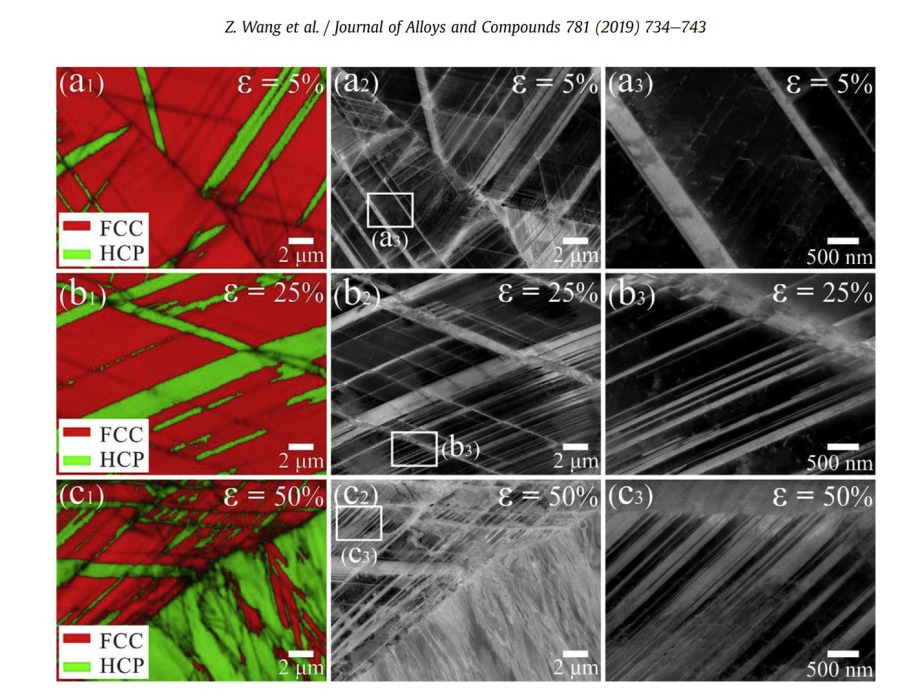 EBSD maps and ECC images of the CG iHEA after (a) 5% strain, (b) 25% strain, and (c) 50% strain at 77 K. (3) shows zoom-in images for the marked regions in (2). CG refers to the coarse-grained iHEA, and ε refers to the global engineering strain.
Origin of the observed Extraordinary Strain Hardening
The extraordinary strain hardening observed at 77 K stems from two synergistic mechanisms operating across different strain regimes. At low strains (<10%), dislocation slip and stacking fault formation dominate the FCC matrix. The fine-grained variant exhibits higher initial strain hardening here due to dislocation pile-ups at grain boundaries and pinning by M23C6 precipitates.
As deformation progresses to medium and high strains, dynamic strain partitioning takes over. The gradually transformed HCP phase and the retained FCC matrix undergo efficient, damage-free co-deformation and load-sharing. The sustained, high-level transformation-induced plasticity (TRIP) effect, fueled by the low stacking fault energy and elevated flow stress at cryogenic temperatures, continuously delays necking. Consequently, the strain hardening rate does not decay as it does at room temperature; instead, it remains exceptionally high or even increases throughout the deformation regime. This unique combination of mechanisms establishes interstitially doped, metastable high-entropy alloys as a highly promising structural material class for demanding cryogenic applications.
![(a) BF, (b) DF, and (c, d, and e) HR TEM images of the FG iHEA after 5% strain at 77 K. The DF image was taken based on the (0110) spot, as indicated by the green circle. The HR TEM image was obtained with the electron incidence direction of [011]FCC. (Fo](https://www.dierk-raabe.com/s/cc_images/teaserbox_2498807681.jpg?t=1785581573) (a) BF, (b) DF, and (c, d, and e) HR TEM images of the FG iHEA after 5% strain at 77 K. The DF image was taken based on the (0110) spot, as indicated by the green circle. The HR TEM image was obtained with the electron incidence direction of [011]FCC. (Fo
(a) BF, (b) DF, and (c, d, and e) HR TEM images of the FG iHEA after 5% strain at 77 K. The DF image was taken based on the (0110) spot, as indicated by the green circle. The HR TEM image was obtained with the electron incidence direction of [011]FCC. (Fo

We investigate the cryogenic deformation response and underlying mechanisms of a carbon-doped interstitial high-entropy alloy (iHEA) with a nominal composition of Fe49.5Mn30Co10Cr10C0.5 (at. %). Extraordinary strain hardening of the iHEA at 77 K leads to a substantial increase in ultimate tensile strength ( 1300 MPa) with excellent ductility ( 50%) compared to that at room temperature. Prior to loading, iHEAs with coarse ( 100 mm) and fi ne ( 6 mm) grain sizes show nearly single face-centered cubic (FCC) structure, while the fraction of hexagonal close-packed (HCP) phase reaches up to 70% in the cryogenically tensile-fractured iHEAs. Such an unusually high fraction of deformation-induced phase transformation and the associated plasticity (TRIP effect) is caused by the strong driving forc
J Alloys Comp 2018 - strain hardening in[...]
PDF-Dokument [4.3 MB]
 Druckversion