
Crystal–Glass High-Entropy Nanocomposites with Near Theoretical Compressive Strength and Large Deformability
High-entropy alloys (HEAs) and metallic glasses (MGs) are two material
classes based on the massive mixing of multiple-principal elements. HEAs are
single or multiphase crystalline solid solutions with high ductility. MGs with
amorphous structure have superior strength but usually poor ductility. Here,
the stacking fault energy in the high-entropy nanotwinned crystalline phase
and the glass-forming-ability in the MG phase of the same material are con-
trolled, realizing a novel nanocomposite with near theoretical yield strength
(G/24, where G is the shear modulus of a material) and homogeneous plastic
strain above 45% in compression. The mutually compatible flow behavior of
the MG phase and the dislocation flux in the crystals enable homogeneous
plastic co-deformation of the two regions. This crystal–glass high-entropy
nanocomposite design concept provides a new approach to developing
advanced materials with an outstanding combination of strength and ductility.
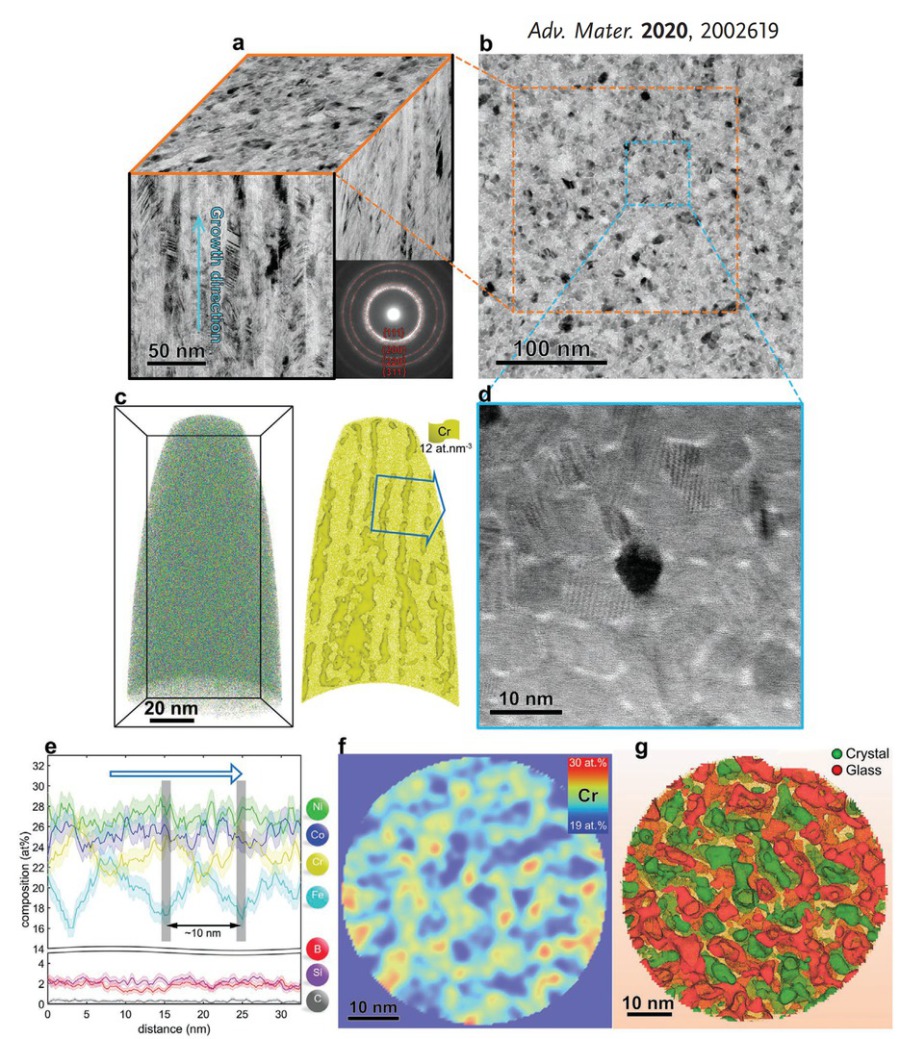 Structure and composition of the crystal–glass high-entropy nanocomposite. a) Typical bright-field plane-view and side-view TEM images. The inset shows a selected-area electron diffraction (SAED) pattern obtained from side-view TEM probing. The ring feat
Concept and Motivation for our Study
The long-standing trade-off between strength and ductility in structural metals remains one of the central challenges in alloy design. High-entropy alloys (HEAs) based on multiple principal
elements offer broad compositional freedom and generally good ductility through dislocation slip, twinning, or deformation-induced phase transformation, but their shear strength remains well below
G/10 — the theoretical limit. Metallic glasses (MGs), by contrast, achieve shear strengths approaching G/37, yet fail catastrophically through shear band localization at ambient temperature. We
sought to transcend both limitations simultaneously by merging the two material classes at the nanoscale into a single crystal-glass high-entropy nanocomposite architecture.
The key physical insight underpinning our design is twofold. First, the stacking fault energy (SFE) of the crystalline HEA phase governs twin nucleation and density; keeping the SFE low — as in
CrFeCoNi-based systems (~27 mJ m⁻²) — promotes the formation of high-density nanotwins that act as strong barriers to dislocation motion while simultaneously providing additional shear carriers and
kinematic degrees of freedom for plastic flow. Second, MGs become intrinsically capable of homogeneous plastic flow when their characteristic size is reduced below ~100 nm, a regime in which shear
bands remain confined and cannot percolate. By combining both effects in one material, we aimed at a nanocomposite in which the crystalline and amorphous phases deform compatibly rather than
sequentially or catastrophically.
Synthesis and Microstructural Architecture
We produced the nanocomposite by magnetron co-sputtering of a CrCoNi target and a Fe₇₈Si₉B₁₃ metallic glass target, both of 99.9 at% purity. By tuning the substrate-to-target distance ratio, we
accessed the compositional window 23.1 Cr – 20.7 Fe – 24.8 Co – 26.7 Ni – 1.7 B – 0.3 C – 0.6 O – 2.1 Si (at%), as confirmed by atom probe tomography (APT). The rationale for adding Fe-Si-B into the
CrCoNi base is grounded in glass-forming-ability (GFA) theory: Cr content exceeding ~20 at% in Fe-Co-Ni mixtures forces near-eutectic conditions in the binary sub-systems (Fe-Cr, Co-Cr, Ni-Cr), which
strongly suppresses crystallization; B, C, O, and Si further enhance the GFA through their directional bonding character.
The resulting microstructure consists of nanocolumnar fcc grains approximately 8 nm in width, with weak crystallographic texture as confirmed by selected-area electron diffraction. Between the
grains, an amorphous phase of average thickness ~1 nm forms preferentially at triple junctions and along a subset of grain boundaries — a topology consistent with faster elemental diffusion along
triple lines. APT and annular bright-field STEM (ABF-STEM) analysis confirms that this amorphous phase is enriched in Cr (Cr iso-concentration surface at 12 at nm⁻³), while the crystalline grains are
enriched in Fe. B, C, O, and Si distribute essentially uniformly across both phases. Critically, the average amorphous region size is well below the ~100 nm threshold below which MGs exhibit
homogeneous plastic flow.
Within the crystalline grains, low-angle annular dark-field (LAADF)-STEM reveals an extraordinarily high density of nanotwins and stacking faults (SFs) on {111} habit planes, with a
Kurdjumov–Sachs orientation relationship ([1-10]twin ∥ [-110]γ) relative to the adjacent matrix. Because the columnar grains carry only weak texture, twinning operates on all available
{111}<112> systems. The average twin boundary density is 1.0 × 10⁹ m⁻¹, and twin/SF/matrix lamellae are sub-2 nm thick, subdividing the already ~8 nm grains into an exceptionally fine lamellar
sub-structure. Higher-order fivefold nanotwins are also observed. This density of twin boundaries, far exceeding what is typically achievable in bulk processing, is made possible by the extreme
quench rate (~10¹⁰ K s⁻¹) inherent to sputter deposition and by the low SFE of the CrFeCoNi system.
Mechanical Performance
Mechanical behavior was assessed by micro-pillar compression at pillar diameters of 380, 400, 500, and 1000 nm, all giving the same yield strength — confirming the absence of a mechanical size
effect in this regime, as the smallest pillar diameter is still more than 40× the grain width. For comparison, we tested single-crystalline CrCoNi, nanocrystalline CrCoNi (average grain width ~20
nm), and nanocrystalline CrCoNi-Fe-Si-B without an amorphous phase (~15 nm grain width) under identical conditions.
The crystal-glass high-entropy nanocomposite achieves a compressive yield strength of 4.1 GPa (0.2% offset criterion), compared to 3.8 GPa for nanocrystalline CrCoNi-Fe-Si-B,
3.3 GPa for nanocrystalline CrCoNi, and 0.7 GPa for single-crystalline CrCoNi. The Young's modulus, obtained from nanoindentation, is E = 124 GPa, giving a shear modulus G = E/[2(1+ν)]. The shear
strength τ = σy/2 yields a G/τ ratio of 24, approaching the theoretical shear strength limit of G/10. None of the reference alloys reach this ratio.
Equally important, the nanocomposite sustains homogeneous plastic strain above 45% in compression without shear band percolation or macroscopic fracture. The reference alloys,
despite also surviving to 50% engineering strain in the pillar geometry, do so through inhomogeneous flow: post-mortem SEM and STEM confirm the formation of discrete shear and slip bands — a
compression instability artifact — rather than genuine homogeneous plasticity. The nanocomposite pillar, by contrast, deforms uniformly throughout its cross-section with no localization
features.
The origin of the near-theoretical strength lies in a synergistic hierarchy of mechanisms: (i) the thin amorphous interfacial phase raises the stress barrier for dislocation nucleation at grain
boundaries; (ii) the extremely fine twin spacing (~2 nm) within ~8 nm grains maximizes twin boundary strengthening, which scales inversely with twin thickness; (iii) the amorphous phase surrounding
the grains suppresses the softening normally associated with grain boundary–twin intersection events; and (iv) the overall duplex crystal-glass nanostructure stiffens the composite response from the
outset of loading.
Deformation Mechanisms
To elucidate the mechanisms responsible for the exceptional combination of strength and ductility, we performed post-deformation APT and LAADF-STEM on pillars compressed to ~50% engineering
strain. Atom probe reconstructions using Cr iso-concentration surfaces (10 at nm⁻³ threshold) reveal three structural zones: undeformed base material with straight columnar grains; a ~80 nm-thick
transition region with bent columnar grains; and the heavily deformed pillar interior where columnar grains have been transformed into globular units ~8 nm in diameter. No grain growth is detected —
a significant departure from the load-driven grain growth typically observed in nanocrystalline metals.
Within the deformed pillar, the Cr-enriched amorphous phase uniformly wraps the now-globular grains, maintaining topological connectivity and showing no shear-band-like localization. The Cr
concentration within the amorphous phase progressively increases from the base material through the transition zone into the fully deformed region, as confirmed by 2D Cr contour maps of 2 nm-thick
APT slices. This Cr redistribution reflects dislocation drag: partial dislocations generated in the crystalline grains carry solute Cr toward the crystal-glass interface, where it is incorporated
into the amorphous phase as dislocations are absorbed.
The deformation sequence we identify is as follows. Partial dislocations are emitted from crystal-glass interfaces, traverse the ~8 nm nanograins, and interact with pre-existing nanotwins and
SFs, driving twin boundary migration via Shockley partial motion — a mechanically induced de-twinning process clearly resolved in LAADF-STEM of the transition region. After 50% deformation, the
average twin boundary density decreases from (1.0 ± 0.2) × 10⁹ m⁻¹ to (5 ± 1) × 10⁸ m⁻¹. De-twinning by itself would normally produce strain softening; however, in our nanocomposite, the progressive
subdivision of grains and the concomitant increase in crystal-glass interfacial area provide additional barriers to dislocation motion, generating a compensating strain hardening increment that keeps
the flow stress approximately constant.
The amorphous phase plays a dual active role. Its nanoscale size — well below the critical dimension for shear band propagation — enables intrinsically homogeneous plastic flow with near-ideal
glassy strength, making it simultaneously a strong interface and a compliant buffer that accommodates dislocation flux without forming shear bands. The absence of dislocation pile-ups (dislocations
are continuously nucleated, traverse the grain, and annihilate at the opposite interface) prevents stress concentrations that would otherwise trigger localized failure. The mutual kinematic
compatibility between viscoplastic flow in the amorphous phase and partial dislocation activity in the crystalline phase is thus the central mechanistic feature enabling co-deformation.
Broader Implications
We demonstrate that by deliberately engineering compositional and structural conditions — low SFE for nanotwin promotion in the crystalline phase, near-eutectic composition and metalloid doping
for GFA in the amorphous phase, and nanoscale confinement of both phases — it is possible to simultaneously approach the theoretical shear strength limit and maintain large homogeneous plastic
strainability exceeding 45% in compression. This performance is not accessible in either pure nanocrystalline HEAs or monolithic metallic glasses.
Beyond mechanical properties, the same compositional space produces soft magnetic behavior (exploiting the Fe-Si-B glassy constituent) and good thermal stability, suggesting applicability in
mechanically loaded micro-electromechanical systems and flexible devices where multifunctionality is essential. The crystal-glass high-entropy nanocomposite concept thus defines a new design space at
the intersection of HEA alloy metallurgy, metallic glass science, and nanoscale materials engineering — one in which the limitations of each constituent class are overcome by the structural and
chemical synergies arising from their nanoscale integration.
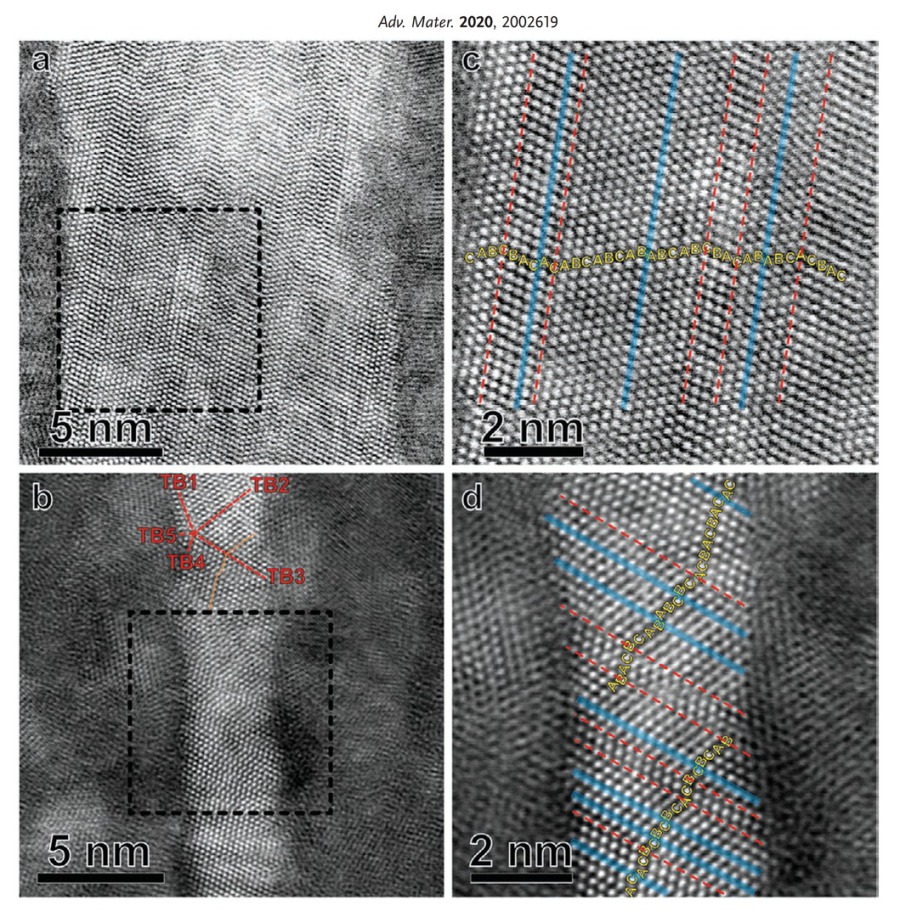 Crystalline structure of the nanograins in the as-prepared crystal–glass high-entropy nanocomposite. a) Cross-sectional LAADF- STEM image of a columnar grain with fcc structure that contains high- density nanotwins of 1.0 × 10⁹ m−1. b) Another columnar g
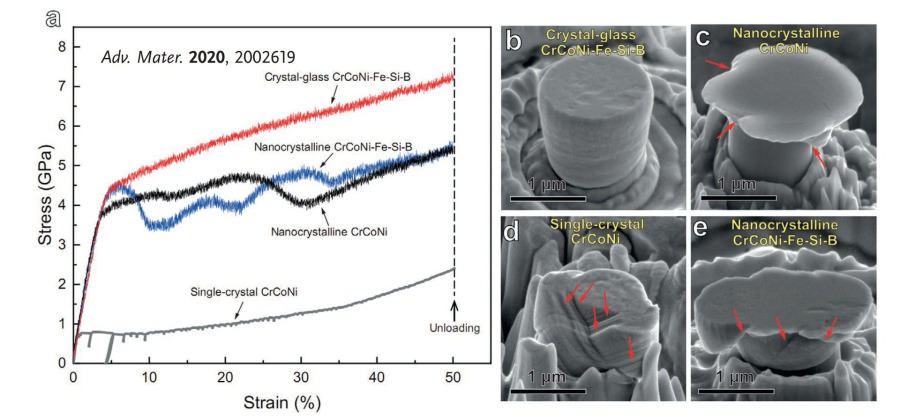 Mechanical properties of the crystal–glass high-entropy nanocomposite. a) Compressive engineering stress–strain curves of the crystal–glass CrCoNi–Fe–Si–B high-entropy nanocomposite, nanocrystalline CrCoNi–Fe–Si–B, nanocrystalline CrCoNi, and single-crys

Crystal–Glass High-Entropy Nanocomposites with Near Theoretical Compressive Strength and Large Deformability
Adv. Mater. 2020, 2002619
adma.202002619.pdf
PDF-Dokument [2.8 MB]
Adv. Mater. 2020, 2002619
adma.202002619.pdf
PDF-Dokument [2.8 MB]
 Druckversion