
High Entropy Alloy SDiscovery with Machine Learning
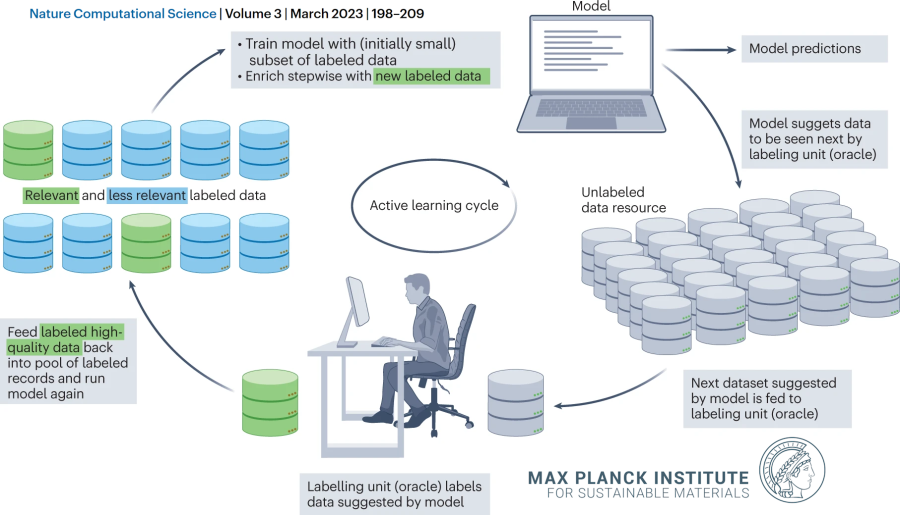 Machine learning–enabled high-entropy alloy discovery (https://www.science.org/doi/10.1126/science.abo4940)
In this project, we developed a closed-loop, physics-informed machine learning framework that enables the rapid discovery of high-entropy Invar and Kovar-type alloys in a practically infinite Fe–Ni–Co–Cr–Cu compositional space, despite only very sparse experimental data. We show that by combining generative modeling, ensemble regression, density-functional theory, thermodynamic calculations, and targeted experiments in an active learning loop, we can identify two quaternary Fe–Ni–Co–Cr Invar high-entropy alloys (HEAs) with room-temperature thermal expansion coefficients of about 2×10⁻⁶ K−1×10⁻⁶K−1, as well as two quinary Fe–Ni–Co–Cr–Cu HEAs with Kovar-like thermal expansion around 5×10⁻⁶ K−1×10⁻⁶K−1.
We start from the technological need for low-thermal-expansion materials for applications such as liquid hydrogen, ammonia, and natural gas transport, where geometric stability under thermal cycling is critical. Classical Fe–Ni Invar, in particular Fe63.5Ni36.5 (wt%), offers a TEC of roughly 1.6×10⁻⁶ K−1×10⁻⁶K−1 at 300 K but suffers from limited mechanical properties and compositional design freedom. At the same time, the HEA concept provides access to a vast composition space – at least 1050050 variants even when restricted to commonly used metallic elements – that cannot be systematically explored by conventional CALPHAD, DFT, and combinatorial experimental strategies alone. Motivated by these limitations, we focus on Invar-type behavior in Fe–Ni–Co–Cr(–Cu) HEAs, a system where composition dominates the emergence of the Invar effect, and processing can be treated as a secondary variable.
To address the scale and sparsity of the problem, we build an active learning workflow with three core stages per iteration: generative alloy design (HEA-GAD), physics-informed property prediction (TERM), and experimental validation. We first curate a benchmark database of 699 Invar-relevant compositions from legacy literature on Fe–Ni-based Invar and related systems, including binary, ternary, and multicomponent alloys. On this basis, we train a Wasserstein autoencoder (WAE) that receives alloy compositions and learns a low-dimensional latent representation capable of reconstructing these compositions with high fidelity. The resulting latent space is physically interpretable: high-entropy compositions cluster in the interior, binary and ternary alloys populate the edges, and Fe–Ni–Co–Cr–Cu compositions form a distinct island that captures Cu-related compositional features.
Within this learned manifold, we apply a Gaussian mixture model to describe the latent distribution and use Markov chain Monte Carlo sampling to generate on the order of 10303 candidate compositions per iteration, biased toward regions likely to contain Invar-like TEC behavior. These candidates are then passed to our two-stage ensemble regression model (TERM). In the first stage, we use multilayer perceptrons and gradient-boosting decision trees trained purely on compositional features to rapidly predict TEC and associated uncertainties, selecting about 1000 compositions that appear promising. In the second stage, we augment these candidates with physics descriptors obtained from DFT and thermodynamic calculations, particularly magnetostriction ??, Curie temperature ??, and phase fractions at relevant annealing temperatures.
A central aspect of our strategy is the ranking policy we employ. Rather than relying solely on mean predictions, we construct a rank-order selection scheme that jointly considers predicted TEC and uncertainty. Exploration is driven by high-uncertainty candidates, whereas exploitation favors those with low predicted TEC, and the rank-based approach allows us to remain robust against unknown underlying data distributions and non-negligible model errors. Per iteration, we select approximately 10–30 compositions for experimental validation, cast the top three alloys, measure their thermal expansion coefficients using a physical properties measurement system, and feed these results back into the training database for the next active learning cycle.
To increase physical interpretability and predictive power, we integrate magnetism-based descriptors rooted in the Masumoto empirical rule for Invar behavior. Historically, Masumoto related the low TEC of ferromagnetic Invar alloys below ?? to the ratio ??/??/Tc, linking magnetostriction to thermally driven lattice expansion. We compute ?? and ?? for Fe–Co–Ni-based alloys at annealing temperatures of 873, 1073, and 1273 K and demonstrate that the experimental TEC correlates particularly well with ??/??/Tc at 873 K. When we incorporate these descriptors into TERM, the final test loss decreases from about 19% without physics-informed features to 14% with them, while the training loss also drops appreciably, underscoring the value of physics-guided features in sparse, high-dimensional alloy design.
We run six active learning iterations and cast 18 alloys in total, including 17 new HEAs and the classical Fe63.5Ni36.5 reference. Because more than 95% of the initial compositions contain no Cu and only a few possess around 5 wt% Cu, Fe–Ni–Co–Cr–Cu alloys constitute a strongly imbalanced class. Consequently, discovery in Fe–Ni–Co–Cr–Cu is much more challenging than in Fe–Ni–Co–Cr, and this difference is reflected in the learning curves we observe. For Fe–Ni–Co–Cr HEAs, the mean experimental TEC decreases systematically from 6.49×10⁻⁶ K−1×10⁻⁶K−1 (first iteration) to 5.61×10⁻⁶ K−1×10⁻⁶K−1 (second) and 3.65×10⁻⁶ K−1×10⁻⁶K−1 (third), while the standard deviation shrinks, indicating that the sampling concentrates around low-TEC compositions. At the same time, the mean absolute percentage error between predictions and experiments falls from about 1.5 to 0.2 over these iterations, highlighting rapid model learning and convergence.
Importantly, during exploration we do encounter highly unexpected results. Alloy A3, which we predict to have one of the higher TEC values within its candidate set (4.39±0.79×10⁻⁶ K−1±0.79×10⁻⁶K−1), turns out to exhibit the lowest measured TEC (1.41×10⁻⁶ K−1×10⁻⁶K−1), essentially matching classical binary Invar. This example illustrates how our active learning loop, by design, encourages sampling of compositions outside narrow exploitation regimes, allowing us to uncover local minima that would likely be missed by purely greedy optimization. For Fe–Ni–Co–Cr–Cu HEAs, the mean TEC evolves less dramatically—from 6.26×10⁻⁶ K−1×10⁻⁶K−1 to 6.64×10⁻⁶ K−1×10⁻⁶K−1 and 5.67×10⁻⁶ K−1×10⁻⁶K−1—but the mean deviation between prediction and experiment reduces from 33.9% to 10.2%, which demonstrates improved predictive fidelity despite severe data imbalance.
Table 1 summarizes the compositions and TEC values of the 17 designed HEAs. Among these, we identify A3 and A9 (Fe–Ni–Co–Cr quaternary alloys) as high-entropy Invar candidates with TEC values around 2×10⁻⁶ K−1×10⁻⁶K−1 at 300 K, comparable to Fe63.5Ni36.5. In addition, B2 and B4 (Fe–Ni–Co–Cr–Cu quinary alloys) exhibit TECs around 5×10⁻⁶ K−1×10⁻⁶K−1 at 300 K, on par with commercial ternary Kovar-type Fe–Co–Ni alloys. By comparing our discovery rate with that of a trial-and-error strategy quantified in the supplementary material, we show that our HEA-GAD–TERM framework improves the rate of finding Invar/Kovar-type alloys by roughly a factor of five.
We complement these property measurements with microstructural and DFT analyses. Electron backscatter diffraction maps reveal that alloy A2, which exhibits a relatively high TEC of 10.52×10⁻⁶ K−1×10⁻⁶K−1, is single-phase bcc with a Curie temperature of about 950 K, whereas the low-TEC alloy A3 is single-phase fcc and shows no phase transformation in the measurement range. Using a partial disordered local moment model within the coherent potential approximation, we demonstrate that the Invar effect in these systems is qualitatively linked to a volume reduction at finite-temperature PDLM states relative to the 0 K ferromagnetic ground state. For A2, in its stable bcc configuration, the lattice parameter increases slightly with temperature, but if we hypothetically stabilize A2 in the fcc phase, DFT simulations predict an Invar-like response, underscoring the importance of magnetic and crystallographic state on TEC behavior. For A3, our PDLM-based DFT results confirm that the observed low TEC is intrinsic, arising from magnetoelastic coupling rather than any hidden phase transformation.
To position our alloys in the broader landscape, we compare TEC–temperature curves of our Invar-like (A3, A9) and Kovar-like (B2, B4) HEAs with those of reported HEAs, medium-entropy alloys, conventional Invar, Kovar, and other compositionally complex alloys. At 300 K, A3 and A9 exhibit TEC values distinctly below those of previously reported HEAs and MEAs and within the classical Invar regime, while B2 and B4 match or surpass conventional Kovar in their thermal expansion performance. We further plot configurational entropy versus TEC for these alloys and the literature systems, showing that traditional Invar alloys typically occupy the low-entropy, low-TEC corner, whereas our HEAs extend the low-TEC regime into substantially higher configurational entropies. This demonstrates that low thermal expansion does not require reduction in compositional complexity; instead, we can combine low TEC with the mechanical and environmental advantages associated with the HEA concept, such as high strength, ductility, and corrosion resistance.

High-entropy alloys are solid solutions of multiple principal elements that are capable of reaching composition and property regimes inaccessible for dilute materials. Discovering those with valuable properties, however, too often relies on serendipity, because thermodynamic alloy design rules alone often fail in high-dimensional composition spaces. We propose an active learning strategy to accelerate the design of high-entropy Invar alloys in a practically infinite compositional space based on very sparse data. Our approach works as a closed-loop, integrating machine learning with density-functional theory, thermodynamic calculations, and experiments. After processing and characterizing 17 new alloys out of millions of possible compositions, we identified two high-entropy Invar alloys wit
science.abo4940.pdf
PDF-Dokument [1.4 MB]
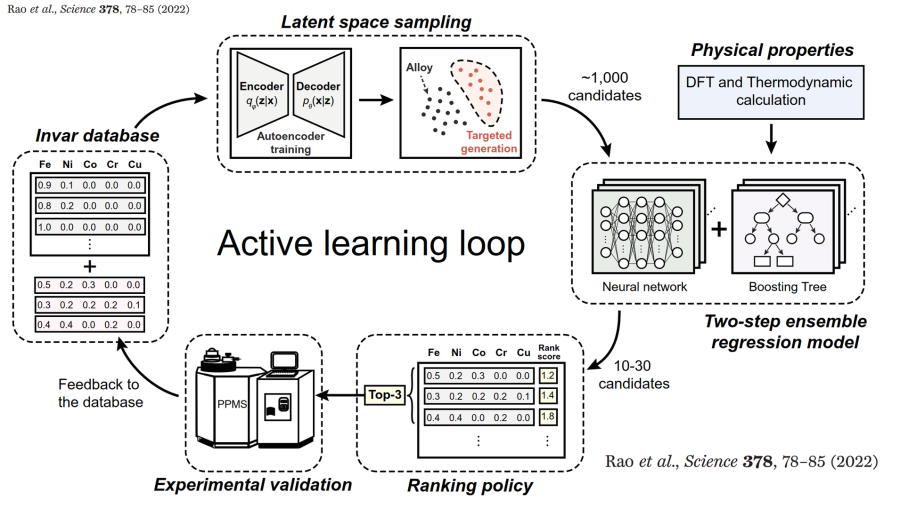 We developed an active learning framework for the targeted composition design and discovery of HEAs, which combines ML models, DFT calculations, thermodynamic simulations, and experimental feedback. First, the promising candidates are generated under the
In conclusion, we demonstrate that understanding and exploiting the underlying physics behind composition–property relations, especially magnetism-driven lattice effects, is essential for alloy design in compositionally complex systems. We show that HEAs with attractive thermal expansion behavior can indeed be discovered efficiently in an immense, largely unexplored composition space when we integrate generative modeling, physics-informed descriptors, ensemble regression, and active experimental feedback in a unified workflow. Our entire design process required only a few months and 17 new alloys to reach two Invar and two Kovar-type HEAs, whereas conventional methods would typically span years and many more experimental iterations. We expect that our generative–active-learning framework can be extended to multi-objective optimization, enabling simultaneous control of thermal, magnetic, electrical, and mechanical properties in HEAs and other compositionally complex alloys.
 Druckversion