
Brief Introduction to High Entropy Alloys: From equiatomic to non‑equiatomic High Entropy Alloys

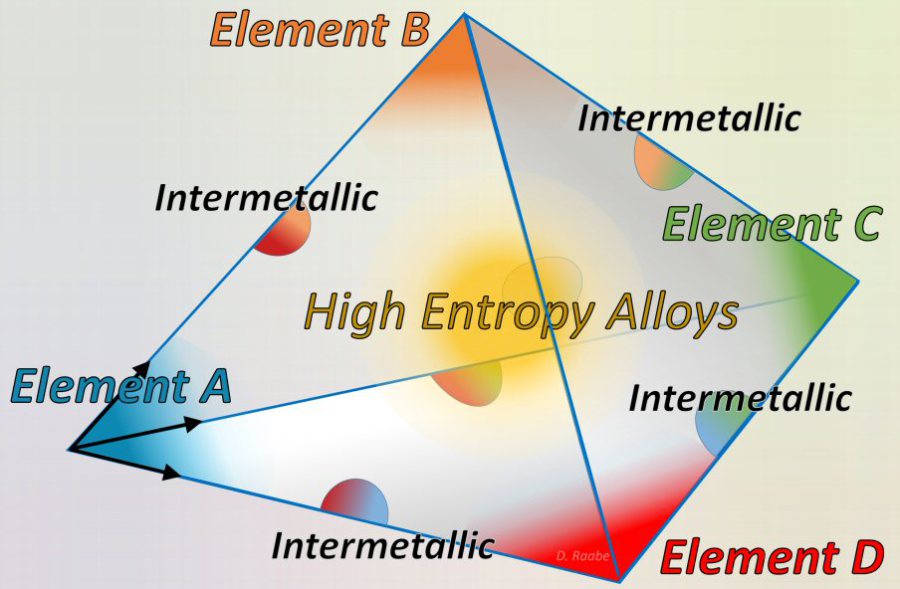
In the early HEA literature, compositional design largely focused on equiatomic or near‑equiatomic solid solutions with one or two phases, motivated by the concept of maximizing configurational entropy to stabilize simple solid solutions in multi‑component systems.
We show in our works that this equiatomic constraint is unnecessarily restrictive and that non‑equiatomic compositions drastically enlarge the accessible compositional space and, more importantly, the accessible spectrum of deformation mechanisms and mechanical properties.
We emphasize that a central limitation of single‑phase equiatomic HEAs is their restricted hardening spectrum: dislocation slip and substitutional solid‑solution strengthening dominate, which constrains both strain‑hardening capacity and the attainable strength–ductility combinations. By relaxing the equiatomic condition and deliberately targeting dual‑ or multi‑phase microstructures, we can introduce additional athermal deformation modes such as twinning‑induced plasticity (TWIP) and transformation‑induced plasticity (TRIP), leading to markedly improved combinations of ultimate tensile strength and total elongation.
Thermodynamic design: stacking‑fault energy and FCC–HCP instability
We build our compositional design strategy around the control of intrinsic stacking‑fault energy in FCC‑based 3d transition‑metal HEAs, using the free energy difference between FCC and HCP phases, ΔG_FCC→HCP, as the key thermodynamic descriptor. Detals are here.
We use Calphad (Thermo‑Calc, TCFE7) calculations at 300 K to quantify Δ?FCC→HCPGFCC→HCP for two prototype HEA families: quaternary Fe80−MnCo10Cr10 with Mn contents between 30 and 45 at.%, and quinary Co20Cr20Fe40−Mn20Ni with Ni contents between 0 and 20 at.%. In both systems, lowering Mn or Ni systematically reduces G_FCC→HCP and thus destabilizes the FCC phase with respect to HCP, thereby promoting TWIP and eventually TRIP as athermal transformation mechanisms. We stress that, in this design philosophy, we do not seek the highest entropy‑driven stability of a single FCC solution; instead, we explicitly exploit controlled phase instability to trigger TWIP and TRIP at targeted stress and strain levels. We also point out that parameter‑free ab initio calculations, particularly density functional theory, provide a complementary route to obtain stacking‑fault energies and FCC–HCP free‑energy differences in such systems.
TWIP–TRIP design in Fe–Mn–Co–Cr and Co–Cr–Fe–Mn–Ni systems:
We confirm the thermodynamic trends experimentally in the Fe80−MnCo10Cr10 system: at 45 at.% Mn (Fe35Mn45Co10Cr10), the alloy is single‑phase FCC with dislocation slip as the dominant deformation mechanism, while at 40 at.% Mn (Fe40Mn40Co10Cr10) we observe additional TWIP behavior in the single‑phase FCC matrix. Further reducing Mn to 30 at.% (Fe50Mn30Co10Cr10) yields a dual‑phase microstructure formed by partial athermal martensitic transformation from FCC to HCP upon cooling from the high‑temperature single‑phase field, leading to a TRIP dual‑phase (TRIP‑DP) HEA consisting of two high‑entropy phases of identical chemical composition. This dual‑phase state significantly enhances both strength and ductility compared to the single‑phase counterparts due to the activation of the
TRIP effect in addition to solid‑solution strengthening.
In the quinary Co20Cr20Fe40−Mn20Ni system, lowering Ni from 20 to about 6 at.% drives a similar FCC‑to‑dual‑phase transition in the homogenized state, even without applied strain. The resulting non‑equiatomic Co20Cr20Fe34Mn20Ni6 alloy shows an FCC+HCP microstructure, exhibits a TRIP effect, and achieves higher tensile strength and strain‑hardening ability than the equiatomic Co20Cr20Fe20Mn20Ni20 reference alloy, despite its higher mixing entropy. We highlight that these results demonstrate that the TRIP‑DP concept originally realized in a quaternary system can be extended to quinary compositions, confirming the generic nature of the non‑equiatomic design route for multi‑phase HEAs.
Interstitial design: TRIP–TWIP‑iHEA concept:
Beyond controlling substitutional composition, we explore interstitial alloying as a second strong lever for tuning phase stability and strengthening in non‑equiatomic HEAs, focusing on carbon additions to TRIP‑DP alloys. We deliberately design an interstitial HEA (iHEA) by adding 0.5 at.% C to the Fe50Mn30Co10Cr10 TRIP‑DP alloy, yielding Fe49.5Mn30Co10Cr10C0.5, with two main objectives: (i) slightly increase the stacking‑fault energy and thus stabilize the FCC matrix to a critical point at which TWIP is triggered while maintaining the TRIP effect, and (ii) exploit strong interstitial solid‑solution strengthening via the large local lattice distortions caused by carbon, in addition to the massive substitutional solid‑solution strengthening already present.
Electron backscatter diffraction (EBSD), electron channeling contrast imaging (ECCI), atom probe tomography (APT), and transmission electron microscopy (TEM) reveal that, after recrystallization annealing, the iHEA shows a reduced HCP phase fraction compared to the C‑free TRIP‑DP alloy, consistent with the slight increase in stacking‑fault energy and enhanced FCC stability. At the same time, we observe a high density of annealing twins in the FCC matrix and a population of M23C6 carbides (M = Cr, Mn, Fe, Co) with FCC structure, having typical sizes of 50–100 nm and a total volume fraction of about 1.5 vol.%. These carbides are finely dispersed and are chemically characterized by APT and crystallographically confirmed by TEM selected area diffraction. Mechanically, the Fe49.5Mn30Co10Cr10C0.5 iHEA reaches an ultimate tensile strength approaching 1 GPa coupled with a total engineering elongation of approximately 60%, which we attribute to the joint activity of interstitial and substitutional solution strengthening, TWIP, TRIP, nanoprecipitation, dislocation interactions, stacking faults, and grain‑boundary strengthening.
Processing routes and compositional homogeneity
We emphasize that processing routes are as critical as composition in determining the final microstructure, compositional homogeneity, and mechanical performance of non‑equiatomic HEAs. For 3d transition‑metal systems, we exploit standard bulk metallurgical processes to produce high‑quality sheets: vacuum induction melting and casting into copper molds (including a combinatorial rapid alloy prototyping (RAP) setup for synthesizing up to five compositions in a single operation), followed by hot rolling, homogenization, cold rolling, and recrystallization annealing. In the as‑cast state, HEAs frequently show coarse dendritic microstructures with significant segregation between dendrite cores and interdendritic regions, consistent with classical Scheil segregation; this can give the misleading appearance of single‑ or dual‑phase structures in X‑ray diffraction despite strong local compositional heterogeneity.
We hot‑roll plates at about 900 °C with roughly 50% thickness reduction, adjust temperatures where necessary depending on the alloy, and then homogenize at around 1200 °C for more than 2 h followed by water quenching to reduce segregation and eliminate casting defects. Even after homogenization, large grain sizes (>30 μm) are common, so we employ ~60% cold rolling followed by annealing around 900 °C with carefully selected times to achieve full recrystallization, controlled grain sizes, and desired textures, while also tuning phase fractions in dual‑phase alloys such as Fe50Mn30Co10Cr10. We demonstrate that, without homogenization, coarse‑grained as‑cast alloys with compositional inhomogeneity show strongly reduced ductility and strain hardening due to early strain localization in Fe‑enriched regions with lower stacking‑fault energy, which preferentially undergo deformation‑induced phase transformation. Even when grain size is refined (≈4 μm) but compositional heterogeneity persists, we find an almost complete loss of work hardening attributed to highly localized planar slip; these observations underline that uniform distribution of the principal elements is a prerequisite for achieving the targeted TRIP/TWIP responses and robust strength–ductility combinations.
Grain size, phase fraction, and annealing control
We systematically investigate how annealing time at 900 °C affects grain size and HCP phase fraction in the Fe50Mn30Co10Cr10 TRIP‑DP alloy and show that both the FCC grain size and the HCP fraction can be tuned within wide ranges by adjusting annealing times from 0 to 60 min. In the cold‑rolled state (0 min annealing), the alloy exhibits an average grain size of about 250 nm and an HCP fraction of roughly 91%; with increasing annealing time, the FCC grain size grows from ~4.5 μm at 3 min to ~17.5 μm at 60 min, while the HCP phase fraction initially drops from ~32% at 3 min to ~14% at 5 min and then increases gradually to ~36% at 60 min. We interpret this non‑monotonic behavior in terms of kinetics: nucleation and growth of the HCP phase compete with grain growth and the blocking effect of grain boundaries, so that phase fractions are strongly path‑dependent rather than given by equilibrium thermodynamics alone. The ability to decouple, to some extent, grain size and phase fraction by appropriate annealing schedules proves essential for optimizing work hardening, because grain refinement, phase fraction, and phase stability collectively determine the activation sequence of TRIP and TWIP during loading.
Microstructure hierarchy and characterization
Using EBSD, ECCI, APT, and TEM, we map the microstructure hierarchy across the designed non‑equiatomic HEAs, from single‑phase FCC solid solutions with abundant annealing twins to dual‑phase FCC+HCP matrices and interstitially reinforced multi‑phase states. In the Fe50Mn30Co10Cr10 TRIP‑DP alloy, the microstructure is composed of an FCC γ matrix and lamellar HCP ε plates formed within the γ grains by athermal transformation; annealing twins, stacking faults, and dislocation substructures further enrich the hierarchy and directly provide preferred nucleation sites and paths for subsequent deformation. Upon carbon addition, the HCP fraction is significantly reduced in the annealed iHEA, consistent with enhanced FCC stability, but the FCC matrix shows a high density of twins and hosting nanometer‑scale M23C6 carbides, resulting in a multi‑length‑scale architecture of phases, interfaces, and defects that can be simultaneously mobilized and stabilized under load. We emphasize that such microscopic and nanoscale analyses are indispensable for linking specific combinations of deformation mechanisms (slip, twins, martensitic transformation, particle strengthening) to observed stress–strain responses in these complex alloys.
Mechanical performance: strength–ductility map
We compile ultimate tensile strength and total elongation data for a series of non‑equiatomic and equiatomic 3d transition‑metal HEAs tested at room temperature under identical conditions and geometries, thereby establishing a directly comparable strength–ductility map. The homogenized single‑phase non‑equiatomic Fe40Mn27Ni26Co5Cr2 alloy (#1) shows ultimate tensile strength and elongation values similar to the equiatomic Co20Cr20Fe20Mn20Ni20 (#2), despite its finer grain size (35 μm vs. 140 μm) and the prevalence of dislocation slip. Homogenized single‑phase Fe35Mn45Co10Cr10 (#3) also lies in a comparable regime, whereas the single‑phase Fe40Mn40Co10Cr10 (#4) shows significantly higher ultimate strength (≈995 MPa) due to the introduction of a more pronounced TWIP effect in the single FCC phase.
The newly designed non‑equiatomic Co20Cr20Fe34Mn20Ni6 TRIP‑assisted dual‑phase alloy (#5) further enhances ultimate strength compared with the TWIP‑assisted Fe40Mn40Co10Cr10 (#4), illustrating the benefit of adding a phase‑transformation contribution on top of twinning. The dual‑phase Fe50Mn30Co10Cr10 alloy (#6) exhibits much higher ultimate strength than the single‑phase alloys (#1–4) and the dual‑phase Co20Cr20Fe34Mn20Ni6 (#5), while still maintaining total elongation above 50%. Further grain refinement of Fe50Mn30Co10Cr10 (#7) leads to a significant joint increase in strength and ductility, attributable to improved work‑hardening capacity and refined control of phase stability and phase fractions via the tailored processing route. Finally, the carbon‑containing Fe49.5Mn30Co10Cr10C0.5 iHEA (#8) unifies all major strengthening mechanisms and attains nearly 1 GPa ultimate strength and around 60% total elongation, representing a benchmark strength–ductility combination within the studied HEA family.
Mechanistic progression across alloy states
We present a mechanistic overview in which we track the progression of deformation modes across the different alloys from #1 to #8 and correlate this with the observed mechanical performance. Starting from single‑phase non‑equiatomic Fe40Mn27Ni26Co5Cr2 and Fe35Mn45Co10Cr10, where mechanical response is dominated by dislocation slip and limited twinning, we move towards equiatomic Co20Cr20Fe20Mn20Ni20 and non‑equiatomic Fe40Mn40Co10Cr10, where TWIP is increasingly active. We then introduce dual‑phase microstructures and TRIP effects in Co20Cr20Fe34Mn20Ni6 and Fe50Mn30Co10Cr10, thereby adding phase boundaries and strain‑induced martensitic transformation as further sources of strain hardening. In the carbon‑alloyed Fe49.5Mn30Co10Cr10C0.5 iHEA, we add interstitial solid solution and nanoprecipitate strengthening on top of TWIP and TRIP, effectively unifying all major strengthening pathways in one material. This stepwise introduction and combination of deformation mechanisms during mechanical and/or thermal loading unequivocally demonstrates that tuning the activation sequence and mutual interactions of these mechanisms is key to designing non‑equiatomic HEAs with superior strength–ductility combinations.
Outlook: multifunctionality and broader HEA families
While we have achieved outstanding room‑temperature strength and ductility in several non‑equiatomic transition‑metal HEAs—such as the TRIP–TWIP‑iHEA with ≈1 GPa ultimate strength and ≈60% elongation—we highlight multiple directions for future research. First, the low‑ and high‑temperature mechanical behavior of these and other non‑equiatomic HEAs remains largely unexplored; by systematically mapping strength–ductility combinations as functions of temperature, we can identify compositions suitable for cryogenic or elevated‑temperature applications. Second, beyond strength and ductility, properties such as resistance to hydrogen‑induced degradation, corrosion resistance, fatigue behavior, and magnetic performance must be investigated, with the aim of identifying multifunctional property sets that justify the higher alloying costs compared with established high‑strength and austenitic stainless steels; we also outline the possibility of designing shape‑memory non‑equiatomic HEAs via tailored stacking‑fault energies and FCC–HCP free‑energy landscapes.Li_et_al-2017-JOM-2017-small-overview-NON-equi-HEA.pdf
Third, we note that the non‑equiatomic concept is not limited to 3d transition‑metal systems, and we expect similar design routes to be fruitful in refractory HEAs based on Ti, Nb, Ta, Zr, Hf, V, Mo, and W for high‑temperature structural applications, particularly in aerospace. Fourth, extensive work remains to be done in systematically screening the influence of minor interstitial additions (C, N, B, O, etc.) in various non‑equiatomic HEA matrices, both to further improve mechanical performance and to understand the underlying mechanisms by which these interstitials interact with complex substitutional lattices and defect structures. Overall, we argue that the shift from single‑phase equiatomic to dual‑ and multi‑phase non‑equiatomic HEAs, guided by stacking‑fault and phase‑stability design and enabled by robust processing routes, provides a powerful and versatile pathway to unify multiple strengthening and toughening mechanisms in a single material class.
We present a brief overview on recent developments in the fi eld of strong and ductile non-equiatomic high-entropy alloys (HEAs). The materials reviewed are mainly based on massive transition-metal solute solutions and exhibit a broad spectrum of microstructures and mechanical properties. Three relevant aspects of such non-equiatomic HEAs with excellent strength–ductility combination are addressed in detail, namely phase stability-guided design, controlled and inexpensive bulk metallurgical processing routes for appropriate microstructure and compositional homogeneity, and the resultant microstructure–property relations. In addition to the multiple principal substitutional elements used in these alloys, minor interstitial alloying elements are also considered. We show that various gro
Li_et_al 2017 JOM 2017 small overview NO[...]
PDF-Dokument [3.5 MB]
 Druckversion