
Soft Magnetic High-Entropy Alloys
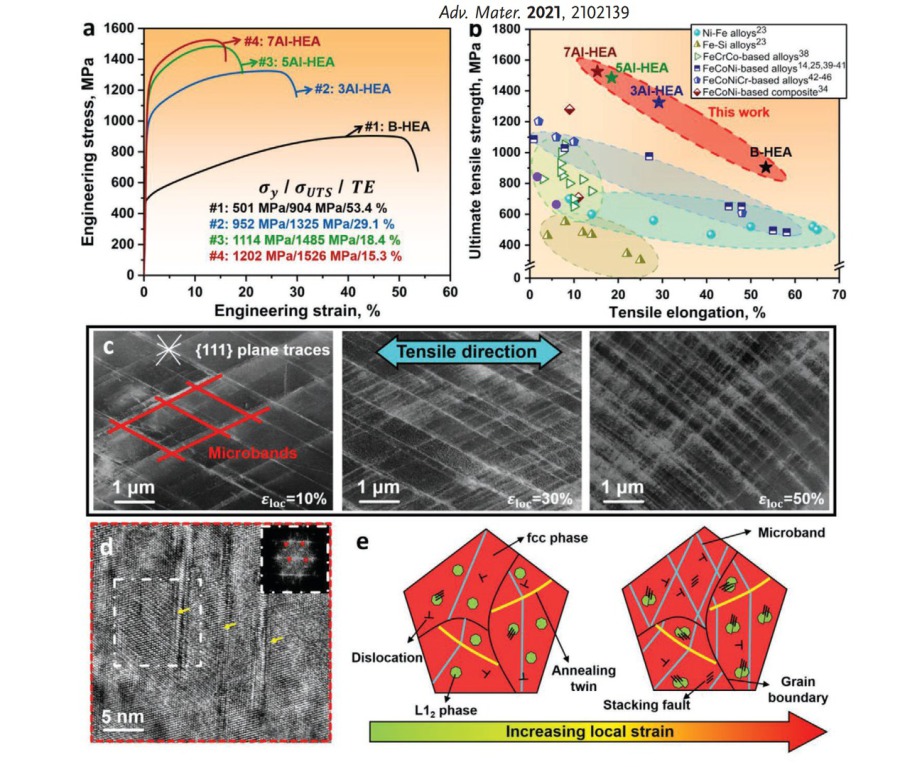 Mechanical behavior and deformation mechanisms of the 7Al-HEA. a) Room temperature tensile stress–strain curves for the B-HEA, 3Al-HEA, 5Al-HEA, and 7Al-HEA. σy, σUTS, and TE represent the yield strength, the ultimate tensile strength and the tensile elo
Ultrastrong, ductile soft magnetic HEAs by coherent ordered nanoprecipitates
We addressed a central contradiction in soft magnetic materials: the microstructural defects that strengthen alloys usually also pin magnetic domain walls and raise coercivity. This is a serious limitation for soft magnetic components that must operate under mechanical load, vibration, torque, or high rotational speed. Our strategy was to strengthen a bulk ferromagnetic high-entropy alloy not by incoherent particles, severe grain refinement, or high dislocation density, but by introducing a high number density of nanoscale, coherent, ordered precipitates that can obstruct dislocation motion while remaining almost invisible to Bloch walls.
We designed a non-equiatomic Fe–Co–Ni–Ta–Al high-entropy alloy system with nominal compositions Fe₃₅₋ₓ/₃Co₃₀₋ₓ/₃Ni₃₀₋ₓ/₃Ta₅Alₓ, with x = 0, 3, 5, and 7 at%. Fe, Co, and Ni provide the ferromagnetic fcc matrix, while Ta and Al promote ordered intermetallic nanoprecipitation. The alloys were cast as 10 mm plates, hot rolled at 1473 K to 50% thickness reduction, homogenized for 10 min at the same temperature, and water quenched. This processing route produced bulk material rather than thin ribbons or amorphous sections, which is important for structural-functional applications.
Microstructure: fcc matrix with coherent L1₂ nanoprecipitates
The Al-free base alloy remained a single-phase fcc solid solution after homogenization. Atom probe tomography confirmed a statistically random elemental distribution without nanoscale segregation. Its grain size was 64.8 ± 9.8 µm.
Adding Al changed the phase state fundamentally. In the Al-containing alloys, we formed homogeneously distributed ordered L1₂ nanoprecipitates inside the fcc matrix. In the 7Al alloy, X-ray diffraction revealed the fcc matrix together with L1₂ reflections, while EBSD showed an equiaxed matrix grain structure with an average grain size of 65.3 ± 10.3 µm. Thus, the grain size remained essentially unchanged relative to the base alloy; the property changes therefore originate primarily from nanoscale precipitation, not from grain refinement.
High-resolution TEM and atom probe tomography showed that the L1₂ precipitates are fully coherent with the surrounding fcc matrix. In the 7Al alloy, the precipitates were near-spherical and had an average TEM size of 13.5 ± 2.5 nm. APT gave an average precipitate volume of 2294 ± 125 nm³ for the 7Al alloy, compared with 168 ± 27 nm³ in the 3Al alloy. The precipitate volume fraction increased strongly with Al content and exceeded 42% in the 7Al alloy.
The chemical partitioning was pronounced. In the 7Al alloy, the L1₂ precipitates were enriched in Ni, Ta, and Al, with an approximate composition of Ni₄₂Co₂₄Ta₁₄Al₁₁Fe₉ at%. The surrounding fcc matrix was enriched in Fe and Co, with a composition close to Fe₃₇Co₃₀Ni₂₄Al₈Ta₂ at%. This partitioning is essential: it allows us to combine an Fe–Co-rich ferromagnetic matrix with ordered precipitates that provide strong mechanical resistance.
The precipitates remained coherent despite their high volume fraction. Quantitative strain mapping by 4D-STEM showed only small local elastic strain fields. In the 3Al alloy, the local strain varied roughly between −0.2% and +0.2%; in the 7Al alloy, where precipitates were larger and the lattice misfit was higher, it ranged approximately from −0.2% to +0.5%. This low strain amplitude is critical for the magnetic response, because strong long-range elastic distortions would increase domain-wall pinning.
Mechanical response: strength beyond conventional soft magnetic alloys
The base alloy was ductile but comparatively soft. It showed a yield strength of 501 MPa and a tensile elongation of 53.4%. Once coherent L1₂ nanoprecipitates were introduced, the strength increased sharply while useful ductility remained.
The main mechanical values are:
- Base HEA: yield strength 501 MPa, tensile elongation 53.4%.
- 3Al-HEA: yield strength 952 MPa, ultimate tensile strength 1325 MPa, tensile elongation about 29%.
- 7Al-HEA: yield strength 1202 MPa, ultimate tensile strength 1526 MPa, tensile elongation 15.3%.
Thus, the 7Al alloy more than doubled the yield strength of the precipitate-free base alloy and reached an ultimate tensile strength of about 1.53 GPa while still retaining meaningful tensile ductility. This strength–ductility combination is exceptional for soft magnetic alloys, especially in bulk form.
The strengthening originates from several coupled mechanisms. First, the chemically complex fcc matrix provides strong solid-solution strengthening. The Al addition alone contributes an estimated additional 87 MPa in the 3Al alloy and 134 MPa in the 7Al alloy relative to the base composition. Second, the ordered coherent L1₂ precipitates are sheared by dislocations and stacking faults. Because shearing ordered precipitates requires the creation of new interfacial and antiphase-boundary-related defects, the precipitates offer a large resistance to glide. The calculated precipitation-strengthening contribution increases from about 339 MPa in the 3Al alloy to about 528 MPa in the 7Al alloy.
Third, and equally important for ductility, the alloys develop dynamic microband refinement during deformation. ECCI and TEM showed dislocation generation and pile-ups already at local strains around 5%, followed by the formation of dense planar microbands. In the 7Al alloy, the mean spacing between parallel microbands decreased from 735 ± 251 nm at 30% local strain to 163 ± 35 nm at 50% local strain. This progressive reduction in microband spacing raises the stress needed for continued plastic flow and sustains a high work-hardening rate. We did not observe deformation twinning; plasticity is governed by planar dislocation glide, stacking faults, precipitate shearing, and microband subdivision.
Magnetic behavior: low coercivity retained despite high strength
The key result is that the large mechanical strengthening penalty normally expected for soft magnetic materials did not occur. All Al-containing alloys retained soft magnetic behavior at room temperature.
The saturation magnetization decreased moderately with increasing Al content, from 105 Am² kg⁻¹ in the 3Al alloy to 88 Am² kg⁻¹ in the 7Al alloy. This trend follows directly from composition: Al and Ta are non-ferromagnetic, while Fe, Co, and Ni carry the magnetic moment. Increasing Al reduces the fraction of ferromagnetic elements and therefore slightly lowers the total magnetization.
The coercivity increased only marginally. It rose from 8.6 Oe in the 3Al alloy to 10.7 Oe in the 7Al alloy, remaining below 11 Oe, or about 0.87 kA m⁻¹. These values fall well within the soft magnetic regime and are remarkable considering the yield strength of up to 1202 MPa.
Kerr microscopy clarified why coercivity remained low. Magnetic domains moved smoothly inside grains, while stronger pinning occurred mainly at grain boundaries and annealing twin boundaries. We did not observe significant pinning by the coherent L1₂ nanoprecipitates. This confirms the central design premise: precipitates with dimensions around a few to tens of nanometers, far below typical Bloch wall thicknesses, and with coherent interfaces impose only weak magnetic obstacles. Their structural coherency avoids the strong magnetoelastic and interfacial discontinuities that would otherwise immobilize domain walls.
The average magnetic domain width decreased with increasing Al content. The 3Al alloy showed an average domain width of 23.5 ± 5.8 µm, while the 7Al alloy showed 12.3 ± 2.3 µm. Both are smaller than the average grain size of about 65 µm. The refinement likely reflects changes in magnetic anisotropy and domain-wall energy caused by Al enrichment in the matrix and by nanoscale chemical heterogeneity from precipitation. Nevertheless, this refinement did not translate into a severe coercivity penalty.
We also tested magnetic stability at elevated temperatures. The 3Al alloy retained 86%, 73%, and 61% of its room-temperature saturation magnetization at 573, 673, and 773 K, respectively. This thermal robustness is attributed to the Fe–Co-rich matrix and the stability of the L1₂ phase, making these alloys relevant for thermally loaded electromagnetic components.
Mechanistic conclusion and materials significance
We show that coherent ordered nanoprecipitation can break the usual trade-off between strength and soft magnetism. In our Fe–Co–Ni–Ta–Al HEAs, the L1₂ precipitates strongly impede dislocation motion and promote strain hardening through planar slip and dynamic microband refinement. At the same time, their small size, coherency, and weak strain fields prevent severe Bloch wall pinning. The result is a bulk soft magnetic alloy family with yield strengths up to 1.2 GPa, ultimate tensile strength up to 1.53 GPa, tensile elongation above 15%, saturation magnetization up to 105 Am² kg⁻¹, and coercivity below 11 Oe.
The broader message is that soft magnetic alloys do not need to remain mechanically weak. If the strengthening objects are coherent, ordered, nanoscale, and chemically compatible with a ferromagnetic matrix, they can raise strength dramatically while preserving domain-wall mobility. This design principle offers a practical path toward mechanically robust soft magnetic materials for electrified transport, high-speed motors, transformers, sensors, and other devices where magnetic performance and mechanical reliability must be delivered simultaneously.
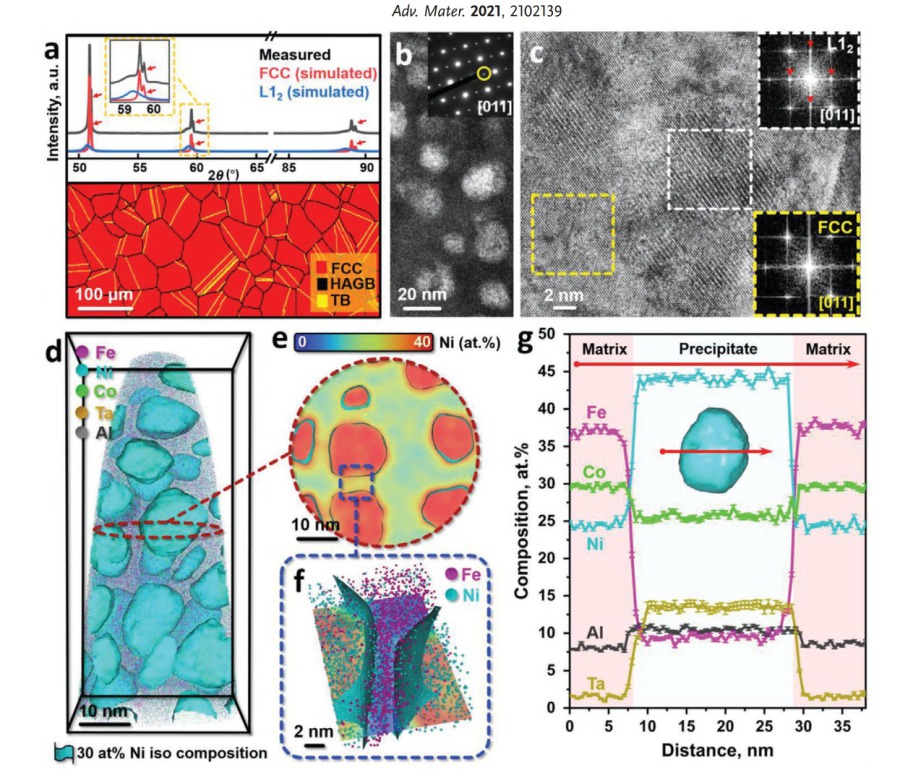 Microstructure of the 7Al-HEA from micro- to near atomic-scale. a) XRD pattern and EBSD phase map. The Cu Kα2 radiation causes addi- tional diffraction peaks, marked by the red arrows. b) Centered dark-field TEM image of the precipitates using the (011) s

In this paper we discuss a central contradiction in soft magnetic materials: the microstructural defects that strengthen alloys usually also pin magnetic domain walls and raise coercivity. This is a serious limitation for soft magnetic components that must operate under mechanical load, vibration, torque, or high rotational speed. Our strategy was to strengthen a bulk ferromagnetic high-entropy alloy not by incoherent particles, severe grain refinement, or high dislocation density, but by introducing a high number density of nanoscale, coherent, ordered precipitates that can obstruct dislocation motion while remaining almost invisible to Bloch walls.
Adv. Mater. 2021, 2102139
Ultrastrong and Ductile Soft Magnetic Hi[...]
PDF-Dokument [2.3 MB]
 Druckversion