
Design of compositionally complex and high entropy alloys via physics-informed artificial intelligence
The chemical space available for materials design is effectively boundless, rendering disruptive advances through traditional physics‑based modelling alone increasingly difficult. At the same time, training data suitable for learning composition–structure–property relationships by artificial intelligence remain scarce. We outline how progress may be accelerated through hybrid strategies that integrate fundamental physics laws with machine‑learning methods to enable the discovery of new chemically complex materials.
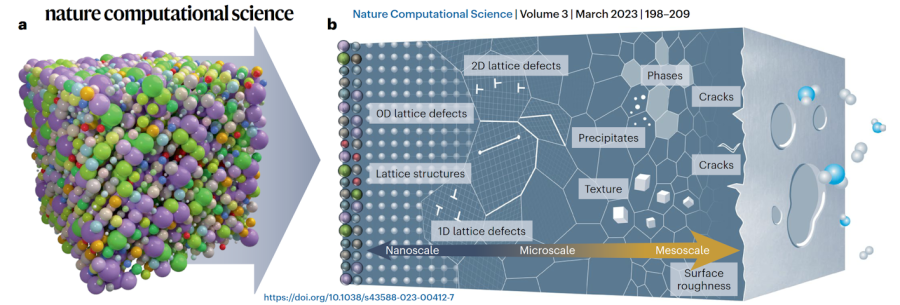 Chemical complexity influences microstructure complexity. a, View of a chemically complex material, where different types of atoms (indicated by the colored spheres) are mixed together in a crystalline solid solution, stabilized by configurational entr
Introduction to the design of compositionally complex materials by artificial intelligence
New materials are pivotal in two fundamental respects. First, they enable transformative advances in civilisation: early ceramics made pottery possible; bronze revolutionised agriculture; steels powered machinery; cement enabled modern construction; aluminium opened the door to aviation; titanium facilitated space exploration; rare‑earth elements underpin high‑performance magnets; semiconductors form the basis of computer chips; platinum‑group metals drive catalytic processes; and polymers support packaging, medicine and countless everyday applications. Second, the production of materials constitutes the largest single source of greenhouse‑gas emissions, energy consumption and environmental pollution. This reality compels us to rethink entirely how materials are produced, used and recycled.
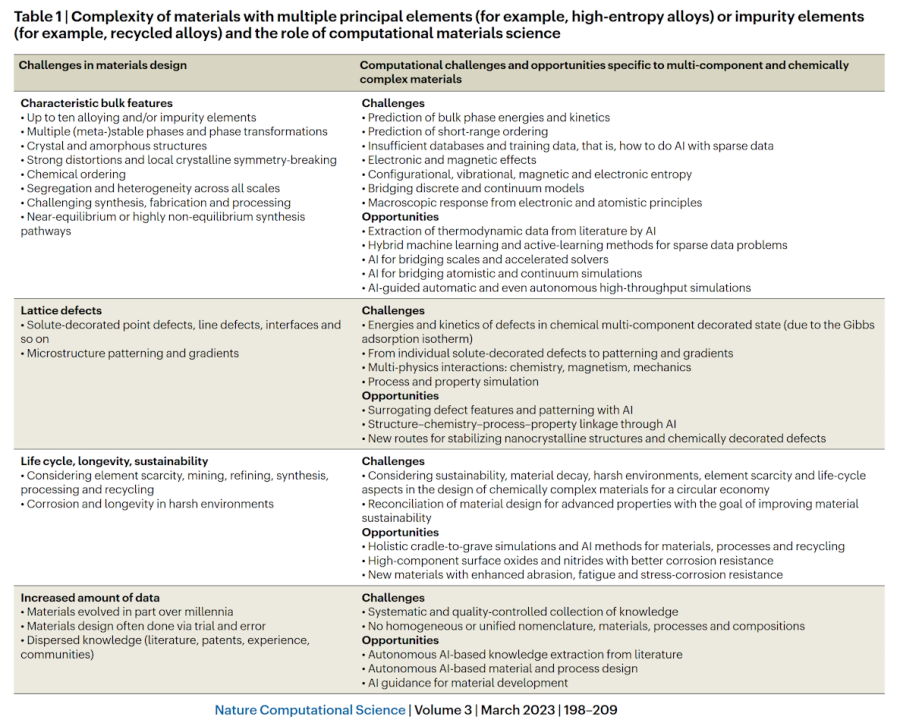
The pursuit of ever‑improving materials has driven a steady increase in their chemical complexity. Enhancing properties often requires adjusting composition to fine‑tune intrinsic characteristics and microstructure‑dominated behaviour. Examples include chemically tailored intermetallic phases in superalloys, intricate precipitation pathways in high‑performance aluminium alloys, and engineered interfaces in advanced magnets. A further challenge arises in microelectronics, where multiple elements are blended at near‑atomic scales and the boundary between product and material becomes blurred, as seen in the most advanced semiconductor manufacturing processes. These trends increase the compositional complexity of materials and highly integrated systems. They are prerequisites for advanced product performance and gateways to new solid‑state phenomena. Yet chemistry never acts alone: compositional complexity inevitably translates into microstructural complexity. Even small changes in chemical composition can profoundly alter defect structures—affecting solute decoration, defect energies, drag forces and the formation of new phases. As a result, increasing chemical complexity is inseparable from increasing microstructural complexity. This is crucial because materials are almost never used in thermodynamic equilibrium; instead, they operate in transient states defined by rich microstructural “cosmoses” of point defects, dislocations and interfaces.

Raabe_et_al-2023-Nature_Computational_Sc[...]
PDF-Dokument [2.3 MB]
 Druckversion