
Hydrogen-induced damage in Ni-based superalloys at elevated temperatures: a vacancy-driven carbide dealloying mechanism
We set out to resolve a long-standing blind spot in hydrogen embrittlement research: what actually happens in Ni-based superalloys when hydrogen exposure and mechanical loading coincide at elevated service temperatures, as will be the case in H2-fuelled gas turbines and aero-engines. The established picture of hydrogen embrittlement in fcc alloys rests almost entirely on physical trapping of hydrogen at interfaces and dislocations, with damage governed by enhanced decohesion or hydrogen-modified plasticity. This framework works well at room temperature and below, but our data show it breaks down once temperature rises into the few-hundred-degree range relevant to turbine hot-section components, and a fundamentally different, chemistry-driven mechanism takes over.

The urgent need to decarbonize the energy and transport sectors motivates the use of hydrogen-containing fuels in gas turbines for power generation and aviation applications, exposing safety-critical components to hydrogen environments at elevated temperatures. Ambient-temperature hydrogen embrittlement has long been interpreted through the physical interactions between hydrogen and microstructural defects like interfaces and dislocations. Here we show that this understanding does not fully capture the behaviour at elevated temperatures, where vacancy-driven chemical reactions between hydrogen and specific microstructural constituents can markedly intensify embrittlement compared with ambient conditions. In a prototypical face-centred cubic Ni-based superalloy, our near-atomic-scale charac
Nature Materials 2026 Hydrogen-induced d[...]
PDF-Dokument [8.0 MB]
Material and baseline microstructure.
We used forged IN718, solution-treated and two-step aged, giving a standard fcc γ-matrix (grain size ~19.8 µm) strengthened by γ′ (L1₂) and γ″ (D0₂₂) precipitates, with δ-phase (D0a) at grain boundaries and intragranularly, and primary (Nb,Ti)C MC carbides. Atom probe tomography on these carbides returned a carbon concentration of only 41.2 at.%, well below stoichiometric 50 at.%, indicating a substantial population of structural carbon vacancies in the non-metallic sublattice — a well-known feature of transition-metal carbides that can vary composition without a change of crystal structure. This vacancy population turns out to be the crux of the whole story.
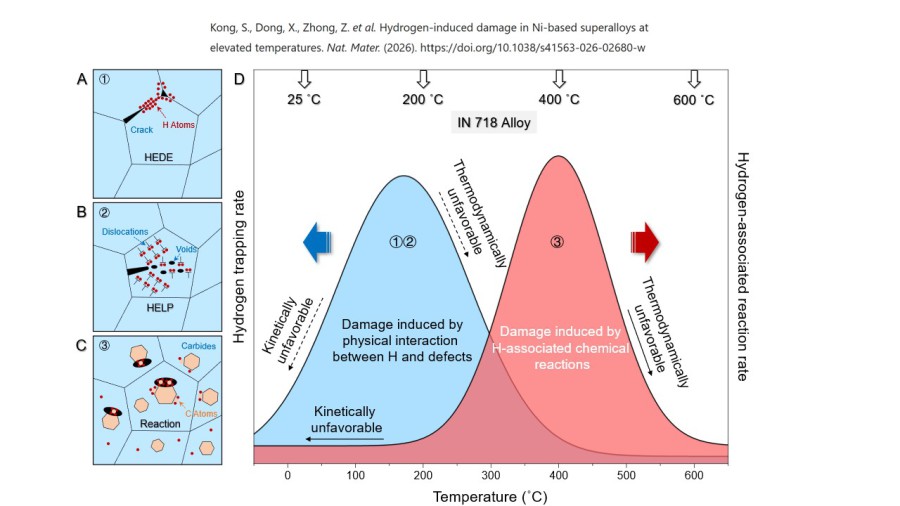 The influence of temperature on H-associated interactions and reactions with microstructural constituents and the resulting prevalent H embrittlement mechanisms. (A) H-enhanced interface decohesion. (B) H-affected dislocation emission/motion. (C) H-associ
Mechanical response.
In situ tensile tests under 2 MPa H2 at 400 °C showed a 14.9% reduction in total elongation and 18.8% reduction in area versus an Ar reference — roughly twice the embrittlement severity measured at room temperature (8.9% and 9.4%, respectively) under identical H2 pressure. This is notable because room temperature is conventionally regarded as the regime of maximum hydrogen embrittlement severity for Ni-based alloys. Lowering the strain rate or pre-charging with hydrogen before testing pushed the ductility loss up to 29.4%. The Portevin–Le Chatelier serrations characteristic of dynamic strain ageing at 400 °C were essentially unaffected by hydrogen (stress-drop amplitude 29.2 ± 7.1 MPa in Ar vs 33.9 ± 7.8 MPa in H2), telling us that hydrogen is not perturbing the dislocation–solute interactions responsible for that instability.
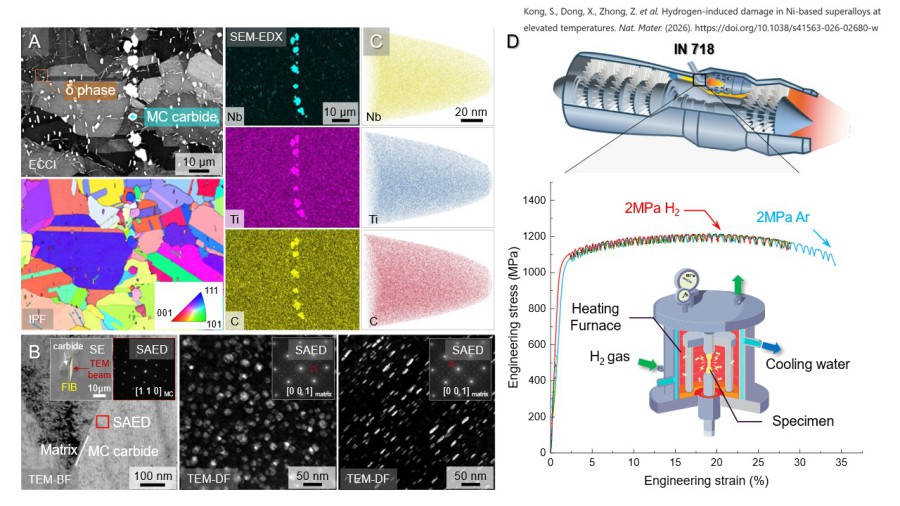 Microstructure of the studied material (IN 718 alloy) commonly used in gas turbines/jet engines and the influence of high-temperature H2 atmosphere (400 ˚C) on the tensile properties. (A) The electron channeling contrast imaging (ECCI), electron backscatt
Fractography and damage statistics.
Unlike at 25 °C and 200 °C — where fracture is intergranular/cleavage-like and tied to δ-phase interfaces and the δ/γ boundary — at 400 °C under H2 we found no such features at all. Instead, fracture surfaces were dominated by ductile dimples containing cracked or debonded MC carbides. Systematic damage quantification across large areas (~500 × 2000 µm²) under four conditions (as-received; H-charged only, no load; H-charged + loaded; Ar + loaded) revealed that hydrogen charging alone, with zero external stress, already increases carbide–matrix interfacial decohesion frequency by a factor of ~4.9 relative to the uncharged state. EBSD kernel average misorientation mapping around these charging-only cracks showed clear local strain concentration in the matrix adjacent to the interface, consistent with a volume-expansive process occurring at the carbide during hydrogen exposure itself, not as a consequence of applied stress. Under combined loading and H2 exposure, carbide–matrix debonding rose to 30.3% of all cracking events versus 18.1% under Ar, identifying interfacial decohesion around carbides — not δ-phase-related cracking — as the dominant failure-initiating damage mode at this temperature.
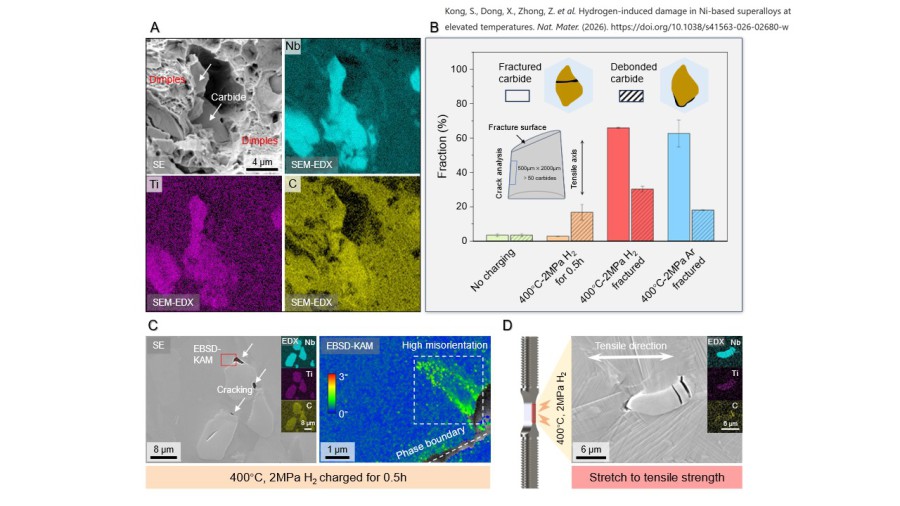 . 3 H-induced damage behavior at 400 ˚C. (A) Representative second electron (SE) image and the corresponding SEM-EDX mapping of the fracture surface of the sample failed in H atmosphere. (B) Statistical analysis of micro-cracks in longitudinal section of
Structural transformation of the carbide and hydrogen enrichment.
TEM probing close to cracked carbide/matrix interfaces revealed something we had not anticipated: a clear superlattice diffraction pattern in the carbide near the interface, indexed to a vacancy-ordered M6C5-type structure (C2/m), while the carbide interior retained its original disordered fcc B1 structure (lattice parameter unchanged, 4.40 Å). This superlattice was absent both in the initial material and in samples deformed under Ar at 400 °C, so we attribute it unambiguously to a hydrogen-driven structural transition — effectively a partial decomposition of the carbide into a more carbon-depleted, vacancy-ordered phase. Site-specific, cryo-FIB-prepared APT specimens (milled at −190 °C to suppress hydrogen redistribution during preparation) taken directly across a partially cracked interface confirmed strong local hydrogen enrichment: up to 13 at.% H within a few nanometres of the interface, compared with ~4 at.% in the carbide interior and ~2 at.% in the matrix. Given the small analysis volumes involved and the propensity for diffusible hydrogen to desorb during FIB milling, this enrichment can only be explained by deep, strong trapping — most plausibly at the carbon vacancies known to dominate the MC carbide defect population.
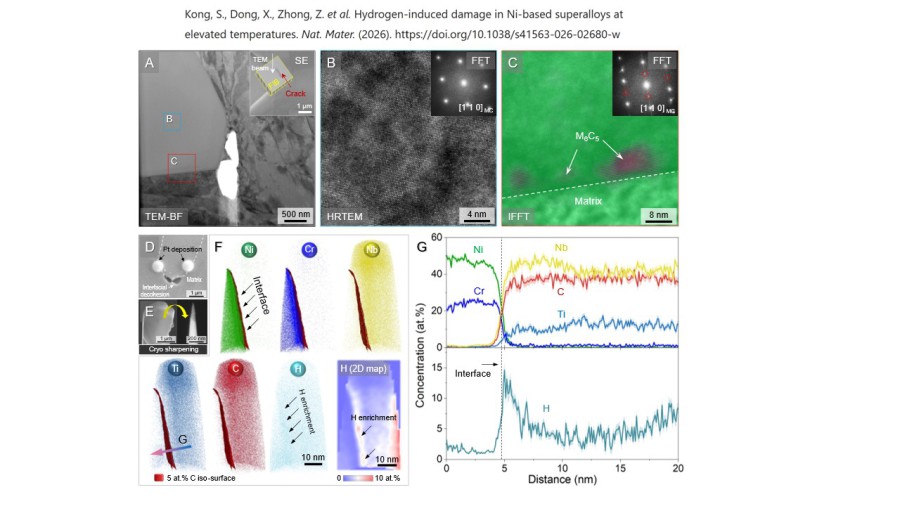 Microstructure analysis of regions close to carbide/matrix interfaces that are damaged upon H2 exposure and simultaneous mechanical loading at 400 ˚C. (A) The overview TEM-BF image of a cracked carbide/matrix interface, with a SE inset showing the corresp
Ab initio confirmation of vacancy-driven trapping and reaction.
DFT calculations quantified this directly. In pristine NbC and TiC, hydrogen incorporation is strongly unfavourable (binding energies of +2.20 eV and +1.36 eV relative to octahedral interstitial H in Ni). Introducing a single carbon vacancy flips this entirely, to −0.17 eV (Nb₃₂C₃₁) and −1.00 eV (Ti₃₂C₃₁). Extending the calculations to the experimentally observed vacancy-ordered M6C5 (C2/m) and M2C (Fd-3m) phases gave consistently negative binding energies between −0.19 and −1.00 eV per H atom, depending on metal species, vacancy concentration and hydrogen occupancy. We then evaluated the Gibbs free energy of the reaction MC + xH2 → MCₓH + (1−x)CH4 (schematically), at a fixed H2 partial pressure of 2 MPa across a range of assumed methane pressures. ΔG becomes negative — thermodynamically favourable — for both Nb6C5H and Ti6C5H formation at 400 °C, with an equilibrium methane pressure at ΔG = 0 of roughly 0.4 GPa at this temperature. Such locally generated, highly pressurized methane accumulating at the carbide/matrix boundary provides a physically direct route to interfacial weakening and cracking, even without any externally applied load — consistent with what we observed experimentally for the charging-only condition. Critically, when we repeated the thermodynamic analysis excluding hydrogen occupation of carbon vacancies, the reaction became unfavourable (ΔG > 0) across most of the modelled conditions, confirming that vacancy trapping of hydrogen is the enabling step, not a side effect.
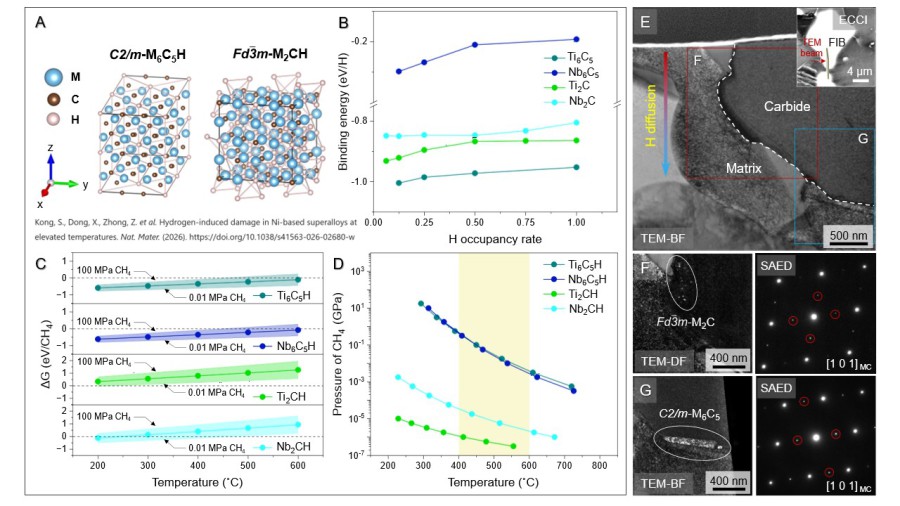 Thermodynamics and experimental validation of H-vacancy interactions at elevated temperatures. (A) Atomic configurations of H-filled vacancy-ordered carbides, M6C5H and M2CH. (B) Variation in binding energy per H atom as a function of H occupancy rate in
Kinetics and depth dependence of the transformed phase.
Direct hydrogen exposure of a freshly polished, unloaded surface (2 MPa H2, 400 °C, 0.5 h) reproduced the carbide transformation independent of external stress. Interestingly, the specific transformation product varied with depth (i.e., with hydrogen concentration and diffusion/reaction time): M2C-type carbides formed near the surface, where hydrogen arrives earliest and at highest local activity, whereas M6C5-type carbides dominate at greater depth, where hydrogen concentration and interaction time are lower. This shows that both thermodynamic driving force and kinetic factors (hydrogen mobility, local fugacity, exposure time) jointly determine which vacancy-ordered carbide phase actually forms.
Why this differs from established embrittlement pictures.
Two comparisons anchor the mechanistic interpretation. First, relative to classical H-enhanced decohesion at grain boundaries or interfaces, our own DFT-based occupancy estimates give only ~6% hydrogen occupation probability at Ni grain-boundary trapping sites at 400 °C, reflecting the well-known collapse of shallow-trap occupancy with rising temperature (McNabb–Foster-type behaviour). Carbon-vacancy trapping in the carbide, by contrast, retains strongly negative binding energies and thus high occupancy even at 400 °C — precisely the reservoir that sustains the reaction pathway once dislocation- and interface-based trapping has become kinetically and thermodynamically ineffective. Second, this mechanism is mechanistically distinct from classical high-temperature hydrogen attack in carbon steels, where hydrogen reacts with dissolved matrix carbon to dissolve cementite and nucleate cavities within the matrix or at grain boundaries. Here the reaction is localized specifically at the carbide/matrix heterointerface and is driven by structural vacancies intrinsic to the carbide sublattice, not by matrix carbon content. Supporting this, a second alloy with a much higher carbide fraction (directionally solidified CM247LC, ~1.7 vol% (Ta,Hf)C versus ~0.2 vol% MC in IN718) showed the same carbide transition and interfacial debonding, but with far more severe ductility loss (~63.8%), scaling with carbide fraction rather than matrix carbon — the opposite dependence expected from classical hydrogen attack.
Temperature window and practical implications.
The favourability of the carbide–hydrogen reaction is itself temperature-limited: ΔG becomes progressively less negative as temperature rises further, and at 600 °C we found no evidence of the superlattice transformation, no methane-driven interfacial cracking, and no measurable ductility penalty from H2 exposure. This produces the rise-then-fall envelope for hydrogen damage severity with temperature that we schematize conceptually — physical trapping dominating and peaking at low-to-intermediate temperature, chemical vacancy-carbide reaction dominating and peaking at intermediate-to-high temperature, and both mechanisms losing effectiveness at the temperature extremes for kinetic or thermodynamic reasons respectively.
Overall, we identify a previously unrecognized, vacancy-mediated chemical embrittlement pathway operating in carbide-strengthened Ni-based superalloys at elevated temperature: hydrogen exploits intrinsic carbon vacancies in MC carbides as deep trapping sites, drives local decomposition into carbon-depleted, vacancy-ordered M6C5/M2C phases, and generates pressurized methane preferentially at the carbide/matrix interface, weakening it and rendering it susceptible to deformation-induced decohesion. This provides a quantitative, DFT- and APT-anchored physical basis for modelling hydrogen damage in Ni-based superalloys under the combined thermal and hydrogen loads expected in hydrogen-fuelled turbines, and it argues that carbide vacancy chemistry, not just interface and dislocation trapping, needs to be built into damage-tolerant alloy design and lifing models for these environments.
 Druckversion