
Nickel and Its Alloys: Metallurgy, Microstructure, and Sustainability
Nickel and Its Alloys: Crystal Structure, Electronic Configuration, and Physical Propertiies
Nickel: Phase Equilibria and the Principal Alloying Systems
The binary nickel-chromium system is a continuous solid solution across the entire composition range, both elements being face-centered cubic with only a 1.4 percent lattice mismatch. This complete miscibility is the foundation of the Ni-Cr and Ni-Cr-Fe families used for oxidation resistance and solid-solution strengthening. Chromium partitions preferentially to grain boundaries at moderate temperatures and forms a protective chromia scale above roughly 1000 K, but above 20 weight percent it also promotes short-range order and, at lower temperatures, can contribute to alpha-chromium precipitation in highly supersaturated compositions.
The nickel-aluminium binary introduces the intermetallic Ni3Al with the L12 ordered structure, the so-called gamma-prime phase, which is coherent with the face-centered cubic gamma matrix and exhibits a lattice misfit typically between 0 and plus 0.3 percent in engineered superalloys. The gamma-prime phase is anomalous in that its yield strength increases with temperature up to approximately 900 to 1000 K, a consequence of cross-slip of superdislocations from octahedral to cube planes, locking the dislocation configuration and requiring higher stresses to re-initiate glide. This single mechanism is arguably the most important metallurgical fact underlying jet-engine turbine design.
The nickel-titanium system, by contrast, gives rise to the equiatomic NiTi intermetallic with the B2 ordered structure that undergoes a thermoelastic martensitic transformation to the monoclinic B19-prime phase. The transformation temperature is exquisitely sensitive to composition: a shift of 0.1 atomic percent in the nickel-to-titanium ratio moves the martensite start temperature by roughly 10 K. This sensitivity makes the alloy both powerful for shape-memory and pseudoelastic applications and difficult to manufacture within the tight compositional windows required for reproducible transformation behaviour.
Superalloys: Microstructure, Strengthening, and Creep
The modern single-crystal nickel-base superalloy is a two-phase microstructure of gamma matrix and gamma-prime precipitates, the latter occupying volume fractions between 55 and 70 percent. The precipitates are cuboidal, aligned along the elastically soft 100 directions of the matrix, with edge lengths in the range of 300 to 600 nm after standard heat treatment. The coherency strain fields around these cuboids interact with dislocations and, combined with the antiphase boundary energy of the ordered phase (typically 150 to 250 mJ per square metre for Ni3Al-based compositions), produce critical resolved shear stresses in the matrix channels that can exceed 600 MPa at 1000 K.
Creep resistance in these alloys is governed by the rate at which dislocations can bypass or shear the precipitate array. At stresses below roughly 500 MPa and temperatures above 1200 K, the dominant mechanism is climb-controlled bypass through the gamma channels, whose effective width after directional coarsening, or rafting, can shrink to 40 to 60 nm. The rafting process itself is driven by the sign of the lattice misfit and the applied stress axis: under tensile loading along 001, a positive misfit produces rafts perpendicular to the stress axis, effectively creating a layered composite that initially retards but eventually accelerates creep strain accumulation.
Rhenium additions of 3 to 6 weight percent in second- and third-generation superalloys reduce the gamma-channel diffusion coefficient by a factor of roughly two to three and raise the minimum creep rate correspondingly. However, rhenium also promotes the formation of topologically close-packed phases such as sigma and mu, which are brittle, deplete the matrix of solid-solution strengtheners, and nucleate preferentially at dendrite cores where microsegregation during solidification enriches the residual liquid in refractory elements. Managing the phase stability of these alloys therefore requires careful balancing of the electron vacancy number and the d-band filling, often quantified through empirical parameters such as the New Phases Research method or its successors.
Other Alloy Families: Monel, Hastelloy, Incoloy, and Beyond
Outside the superalloy domain, nickel serves as the base for several industrially critical alloy families. The Ni-Cu system, exemplified by alloys containing 63 to 70 weight percent nickel and 28 to 34 weight percent copper, retains a single face-centered cubic phase and combines moderate strength with resistance to reducing acids and seawater. The Ni-Mo-Cr ternary system, the basis of the Hastelloy compositions, achieves corrosion resistance in hydrochloric and sulphuric acid environments by maintaining a chromium-rich passive film while molybdenum stabilises the matrix against pitting and crevice attack. In these alloys the absence of aluminium and titanium suppresses any ordered-phase precipitation, so strengthening relies on solid-solution effects and, in wrought grades, on cold work and recrystallisation texture control.
The Ni-Fe-Cr austenitic alloys, sometimes classified under the Incoloy designation, exploit the gamma-phase stability that nickel confers on the iron-chromium matrix, permitting service in carburising and nitriding atmospheres at temperatures up to roughly 1200 K without the sigma-phase embrittlement that would plague ferritic alternatives.
Microstructural Stability and Degradation Kinetics of Nickel
A recurring theme across all nickel alloys is the competition between the desired metastable microstructure and the thermodynamic drive toward equilibrium phases. In superalloys, the coarsening of gamma-prime follows Lifshitz-Slyozov-Wagner kinetics with a cube-of-radius dependence on time, and the coarsening rate constant is proportional to the interfacial energy and the matrix diffusivity. At 1100 K, typical coarsening rates yield precipitate edge lengths doubling over exposure times of 1000 to 3000 hours, which sets practical upper limits on component life in the hottest sections of gas turbines.
In solid-solution-strengthened Ni-Cr-Mo alloys, long-term exposure in the range of 800 to 1000 K can trigger the precipitation of Ni2Mo-type ordered domains or, in tungsten-bearing grades, mu phase along grain boundaries. The kinetics are slow because diffusion coefficients in these concentrated alloys are on the order of 10 to the power minus 18 to 10 to the power minus 16 square metres per second at those temperatures, but service lives of tens of thousands of hours are sufficient for measurable embrittlement.

The Materials Science behind Sustainable[...]
PDF-Dokument [5.9 MB]
Sustainability, Resource Security, and Metallurgical Recycling of Nickel and Nickel-Alloys
Nickel production from laterite and sulphide ores is energy-intensive. Primary nickel extraction from laterite by high-pressure acid leaching or rotary-kiln electric-furnace smelting requires between 200 and 300 MJ per kilogram of contained nickel, while sulphide concentrators followed by flash smelting and electrorefining consume roughly 150 to 250 MJ per kilogram. These figures place nickel among the more energy-demanding structural metals, roughly three to five times the specific energy of primary steel production and an order of magnitude above primary aluminium when normalised to volume rather than mass.
Approximately 68 to 70 percent of global nickel output currently feeds the stainless-steel sector, with superalloys accounting for roughly 8 to 10 percent and electroplating, batteries, and chemical uses absorbing the remainder. The superalloy fraction is small by tonnage but disproportionately critical: a single modern high-pressure turbine blade contains roughly 4 to 6 kilograms of a single-crystal nickel-base superalloy, and the global fleet of land-based and aero gas turbines represents a locked inventory of tens of thousands of tonnes of these compositions.
Recycling of nickel superalloys is technically feasible but metallurgically non-trivial. The presence of aluminium, titanium, tantalum, rhenium, and hafnium in modern compositions means that revert scrap cannot simply be remelted into new castings without careful control of residual elements, particularly lead, bismuth, selenium, and tellurium, which segregate to grain boundaries and cause catastrophic hot shortness at concentrations above a few parts per million. Vacuum arc remelting and vacuum induction melting with argon-oxygen decarburisation steps are standard in the production chain, and closed-loop recycling within aerospace supply chains now recovers 50 to 60 percent of machining swarf and rejected castings. The thermodynamic penalty of re-oxidising and re-reducing these reactive elements during recycling adds 30 to 50 MJ per kilogram relative to primary processing, yet this remains well below the energy cost of ore-to-metal routes.
From a resource-criticality standpoint, nickel itself is not scarce, with identified reserves exceeding 95 million tonnes and annual production around 3.3 million tonnes. The concern lies in the alloying additions. Rhenium, with a global production of roughly 50 to 60 tonnes per year as a by-product of molybdenite roasting, is effectively irreplaceable in current superalloy chemistries. Cobalt, another key gamma-prime stabiliser and matrix strengthener, faces supply concentration in a small number of producing regions. Tantalum and hafnium present similar bottlenecks. These constraints drive active research into rhenium-free and cobalt-reduced superalloy compositions, as well as into additive manufacturing routes that reduce buy-to-fly ratios from the current 5-to-1 or 8-to-1 in forged and machined components toward near-net-shape fabrication with buy-to-fly ratios approaching 1.5 to 2.
Nickel is a critical element in the shift to sustainable energy systems, with the demand for nickel projected to exceed 6 million tons annually by 2040'*,largely driven by the electrification of the transport sector. Primary nickel production uses acids and carbon-based reductants, emitting about 20 tons of carbon dioxide per ton of nickel produced”,Here we present amethod using fossil-free hydrogen-plasma-based reduction to extract nickel from low-grade ore variants known as laterites. We bypass thetraditional multistep process and combine calcination, smelting, reduction and refining into a single metallurgical step conducted in one furnace. This approach produces high-grade ferronickel alloys at fast reduction kinetics. Thermodynamic control of the atmosphere of the furnace enables se
Nature April 2025 Sustainable nickel ena[...]
PDF-Dokument [5.1 MB]
Mineralogy and Crystallographic Structure of Polymetallic Nodules
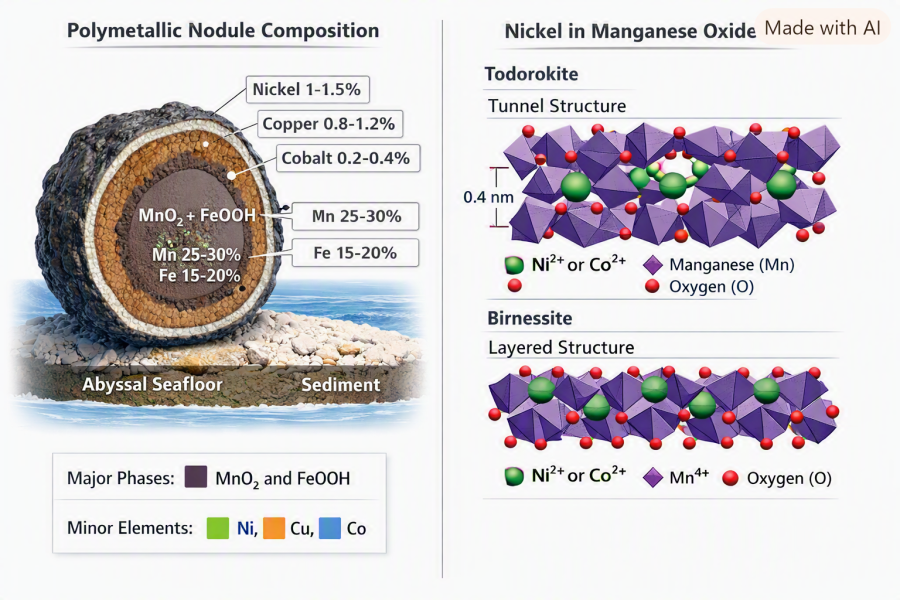
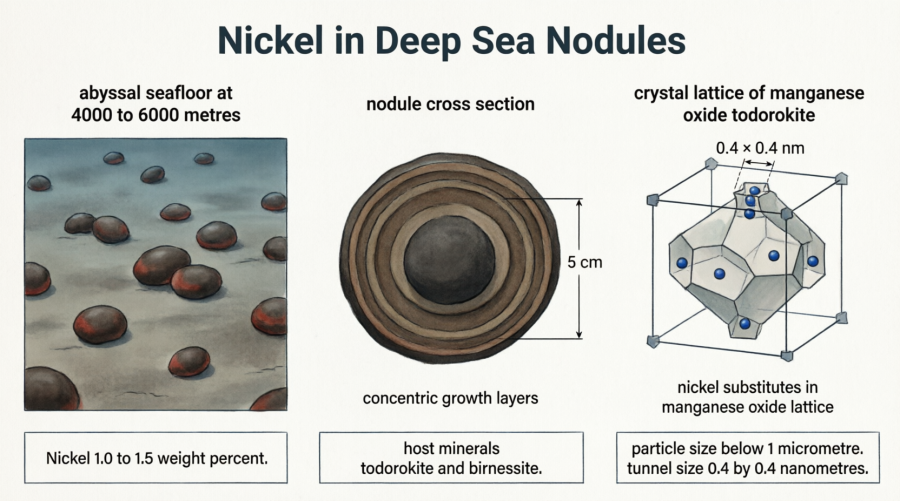
Polymetallic nodules found on abyssal plains at depths of 4000 to 6000 metres form through diagenetic and hydrogenetic precipitation. They consist mainly of manganese and iron oxyhydroxides. Nickel contents are typically between 1.0 and 1.5 weight percent, with similar levels of copper and notable amounts of cobalt. The key metallurgical difficulty is that nickel does not occur as a separate mineral phase. Nickel cations are incorporated into the crystal lattice of manganese oxide minerals, chiefly todorokite and birnessite.
With these items in view the next decade of nickel alloy science will be likely shaped by three intersecting pressures. First, gas-turbine inlet temperatures continue to rise, pushing single-crystal superalloys toward their solvus limits and demanding precipitate volume fractions above 70 percent, where conventional casting and heat-treatment windows become vanishingly narrow. Second, the push for lower-emission energy systems, including hydrogen-fired turbines and advanced nuclear reactors, imposes new environmental degradation modes such as hydrogen-assisted intergranular fracture and high-temperature steam oxidation, for which the existing nickel-alloy microstructural toolbox requires re-evaluation. Third, the sustainability imperative demands that alloy design incorporate end-of-life recyclability as a primary constraint, favouring compositions with fewer exotic additions and narrower elemental spreads so that scrap streams can be reintroduced without excessive dilution or purification.
From the standpoint of fundamental metal physics, these challenges converge on questions of defect energetics in concentrated multi-component face-centered cubic solid solutions. The classical picture of isolated solute atoms perturbing a periodic lattice gives way, in alloys containing five to ten principal elements at comparable atomic fractions, to a landscape of severe local lattice distortion, sluggish diffusion, and short-range chemical order that defies simple mean-field descriptions. Understanding how dislocations, grain boundaries, and phase interfaces navigate this landscape, and how they evolve under coupled thermal, mechanical, and chemical driving forces over thousands of hours, remains the central scientific problem. Nickel, with its rich phase diagram, its tolerance for extensive alloying, and its indispensable role in high-temperature structural applications, will remain the model system in which these questions are posed and, one hopes, answered.
rsta.2023.0247.pdf
PDF-Dokument [645.5 KB]
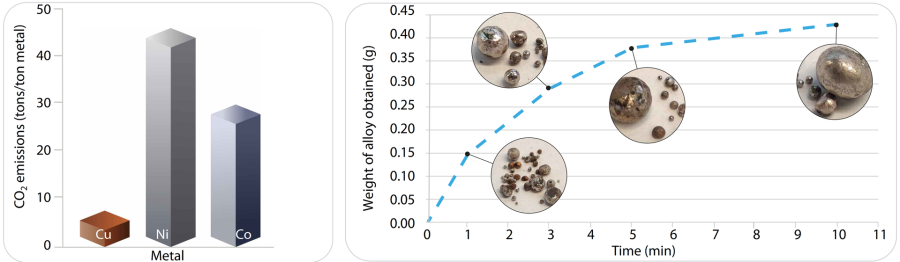
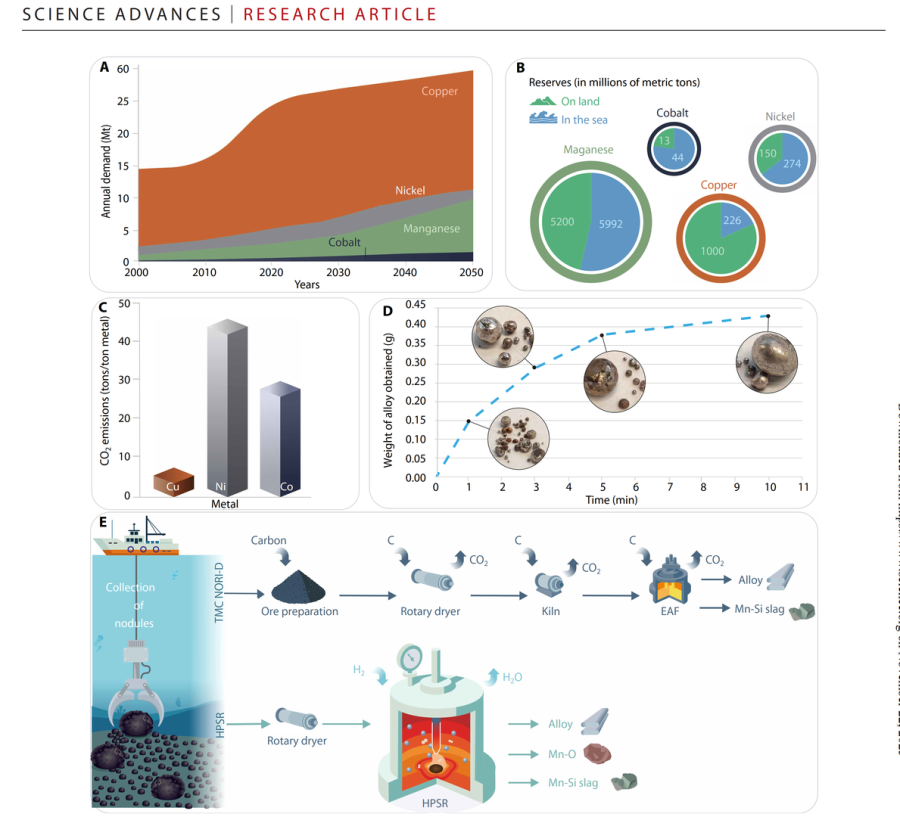
To support the green energy transition, sustainable supplies of critical metals—60 million (metric) tons of copper, 10 million tons of nickel, and 1 million tons of cobalt—annually by 2050 are essential. These metals are currently sourced from declining terrestrial reserves, making deep- sea polymetallic nodules a promising alternative. However, current metal extraction methods are lengthy and energy and carbon intensive, emitting 45, 28, and 4 tons of carbon dioxide equivalent per ton of nickel, cobalt, and copper, respectively. We present a fossil- free hydrogen plasma–based reduction process, powered by green hydrogen and renewable energy, which condenses calcination, smelting, reduction, and refining into a single- step metal extraction, reducing direct carbon dioxide emissions
sciadv.aea1223 Low-waste sustainable ext[...]
PDF-Dokument [4.2 MB]
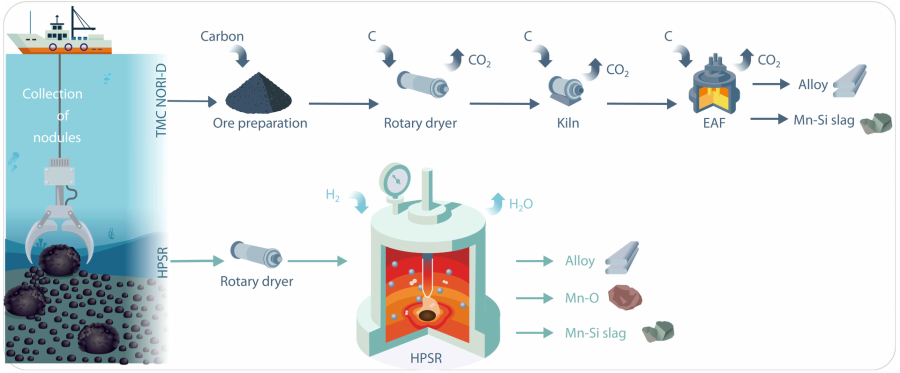 comparative analysis of the current processing route and hydrogen plasma smelting reduction (hPSR) of Mn nodules: the schematic diagram highlights distinct processing steps for the extraction method via tMc NORi-d (the Metals company Nautilus Ocean Reso
Deep Sea Nickel-Manganese Nodules: Thermodynamic and Kinetic Aspects of Phase Breakdown
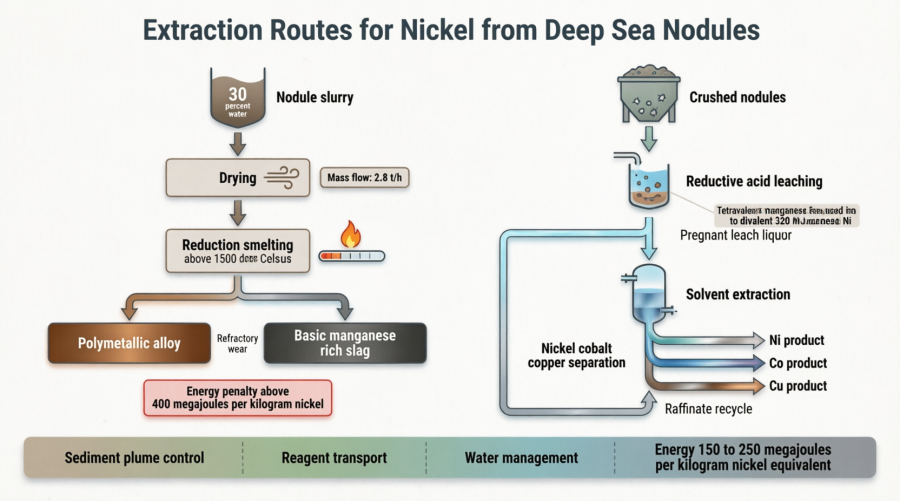
Extraction routes for deep sea nodules follow either pyrometallurgical or hydrometallurgical paths. Each route faces distinct kinetic barriers and thermodynamic costs.
Pyrometallurgical processing has historically used reduction smelting to form a polymetallic alloy, followed by selective oxidation or sulphation roasting. Smelting requires heating a nodule slurry containing about 30 percent water to temperatures above 1500 degrees Celsius. The energy needed to evaporate this water and melt the siliceous gangue can exceed 400 megajoules per kilogram of nickel. High manganese contents produce a fluid, basic slag that attacks magnesia and chromia refractories, causing containment and mass transfer problems.
Hydrometallurgical processing, especially reductive acid leaching, avoids the thermal load of smelting but introduces complex aqueous chemistry. Nickel dissolution requires reduction of tetravalent manganese to divalent manganese, which is soluble in dilute acid. Reductants include sulphur dioxide, hydrogen peroxide, and organic compounds such as glucose or methanol. Leaching kinetics depend on diffusion of hydrogen ions and reductant molecules through the porous manganese oxide matrix. Activation energies of 40 to 60 kilojoules per mole indicate mixed control by surface reaction and internal diffusion. The resulting leach liquor contains manganese, iron, nickel, copper, cobalt, and residual acid, making separation difficult.
Separation Processes and Sustainability Considerations
Nickel separation from the leach liquor relies on small differences in hydration enthalpy and complex stability among transition metal cations. Solvent extraction with hydroxyoxime or phosphonic acid extractants requires precise control of solution acidity. Nickel extraction typically occurs at a hydrogen ion activity corresponding to pH values of about 4 to 5, while manganese and magnesium remain in the aqueous phase. Mass transfer in these two phase systems depends on interfacial tension and diffusion coefficients of metal extractant complexes, which are around 1e minus 10 square metres per second. Mixer settler design must control droplet size to avoid third phase formation and emulsion trapping, and to achieve stage efficiencies above 90 percent.
The sustainability of nodule processing is under active study. Nodules contain battery metals and require no removal of overburden, but the abyssal environment has near freezing temperatures, high pressure, and slow sedimentation. Harvesting generates sediment plumes that alter benthic flow and light transmission, affecting filter feeding organisms over tens to hundreds of kilometres. Hydrometallurgical processing consumes about 150 to 250 megajoules per kilogram of nickel, driven mainly by pumping, heating, and neutralising large volumes of water. Acid and reductant consumption is high, requiring transport of large quantities of reagents to remote ocean processing sites.
Nickel extraction from deep sea nodules is a materials engineering trade off. The feedstock is chemically complex and dilute, requiring strong phase destabilisation and multistage separation. As high grade terrestrial sulphide and laterite ores decline, the thermodynamic and kinetic costs of processing manganese oxyhydroxides may become acceptable. Future extraction flowsheets must reduce reagent use and prevent discharge of metal bearing effluents to avoid long term damage to deep ocean ecosystems.
 Druckversion