
Combinatorial Alloy Design by Laser Additive Manufacturing: Example for High-Throughput Bulk Steel Alloy Design
Combinatorial Alloy Design by Laser Additive Manufacturing
We introduce laser additive manufacturing as a highly efficient combinatorial method for synthesizing microstructurally and compositionally graded bulk alloys. Traditional high throughput thin film approaches fail to capture the microstructural length scales critical for the mechanical response of structural materials. To overcome the time consuming nature of conventional bulk rapid alloy prototyping, we utilize laser metal deposition to rapidly probe novel compositional spaces. We focus on blending a chromium molybdenum vanadium hot working tool steel with an iron nickel cobalt maraging steel. By feeding these two distinct alloy powders simultaneously into the laser melt pool, we deposit a sequence of layers, each approximately 500 micrometers thick, with systematically varying volume fractions. This in situ powder mixing allows us to build a single bulk specimen containing discrete compositional steps ranging from pure maraging steel to pure tool steel. The process involves rapid melting and solidification with cooling rates between 1000 and 1000000 Kelvin per second, yielding exceptionally fine solidification microstructures that are often inaccessible through conventional liquid metallurgy.
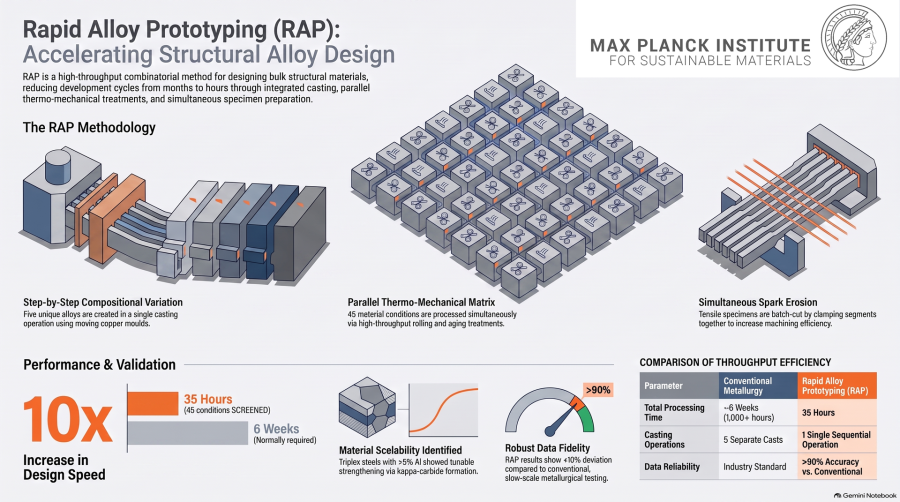 High-throughput combinatorial screening and processing paradigm via Rapid Alloy Prototyping (RAP) for bulk structural materials.

We introduce a new experimental approach to the compositional and thermo-mechanical design and rapid maturation of bulk structural materials. This method, termed rapid alloy prototyping (RAP), is based on semi-continuous high throughput bulk casting, rolling, heat treatment and sample preparation techniques. 45 Material conditions, i.e. 5 alloys with systematically varied compositions, each modifi ed by 9 diff erent ageing treatments, were produced and investigated within 35 h. This accelerated screening of the tensile, hardness and microstructural properties as a function of chemical and thermo-mechanical parameters allows the highly effi cient and knowledge-based design of bulk structural alloys. The efficiency of the approach was demonstrated on a group of Fe–30Mn–1.2C–xAl steel
Acta Materialia 60 (2012) 4950 combinato[...]
PDF-Dokument [1.3 MB]
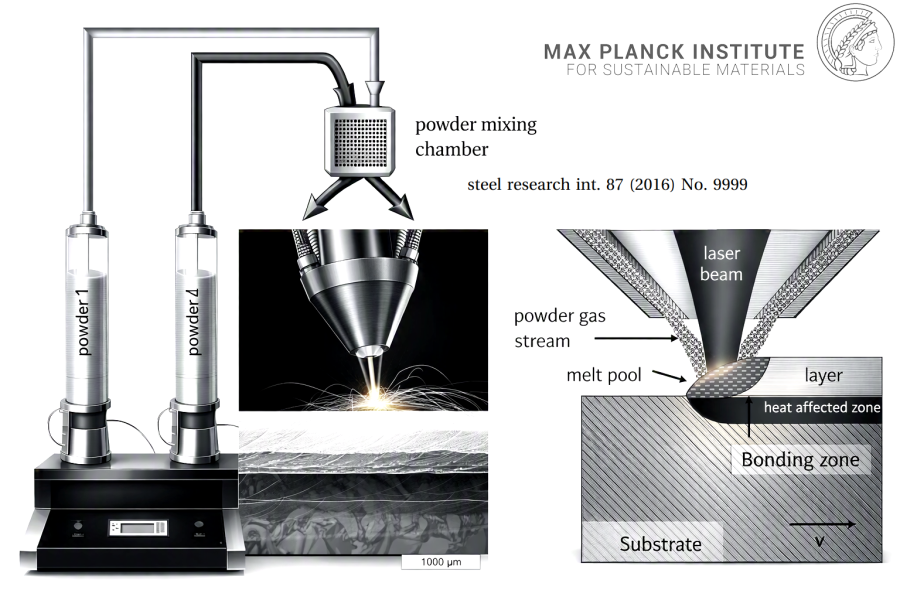 Max Planck Institute for Sustainable Materials Rapid_Alloy_Prototyping_Design_Process with LAM: n the Laser Metal Deposition (LMD) process the pre-mixed metallic powder to be melted and consolidated is introduced into the interaction zone of the laser bea
Microstructural Evolution and Thermomechanical Processing
Following the deposition, we subject the entire multilayer block to a unified thermomechanical treatment to simulate downstream industrial processing and ensure full densification. We apply a total warm deformation of 50 percent thickness reduction at 1100 degrees Celsius. Electron backscatter diffraction and energy dispersive x ray analysis reveal sharp compositional transitions between the adjacent layers, indicating negligible interdiffusion and stable melt pool dynamics during synthesis. Crucially, the crystallographic texture remains remarkably uniform across all compositional variants. This uniformity eliminates texture induced variables, allowing us to directly attribute any mechanical differences purely to chemical composition and local microstructural features. At higher resolution, we observe distinct microstructural responses to the hot rolling procedure. The chromium molybdenum vanadium rich layers undergo significant microstructural refinement and homogenization. Conversely, the near maraging layers exhibit weak homogenization, retaining large prior austenite crystals transformed into a martensitic matrix dominated by low angle grain boundaries. All blends achieve a fully martensitic matrix after deformation, effectively eliminating the retained austenite initially present in the tool steel rich regions.
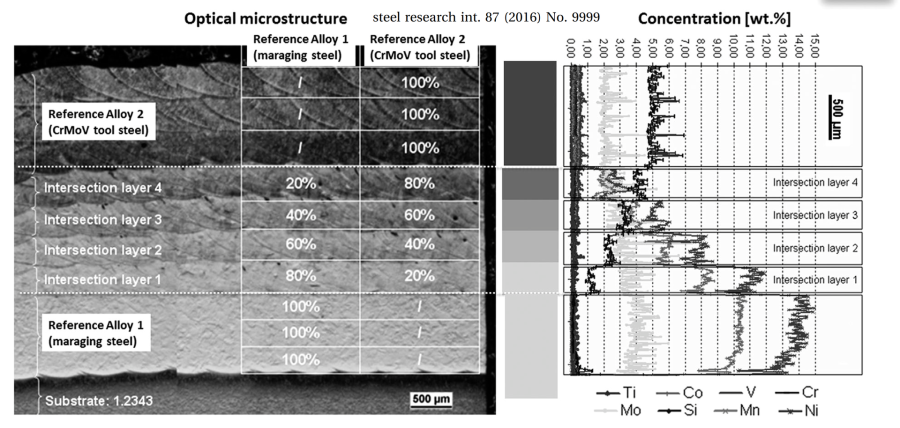 Composition and microstructure overview of the different layers in the bulk graded multi-layer Laser Metal Deposition specimen after subsequent 50% hot thickness reduction conducted at 1100 8C. The respective volume fractions of the tool steel blends can
Mechanical Property Mapping and Alloy Screening
We extract bone shaped tensile specimens from individual layers to map the mechanical properties across the compositional gradient. Microhardness and tensile testing demonstrate a continuous tuning of the strength and ductility profile. The yield and tensile strengths can be seamlessly adjusted between 800 and 1650 megapascals, while the tensile elongation varies between 15 and 25 percent. Interestingly, blending the high strength tool steel with the more compliant maraging steel does not result in a simple rule of mixtures or enhanced ductilization. Instead, we observe a reduction in the strain to failure for the intermediate blends. We attribute this mechanical penalty to the conflicting thermodynamic requirements of the two alloy systems, specifically their differing optimal precipitation temperatures and martensite start temperatures, which prevents a single global heat treatment from maximizing the performance of all layers simultaneously. Despite this specific limitation, our methodology successfully proves that laser metal deposition is a powerful tool for rapid bulk alloy screening. It enables the concurrent synthesis, thermomechanical processing, and comprehensive characterization of multiple complex alloy variants within a single production cycle, drastically accelerating the discovery of next generation structural materials.
 Druckversion