
Combinatorial Design of High Entropy Alloys
The high entropy alloy (HEA) concept has triggered a renewed interest in alloy design, even though some aspects of the underlying thermodynamic concepts
are still under debate. This study addresses the shortcomings of this alloy design strategy with the aim to open up new directions of HEA research targeting
specifi cally non-equiatomic yet massively alloyed compositions. We propose that a wide range of massive single phase solid solutions could be designed by
including non-equiatomic variants. It is demonstrated by introducing a set of novel non-equiatomic multi-component CoCrFeMnNi alloys produced by metallurgical rapid alloy prototyping. Despite the
reduced confi gurational entropy, detailed character-
ization of these materials reveals a strong resemblance to the well-studied equiatomic single phase HEA: The microstructure of these novel alloys
exhibits a random distribution of alloying elements (confirmed by Energy-Dispersive Spectroscopy and Atom Probe Tomography) in a single face-centered-cubic phase
(confirmed by X-ray Diffraction and Electron Backscatter Diffraction), which deforms through planar slip (confirmed by Electron-Channeling Contrast
Imaging) and leads to excellent ductility (confirmed by uniaxial tensile tests). This approach widens the fi eld of HEAs to non-equiatomic multi-component alloys since the concept enables to tailor the
stacking fault energy and associated transformation phenomena which act as main mechanisms to design useful strain hardening behavior.
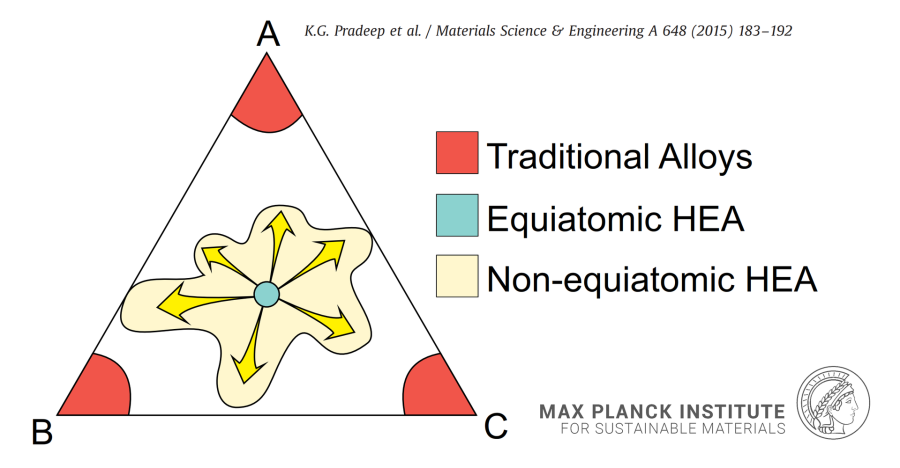 A schematic comparison of traditional alloys with one base element and minor alloying additions, high entropy alloys with equiatomic compositions of all alloying elements, and non-equiatomic – yet still massively alloyed-high entropy alloys, on the isothe

Non-equiatomic high entropy alloys: Approach towards rapid alloy screening and property-oriented design
The high entropy alloy (HEA) concept has triggered a renewed interest in alloy design, even though some aspects of the underlying thermodynamic concepts are still under debate. This study addresses the shortcomings of this alloy design strategy with the aim to open up new directions of HEA research targeting specifically non-equiatomic yet massively alloyed compositions. We propose that a wide range of massive single phase solid solutions could be designed by including non-equiatomic variants. It is demonstrated by introducing a set of novel non-equiatomic multi-component CoCrFeMnNi alloys produced by metallurgical rapid alloy prototyping. Despite the reduced confi gurational entropy, detailed characterization of these materials reveals a strong resemblance to the well-studied equiatomic
Mater Science Engin A648 (2015) 183–19[...]
PDF-Dokument [3.8 MB]
The high entropy alloy (HEA) concept has triggered a renewed interest in alloy design, even though some aspects of the underlying thermodynamic concepts are still under debate. This study addresses the shortcomings of this alloy design strategy with the aim to open up new directions of HEA research targeting specifically non-equiatomic yet massively alloyed compositions. We propose that a wide range of massive single phase solid solutions could be designed by including non-equiatomic variants. It is demonstrated by introducing a set of novel non-equiatomic multi-component CoCrFeMnNi alloys produced by metallurgical rapid alloy prototyping. Despite the reduced confi gurational entropy, detailed characterization of these materials reveals a strong resemblance to the well-studied equiatomic
Mater Science Engin A648 (2015) 183–19[...]
PDF-Dokument [3.8 MB]
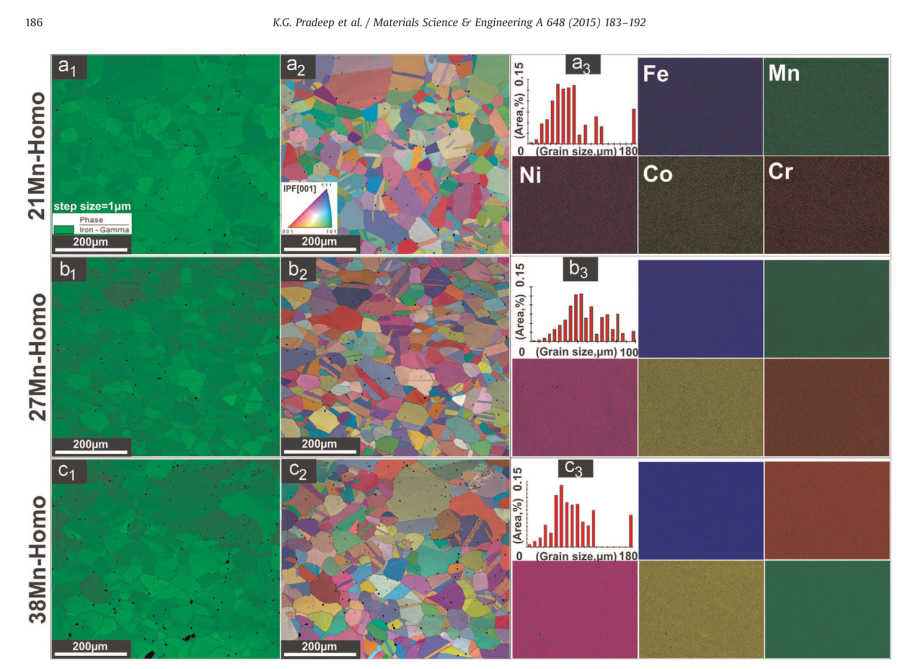 EBSD phase maps of the homogenized state showing single fcc phase (with minor inclusion of MnO formed during casting); inverse pole fi gure maps with grain size distributions and EDX maps of all the elements corresponding to (a) 21Mn, (b) 27Mn and (c) 38Mn
Rethinking Alloy Design Beyond Equiatomic Constraints
We challenge the conventional high entropy alloy design strategy that strictly relies on maximizing configurational entropy through equiatomic proportions. By relaxing this constraint,
we open a vast compositional space for non-equiatomic, yet massively alloyed, single-phase solid solutions. This approach allows us to tailor specific metallurgical parameters, such as stacking fault
energy, to engineer targeted strain hardening behaviors. To demonstrate this, we designed a series of non-equiatomic alloys within the iron-manganese-nickel-cobalt-chromium system. Using a base
composition of 40 atomic percent iron, 27 manganese, 26 nickel, 5 cobalt, and 2 chromium, we systematically varied the manganese content from 21 to 38 atomic percent. We synthesized these variants
via combinatorial rapid alloy prototyping, followed by hot rolling at 900 degrees C, homogenization at 1200 degrees C for two hours, and subsequent cold rolling and annealing treatments.
Microstructural Stability and Kinetic Freezing
Despite a 17 to 20 percent reduction in configurational entropy compared to the equiatomic counterpart, our microstructural characterization confirms the formation of a single
face-centered cubic phase across all compositions. X-ray diffraction and electron backscatter diffraction reveal a gradual lattice parameter expansion from 3.60 to 3.62 Angstroms as manganese
concentration increases. Atom probe tomography verifies a completely random distribution of alloying elements at the atomic scale, both within the grain interiors and across grain boundaries, with no
evidence of elemental partitioning or secondary phase precipitation. Differential scanning calorimetry further demonstrates exceptional thermal stability, showing no phase transformations up to the
melting point near 1250 degrees C.
Thermodynamic and electronic parameters traditionally used to predict solid solution formability, such as atomic size mismatch and valence electron concentration, suggest that higher
manganese variants should precipitate ordered phases or transform to a body-centered cubic structure. However, our diffusion-controlled kinetic calculations reveal that the sluggish atomic mobility
inherent to these multi-component systems kinetically freezes the primary face-centered cubic state. Even when thermodynamically favored to precipitate at 495 degrees C, secondary phase nuclei
exhibit negligible growth, reaching only 3.2 nanometers after more than three years. This confirms that the minimization of the overall Gibbs free energy, governed by kinetic freezing, supersedes the
maximization of configurational entropy in stabilizing these single-phase microstructures.
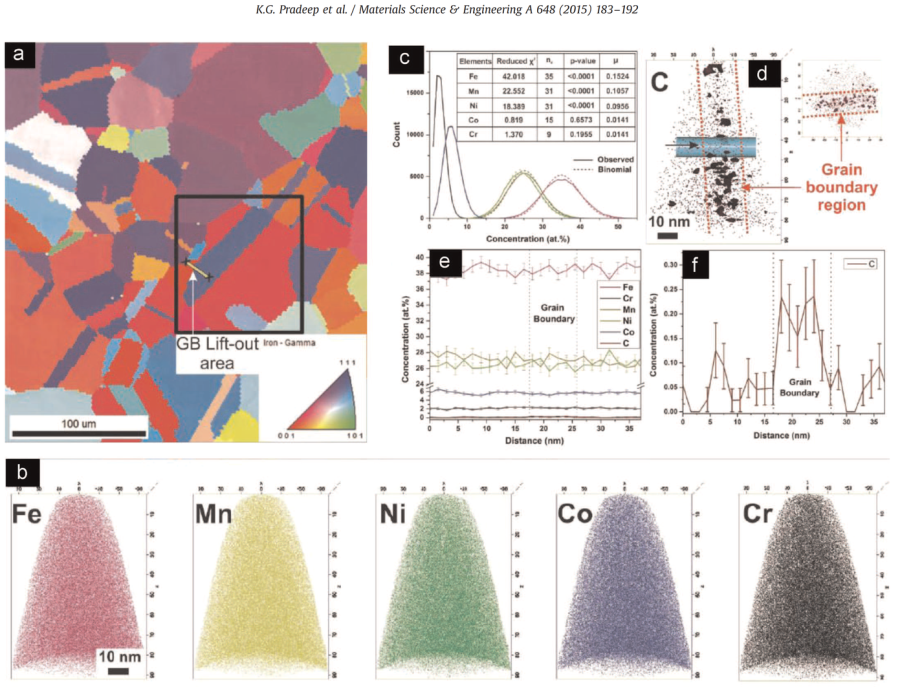 Representative 27 Mn alloy microstructure in the homogenized state with (a) inverse pole fi gure map showing the grain boundary lift out region (indicated by white arrow inside the black rectangle). (b) Three-dimensional elemental maps of all constitutent
Mechanical Response and Deformation Mechanisms
The mechanical behavior of our homogenized alloys exhibits outstanding ductility, maintaining uniform elongations near 38 percent and total elongations around 58 percent, closely
matching equiatomic benchmarks. While the absolute yield and ultimate tensile strengths are roughly 15 to 30 percent lower than the equiatomic alloy due to reduced cobalt and chromium solid solution
strengthening, we observe a marginal 10 to 15 percent strength increase with higher manganese additions. This correlates directly with the increased atomic size mismatch and resulting lattice
distortion, which imposes higher frictional stress on dislocation motion.
To explore property bounds, we subjected the 27 atomic percent manganese variant to 64 percent cold rolling, which increased the ultimate tensile strength to 760 megapascals but
reduced ductility to 16 percent due to exhausted strain hardening capacity. Subsequent recrystallization at 900 degrees C for 10 minutes yielded a fine-grained microstructure averaging 12
micrometers. This grain refinement triggered a pronounced Hall-Petch effect, elevating the yield strength by 150 percent to 240 megapascals and the ultimate tensile strength to 645 megapascals.
Electron channeling contrast imaging of the deformation substructures reveals that our alloys deform primarily through planar slip. At low strain levels of 1 to 2 percent, dislocations
form pile-up zones at grain boundaries. As strain exceeds 5 percent, we observe the development of highly dense dislocation walls and localized slip bands driven by lattice distortion rather than
short-range ordering. At higher strains, cross-slip activates, forming dislocation cell structures that facilitate homogeneous plastic flow without the onset of mechanical twinning. Ultimately, we
prove that single-phase high entropy alloys do not require strict equiatomic ratios, enabling a much broader, property-oriented design paradigm for extreme structural applications.
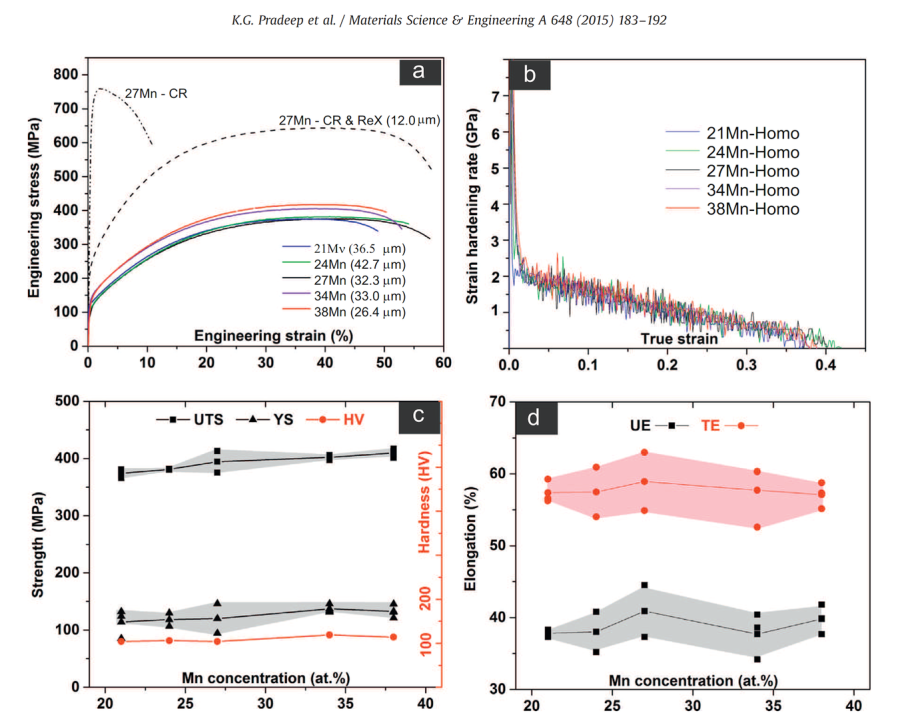 (a) Stress–strain curves of all the alloys in their respective homogenized states, representative 27 Mn alloy both in cold rolled (64%) and recrystallized (900 °C, 10 min) states for comparison. (b) Strain hardening curves for all the x-Mn compositions (a
 Druckversion