
Combinatorial Design of Triplex Steels
We introduce a new experimental approach to the compositional and thermo-mechanical design and rapid maturation of bulk structural materials. This method,
termed rapid alloy prototyping (RAP), is based on semi-continuous high throughput bulk casting, rolling, heat treatment and sample preparation techniques. 45 Material conditions, i.e. 5 alloys
with systematically varied compositions, each modified by 9 diff erent ageing treatments, were produced and investigated within 35 h. This accelerated screening of the tensile, hardness and
microstructural properties as a function of chemical and thermo-mechanical parameters allows the highly effi cient and knowledge-based design of bulk structural alloys. The efficiency of the approach was
demonstrated on a group of Fe–30Mn–1.2C–xAl steels which exhibit a wide spectrum of structural and mechanical characteristics, depending on the respective Al concentration. High amounts of Al
addition (>8 wt.%) resulted in pronounced strengthening, while low concentrations (<2 wt.%) led to embrittlement of the material during ageing.

Combinatorial high throughput bulk design of structural materials based on the example of 30Mn–1.2C–xAl triplex steels
Acta Materialia 60 (2012) 4950 combinato[...]
PDF-Dokument [1.3 MB]
Acta Materialia 60 (2012) 4950 combinato[...]
PDF-Dokument [1.3 MB]
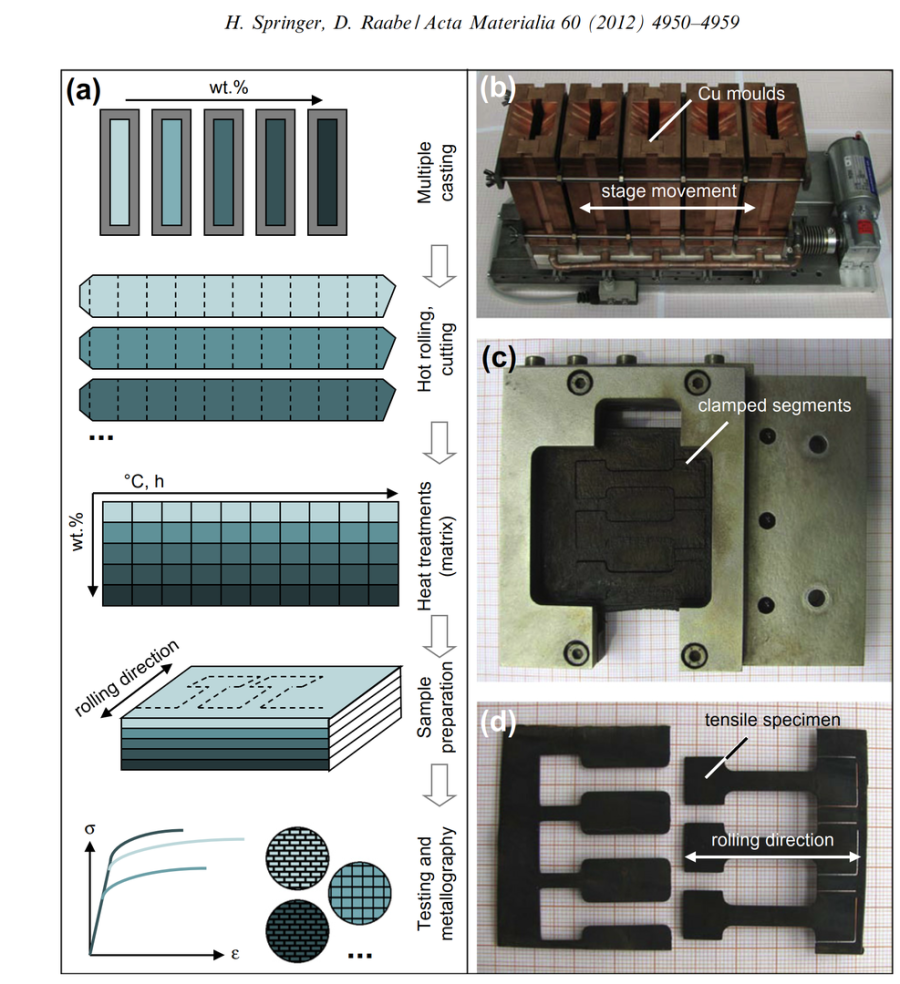 Illustration of the sample production process: (a) schematic sketch of the RAP approach with the diff erently shaded colours referring to the diff erent chemical compositions; (b) device for casting fi ve alloys into separate Cu moulds placed on a linear sta
High Throughput Bulk Combinatorial Design
We introduce a rapid alloy prototyping approach to drastically accelerate the compositional and thermomechanical design of bulk structural materials. Traditional alloy development
relies on iterative, time consuming single charge casting and processing loops. To overcome this, we developed a semi continuous high throughput method combining bulk casting, rolling, heat
treatment, and sample preparation. Using a vacuum induction melting furnace, we cast five distinct alloys in a single operation by sequentially altering the melt composition. We applied this to a
density reduced iron manganese carbon aluminum system, specifically targeting a base composition of iron with thirty weight percent manganese and one point two weight percent carbon, while
systematically varying aluminum additions from zero to eight weight percent. The cast blocks were hot rolled at eleven hundred degrees C to two mm thick sheets, homogenized, and subjected to a matrix
of nine different aging treatments ranging from four hundred fifty to six hundred degrees C for up to twenty four hours. Through simultaneous spark erosion sample preparation, we synthesized,
processed, and evaluated forty five distinct material conditions in just thirty five hours.
Microstructure and Mechanical Response
Our mechanical screening revealed distinct behavioral regimes governed by the aluminum concentration and aging parameters. For the aluminum free baseline alloy, the as homogenized
state yielded the optimal mechanical profile, characterized by a yield strength of three hundred sixty MPa, an ultimate tensile strength of eight hundred thirty MPa, and a total elongation of seventy
seven percent. Aging this alloy induced severe embrittlement and a drastic reduction in both ultimate tensile strength and ductility. Optical microscopy confirmed that this degradation stems from the
precipitation of coarse pearlitic ferrite and cementite particles along the grain boundaries during thermal exposure.
Conversely, the addition of eight weight percent aluminum completely suppressed the formation of these coarse grain boundary particles. Instead, aging the high aluminum alloy triggered
pronounced precipitation hardening. We observed yield and ultimate tensile strengths increasing to nearly double their initial values, driven by the nanoscale precipitation of kappa aluminum iron
manganese carbides within the austenitic matrix. While extended aging maximized strength, it naturally compromised ductility. Alloys with intermediate aluminum contents of two, four, and six weight
percent exhibited a superimposition of these two mechanisms. The concerted formation of intragranular kappa carbides and grain boundary pearlite balanced the strengthening and embrittlement effects,
resulting in a much higher thermal stability of the mechanical properties compared to the extreme compositional ends.
Validation and Efficiency
To validate our high throughput data, we compared the rapid prototyping results against conventionally synthesized and processed cylindrical tensile specimens. The absolute strength
values from our thin sheet rapid prototyping samples aligned closely with conventional data, typically deviating by less than ten percent. We noted a sporadic reduction in measured ductility for the
rapid samples, which we attribute to surface effects, minor sample bending during quenching, and the accelerated thermal kinetics inherent to two mm thick geometries compared to bulk sections.
Despite these minor geometric deviations, the rapid approach reliably captures the fundamental bulk material trends and phase transformation kinetics.
By reducing the timeline from initial design to comprehensive mechanical and microstructural evaluation from several weeks down to a single working day, our methodology provides a
highly efficient screening tool. It allows us to rapidly identify promising compositional hits, such as the high aluminum variants which offer the lowest specific weight and the widest tunable range
of mechanical properties via aging. This bulk combinatorial approach bridges the gap between thin film high throughput methods and industrial scale structural metallurgy, enabling knowledge based
alloy maturation in direct synergy with thermodynamic simulations and targeted high resolution nanoscale characterization.
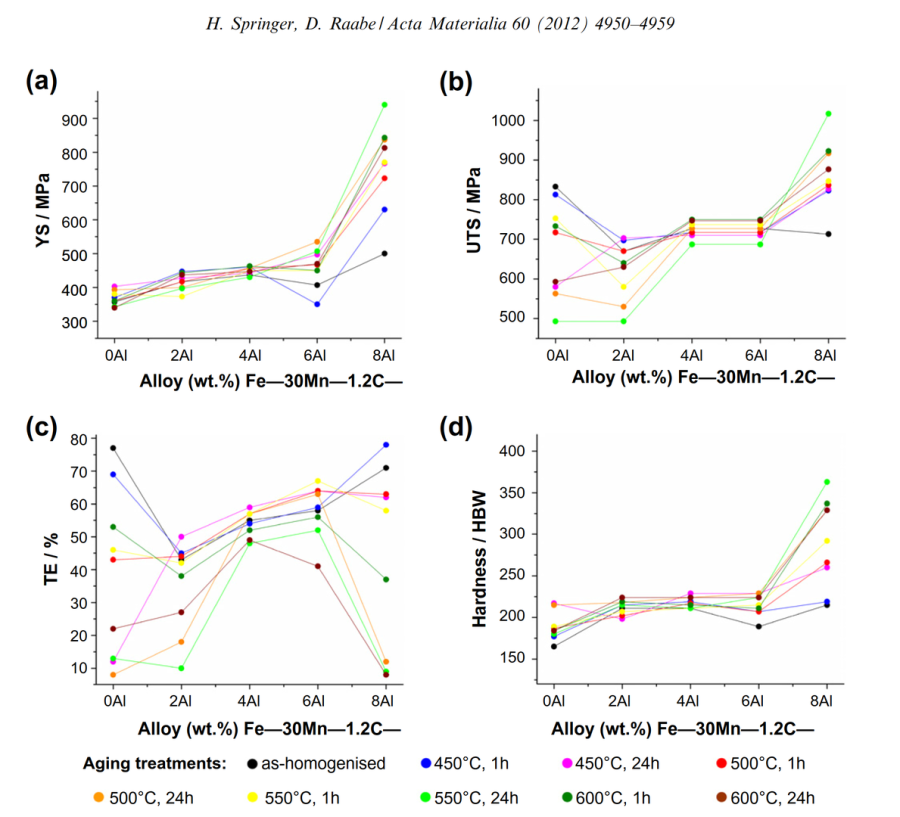 Overview of the mechanical properties obtained from the RAP experiments as a function of alloy composition (Table 1) and the applied ageing treatment: (a) yield stress (YS); (b) ultimate tensile stress (UTS); (c) total elongation (TE); (d) hardness. RAP,
 Druckversion