Sustainable nickel enabled by hydrogen-based reduction
NATURE · ARTICLE · 30 APRIL 2025
U. Manzoor¹ · L. Mujica Roncery² · D. Raabe³ · I. R. Souza Filho¹
¹ Max Planck Institute for Sustainable Materials, Düsseldorf, Germany
² Universidad Pedagógica y Tecnológica de Colombia, Tunja, Colombia
³ Institut Jean Lamour, CNRS (UMR 7198), Université de Lorraine, Nancy, France
Open access (CC BY 4.0) · Received 16 February 2024 · Accepted 14 March 2025 · DOI 10.1038/s41586-025-08901-7
Nickel is a critical element in the shift to sustainable energy systems, with the demand for nickel projected to exceed 6 million tons annually by 2040, largely driven by the electrification of the transport sector. Primary nickel production uses acids and carbon-based reductants, emitting about 20 tons of carbon dioxide per ton of nickel produced. Here we present a method using fossil-free hydrogen-plasma-based reduction to extract nickel from low-grade ore variants known as laterites. We bypass the traditional multistep process and combine calcination, smelting, reduction and refining into a single metallurgical step conducted in one furnace. This approach produces high-grade ferronickel alloys at fast reduction kinetics. Thermodynamic control of the atmosphere of the furnace enables selective nickel reduction, yielding an alloy with minimal impurities (<0.04 wt% silicon, approximately 0.01 wt% phosphorus and <0.09 wt% calcium), eliminating the need for further refining. The proposed method has the potential to be up to about 18% more energy efficient while cutting direct carbon dioxide emissions by up to 84% compared with current practice. Our work thus shows a sustainable approach to help resolve the contradiction between the beneficial use of nickel in sustainable energy technologies and the environmental harm caused by its production.
Key numbers
- 6 Mt/yr — projected Ni demand by 2040, doubled from 3 Mt today
- ~20 t CO₂ per ton of Ni in current practice — ten times the emission of a ton of steel
- −84% — potential cut in direct CO₂ emissions with hydrogen-plasma smelting reduction
- +18% — potential energy savings versus the rotary kiln–electric furnace route
- 1 step — calcination, smelting, reduction and refining merged into one furnace
Nickel is a strategic, hard-to-replace element: 1.97 million tons of stainless steel and 210 kilotons of non-ferrous alloys — especially superalloys — are made with it every year. But the batteries that will electrify transport need another 3 million tons by 2040, doubling global demand to 6 million tons per year.
The supply base is the wrong shape for this demand. Today 60% of annual nickel production comes from high-grade sulfide ores (1.5–4 wt% Ni), whose chemically simple minerals (NiS, Ni₃FeS₂, (Co,Ni)₃S₄) separate cleanly by froth flotation. The remaining 40% comes from low-grade laterites — saprolite and limonite, averaging 1.5 wt% Ni. In laterites there are no discrete Ni minerals: Ni²⁺/Fe²⁺ ions sit dissolved in complex magnesium silicates such as lizardite (Mg,Fe,Ni)₃Si₂O₅(OH)₄, or partially replace iron in goethite (Fe,Ni)OOH. Yet 60% of all land-based nickel reserves are locked in these laterites, and only 40% in sulfides (Fig. 1b).
Processing laterites is punishing. The energy demand runs from 230 to about 570 GJ per ton of Ni — far above the 22 GJ needed for steel. Emissions follow: the rotary kiln–electric furnace (RK-EF) and blast-furnace route emit about 45 t CO₂e per ton of Ni, high-pressure acid leaching (HPAL) about 14 t, pushing the industry average to 20–27 t CO₂e per ton — over ten times steel (2.3 t). Nickel is one of the most environmentally damaging metals to produce (Fig. 1c).
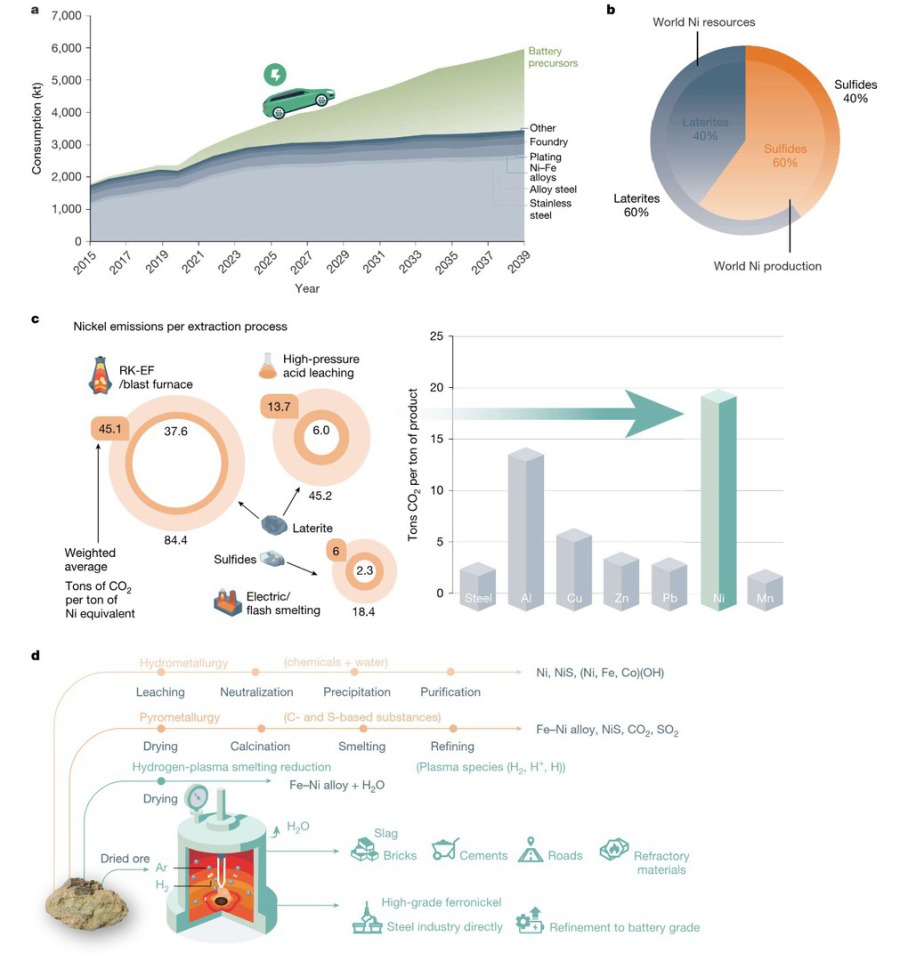 Fig. 1 | Integrated overview of the production of Ni from its natural ores. The market growth, sources, production, processing routes, emissions and comparison with the sustainable one-step hydrogen-plasma route. a, Current and projected (2040) Ni-market
Instead of drying, calcining, smelting and refining in sequence, the whole dried ore charge is melted and reduced at once — hydrogen-plasma smelting reduction (HPSR) — in a single electric arc furnace (Fig. 1d).
Solid-state direct reduction with gaseous hydrogen has been tried, but the crystallographic complexity of laterites, the low Ni content (0.5–2 wt%) and up to 90% impurity oxides make the kinetics sluggish and the hydrogen utilization inefficient, and demand additional pre- and post-treatments. Direct reduction of saprolites is scarcely reported: their silicates are too thermodynamically stable at typical reduction temperatures (800–1,000 °C).
HPSR sidesteps that stability problem by melting first. In the molten state the crystal structures dissociate into ionic species — Fe²⁺, Ni²⁺, Mg²⁺, O²⁻, SiO₄⁴⁻ — without catalysts, and the melt is exposed to highly reactive hydrogen-plasma species (H₂, H and H⁺). Calcination, smelting, beneficiation, metal separation and refining collapse into one metallurgical step, operable entirely on renewable energy: renewable electricity replaces carbon-based fuels, and sustainably produced hydrogen replaces carbon- and sulfur-based reductants — eliminating direct CO₂ and SO₂ emissions and the acids used in HPAL.
In the experiments, ore fines were compacted into ~10 g green pellets, placed on the water-cooled copper hearth of an arc-melting furnace, and reduced for 2 min by a 200 A plasma arc in Ar–10% H₂ at 900 mbar. Even this brief exposure precipitated pure metal droplets.
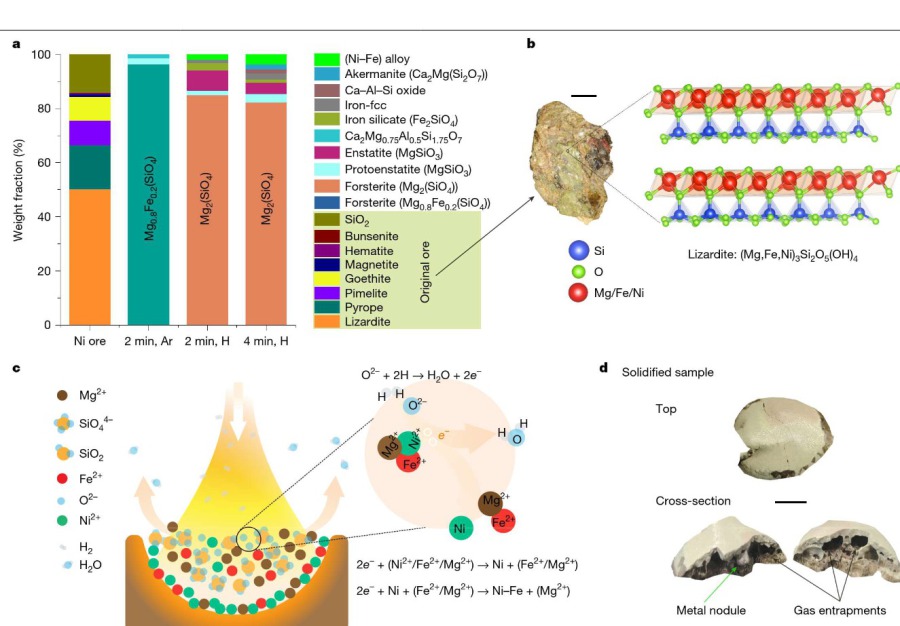 Fig. 2 | Unveiling phase transformations. The complex Ni-hosting mineral structure in the original ore, reduction mechanisms and a visual snapshot of a solidified sample. a, Phase evolution during melting of the original ore in Ar and a lean H₂ atmosphere
Melted in argon alone, the ore solidifies as olivine (forsterite, Mg₂SiO₄, ~86 wt%) and pyroxene (MgSiO₃, ~10 wt%) — no Ni-rich phase at all. Nickel is dissolved in the silicates, confirmed by SEM–EDX mapping. The as-received ore loses ~23 wt% above 1,600 °C: moisture, dehydroxylation of serpentine minerals and decomposition of goethite to haematite.
The reduction mechanism is oxygen extraction, not direct attack on silicate. Free oxide ions (O²⁻) diffuse to the arc–melt interface and are taken by hydrogen-plasma species as water vapour or hydroxyl radicals. Each oxygen leaves two electrons behind, and those electrons are consumed preferentially by the cation with the lowest oxygen affinity — Ni²⁺, precipitating first, followed by Fe²⁺. The two metals form a homogeneous molten phase that solidifies into a single Fe–Ni alloy (Fig. 2c).
After just 2 min the metal has fully separated from the silicate melt — driven by a factor of two to three in density — and can simply be hammered out: ~5 mm nodules embedded in the unreduced slag, or 1–3 mm particles at the sample bottom (Fig. 2d).
<< Neues Textfeld >>
 Druckversion