
Scrap Steel to Prime Steel: Impurity Thermodynamics, Microstructure Tolerance and Alloy Design in Scrap-Based Steelmaking
The reason is thermodynamic and does not depend on process engineering. Primary synthesis is a reduction problem. Iron in hematite is chemically bound to oxygen, and the free energy of that bond
must be repaid. The thermodynamic minimum for reducing hematite to iron is 6.1 MJ per kilogram, while industrial practice consumes 18 to 25 MJ per kilogram, an efficiency of 22 to 33 percent [2,4].
Secondary synthesis is a melting problem. The metal is already reduced, so only sensible and latent heat are needed, about 1.3 GJ per tonne to bring iron from ambient temperature to a liquid at 1600
degrees C. The best electric arc furnaces operate at about 350 kWh per tonne, or 1.26 GJ per tonne, which means the secondary route already runs close to its thermodynamic floor while the primary
route runs at a quarter of its own [1,2]. Because no chemical reductant is required, scrap melting is also the only part of steelmaking that can be electrified directly. A blast furnace cannot be
electrified: coke acts simultaneously as reductant, as heat source and as the load-bearing skeleton that preserves gas permeability and liquid drainage in the cohesive zone. Hydrogen-based direct
reduction can decarbonise primary synthesis, but it needs hydrogen on the order of 100 million tonnes per year for the steel sector alone, against a sustainable supply three to four orders of
magnitude smaller, and plant construction times measured in decades [1,2].
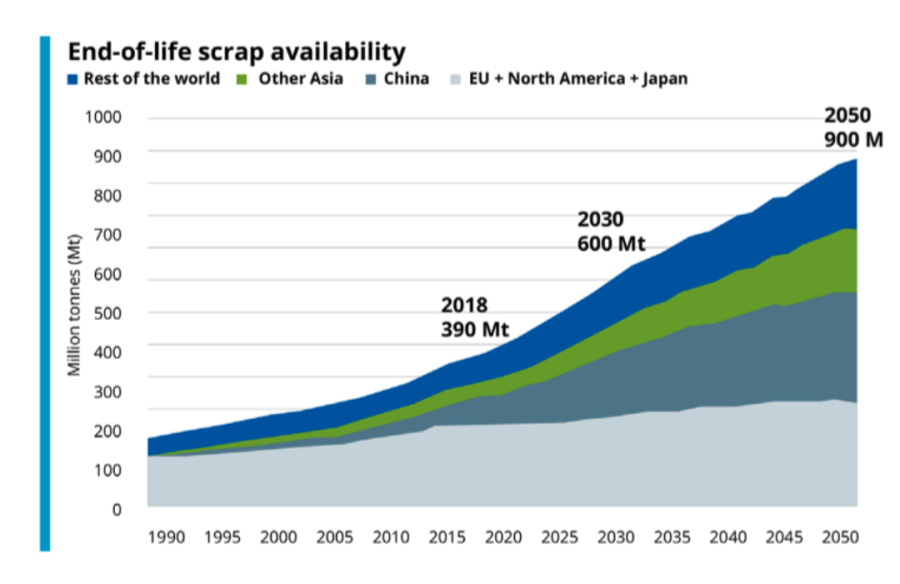
The constraint on recycling is therefore not energetic but statistical and chemical. More than 75 percent of all steel ever produced is still in service, in buildings, bridges,
machinery and vehicles with lifetimes of decades to a century. The global end-of-life recycling rate for carbon steel is about 60 percent, and 90 to 95 percent for automotive sheet, yet the recycled
fraction in new steel is only about one third, because demand exceeds scrap availability by roughly a factor of two [1,5]. Projections for 2050 place the scrap share between 45 and 70 percent, the
spread reflecting assumptions about stock saturation and product lifetime rather than about technology [5,6]. Even under favourable assumptions a substantial primary fraction remains, and entropic
losses through oxidation, corrosion and dissipation set a floor below full circularity [2,7].
Quality is the harder problem. More than half of the carbon steel scrap stream is already old, mixed, post-consumer material, and this fraction is projected to exceed 70 percent [1,6].
Most of it is downcycled into construction grades, which absorb about half of world steel consumption, rather than upcycled into the sheet grades that require tight residual limits. The alloying
value embodied in chromium, nickel, molybdenum and niobium is either oxidised into slag or diluted into products that do not need it. Material flow analyses for end-of-life vehicles put the effective
loss of these elements at up to 93 percent when steels are mixed indiscriminately, while parts-based sorting before shredding can reduce inherent value losses to a few percent [8,9]. Multi-life-cycle
tracking with alloy-resolved models shows chromium lost largely to slag and nickel dispersed into the carbon steel loop, where it accumulates as a residual rather than serving as an alloying element
[10].
The liquid state: what can be removed, and at what cost
Whether an element can be extracted from liquid steel is decided by three quantities: its oxygen affinity relative to iron, its vapour pressure at steelmaking temperature, and the
stability of its sulfides, phosphides or halides in slag. This provides a compact classification of tramp elements that is more useful than any list of specifications [11].
Elements less noble than iron oxidise readily and partition into slag. Silicon, aluminium, manganese, magnesium and calcium are removed in the converter or arc furnace under oxidising
conditions. Zinc and lead have high vapour pressures and leave as vapour or dust, although manganese co-evaporates and must be replaced. Phosphorus requires oxidising conditions together with a
basic, CaO-rich slag of appropriate FeO content, and must therefore be removed before tapping. Sulfur requires the opposite: reducing conditions and low oxygen potential, achieved in the ladle after
deoxidation. The incompatibility is thermodynamic, not procedural. A single reactor cannot dephosphorise and desulfurise, so the process sequence is fixed [1].
The problematic elements are those more noble than iron and insufficiently volatile. Copper, nickel, cobalt, molybdenum, tin, tungsten, arsenic and antimony cannot be oxidised out of
liquid steel without oxidising the iron itself. Copper is the archetype. Its vapour pressure at 1600 degrees C is orders of magnitude below that of zinc, so vacuum distillation is slow; effective
removal requires repeated remelting under high vacuum, with base-metal losses and specific energy penalties that can approach or exceed the entire melting demand of an arc furnace [12]. Kinetic
simulations of the ladle furnace using the effective equilibrium reaction zone approach, in which the size of the reaction zone sets the mass-transfer rate, show copper remaining essentially
unchanged at 0.35 wt.% throughout treatment, with only marginal dilution from copper-free ferroalloy additions [1,13]. The same holds for phosphorus under ladle conditions. Industrially, the only
viable controls remain upstream sorting and dilution with direct reduced iron or pig iron. Dilution reintroduces primary emissions and, in the case of pig iron, carbon that must be oxidised away
again.
Alternatives exist but are not mature. Selective chlorination with a 10 to 1 air-chlorine mixture at 800 degrees C removes zinc from solid scrap because zinc chloride is more stable
than its oxide while the reverse holds for iron [14]. Sulfide and chloride slagging of copper, ammonia blowing under reduced pressure, and Ca2Sn formation have been demonstrated at laboratory scale.
Hydrogen plasma smelting reduction has been shown to remove sulfur, phosphorus and even copper from iron melts, which conventional slag practice cannot achieve, and offers a route in which melting,
reduction and refining occur in one reactor [15]. Electrochemical decarburisation of molten iron under anodic polarisation, discharging oxide ions from slag directly onto dissolved carbon to form CO,
addresses the related paradox that carbon is first added in the blast furnace and then oxidised away in the converter [16].
The quantities involved explain why marginal contamination matters. Sheet specifications typically hold copper at or below 0.15 wt.% and tin below 0.02 wt.%, while long products
tolerate up to about 0.4 wt.% copper. Surveys of steel bars produced from scrap in Japan found copper averaging 0.25 to 0.5 wt.%, and the sum of copper, nickel, chromium, molybdenum and tin is now
used as a scrap quality index [17,18]. Two thirds of the copper accumulated in the Japanese scrap pool originates from insufficient separation and only one third from intentional alloying in
weathering and electrical steels [17]. Tinplate carries about 4 kg of tin per tonne of steel, so 20 kg of tin in a 100 tonne melt already exceeds the admissible limit; bronze bearings can contain up
to 22 wt.% Sn [19]. Galvanised sheet carries about 2.8 wt.% zinc. Copper enters vehicles at roughly 20 kg in a combustion car, 40 kg in a hybrid and above 100 kg in a plug-in electric vehicle, and
the average vehicle already contains about 0.2 wt.% Cu [1]. Sorting is limited by physics of a different kind: during shredding, copper is cold-welded into the iron, so magnetic and density
separation cannot recover it, and coatings, solders and fine wires are dispersed below the liberation size. Exergy analyses of automobile recycling and thermodynamic assessments of element
controllability make the same point in different language: mixing entropy at the component level cannot be undone by separation at the bulk level [11,20,21]. Dynamic stock models for the EU-28
project rising residual levels through 2050, and the European supply of copper-contaminated scrap has exceeded domestic demand for high-tolerance products since about 2009, with the surplus exported
[6,7].
Solid-state consequences of retained residuals
Once solidified, tramp elements act through four mechanisms that usually operate together: alteration of phase equilibria and transformation kinetics, formation of second phases with
unfavourable size and morphology, segregation to grain and interphase boundaries, and formation of low-melting films.
Copper illustrates the last of these. During slab reheating and hot rolling between 1000 and 1200 degrees C, iron oxidises to scale while copper, being nobler, is rejected and enriches
beneath the scale. Local copper can exceed the austenite solubility limit, about 9 wt.% at 1250 degrees C, and because the copper-rich phase melts near 1080 degrees C it forms a liquid that
penetrates austenite grain boundaries under the tensile and bending stresses of rolling and of continuous casting straightening. The result is surface hot shortness and intergranular cracking
[22,23]. The same enrichment reduces scale adhesion and causes uncontrolled descaling, which disturbs the thermal balance of the rolling schedule because the scale acts as insulation between passes
[22]. The composition dependence is metallurgically exploitable. Nickel raises copper solubility in austenite and suppresses liquid formation, with the Ni to Cu ratio rather than the absolute nickel
content being the controlling parameter; tin and antimony lower copper solubility and depress the melting point of the copper-rich phase, aggravating the effect [24,25]. Silicon promotes occlusion of
the copper-rich phase into the internal oxide, removing it from the metal surface, an effect enhanced by water vapour in the furnace atmosphere [24]. Boron, carbon and phosphorus reduce grain
boundary penetration [23]. Rapid solidification bypasses the mechanism entirely: strip casting and sub-rapid solidification disperse copper as fine precipitates instead of allowing subscale
enrichment, and the same precipitates can later contribute precipitation hardening [26,27]. Hot ductility troughs in the 700 to 1000 degrees C range, already deepened by MnS and AlN precipitation,
are further degraded by copper and tin, which is why residual control matters for casting straightening as much as for rolling [25].
Tin, antimony, arsenic and phosphorus act mainly through interface segregation. In the interfacial decohesion framework of Seah and Hondros, larger segregating atoms weaken ferrite
grain boundaries more strongly, placing tin and antimony above phosphorus and arsenic in potency [28]. Auger electron spectroscopy showed that carbon and boron compete with tin for the same boundary
sites and, having higher diffusivity, can pre-empt them [29]. This suggests deliberate boundary passivation by pre-decoration with light interstitials, and it explains a specific vulnerability of
interstitial-free deep-drawing steels, where carbon is held below 0.003 wt.% and nitrogen below 0.004 wt.% and the remainder is scavenged by titanium and niobium. Their boundaries are left
undecorated and open to tin and antimony segregation. Manganese and chromium amplify the effect by lowering carbon activity at interfaces, and nickel by reducing tin and antimony solubility in
ferrite [1,29]. Beyond embrittlement, segregation alters primary recrystallisation texture, suppressing the {111} fibre that gives Lankford values above 1.25 and promoting (100)[001] and (110)[001]
components that are desirable in electrical steels but damaging in forming grades [30,31].
In the bulk, most residuals shift transformation kinetics. Chromium and molybdenum move the pearlite start to higher temperatures and the bainite start to lower temperatures, widening
the transformation-inert region and lowering the critical cooling rate for martensite. Hardenability improves, but continuous hardening becomes harder as martensite start and finish temperatures
fall. Solidification segregation coefficients of 0.25 to 0.63 for molybdenum, 0.25 to 0.9 for chromium and 0.28 to 0.72 for manganese mean that these elements also intensify microsegregation and
banding, and that homogenisation times lengthen [32]. Strong carbide formers can produce coarse carbides and brittle sigma, chi or Laves phases, particularly at higher carbon. Chromium raises tensile
strength by 80 to 100 MPa per wt.% through solid solution and carbide formation, but reduces notch impact energy and weldability. The propagation into processing constraints is direct: residuals
enter the carbon equivalent, CE = C + Mn/6 + (Cr+Mo+V)/5 + (Ni+Cu)/15, so an increase in copper and nickel that is metallurgically benign in the base metal can still push a plate outside its
weldability envelope through heat-affected zone hardness [1,17].
Interstitial content is a separate and often underestimated problem in scrap-based production. Nitrogen solubility in liquid iron peaks near 1600 degrees C, and dissociation of N2 at
the open arc drives pickup; arc-furnace steels commonly carry 60 to 120 ppm nitrogen against 20 to 50 ppm in converter steel. Foamy slag practice, which buries the arc, and dilution with direct
reduced iron, which provides a carbon boil, are the standard countermeasures, and both have energy and yield costs [33,34]. Hydrogen from moisture, oils and hydrated lime on scrap requires vacuum
degassing for heavy plate and forging grades. Cleanliness is also affected: aluminium deoxidation products must be modified with calcium to avoid solid alumina clusters, and higher sulfur from scrap
increases the MnS load that controls anisotropy and through-thickness ductility.
Not all effects are negative, and the useful ones are quantitatively documented. Adding 0.5 wt.% Cu to a 0.15C-1.5Si-1.5Mn TRIP steel raised tensile strength from 727 to 817 MPa and
elongation from 29.2 to 36.4 percent, through increased fraction and altered mechanical stability of retained austenite [35]. Copper in interstitial-free steels retards recrystallisation and
contributes precipitation hardening [36]. Precipitates below 2 to 3 nm increase cyclic hardening capacity and defect tolerance, raising fatigue strength [37]. Above about 0.2 wt.% C the picture
changes, because cementite provides incoherent nucleation sites for copper and the beneficial coherent dispersion is lost [38]. For 42CrMo4, a quench and temper grade whose standard limits copper to
0.4 wt.%, adjusting the tempering temperature allows as much as 1 wt.% Cu to meet industrial requirements [39]. In medium-manganese steels, intercritical annealing time can be used to compensate
charge-to-charge variation in copper, restoring yield strength without ductility loss [40]. These are the concrete demonstrations that processing can act as the compensator for chemistry.
Alloy and process design for impurity tolerance
The organising principle is that chemical composition is a conserved quantity while microstructure is not. Every alloying atom added returns to the scrap pool; grain size, phase
fractions, precipitate dispersion and defect density can be reset indefinitely by solidification, deformation and heat treatment. Several hundred steel grades are already accessible within
Fe-C-Mn-Si, and lean concepts such as Fe-18Mn-3Ti maraging steel achieve ultrahigh strength through segregation-controlled nanoprecipitation without nickel, cobalt or molybdenum [2,41,42]. Chemical
boundary engineering and controlled chemical heterogeneity deliver strength and hydrogen resistance from lean compositions by placing solutes where they are useful rather than distributing them
uniformly [43,44]. The design philosophy that follows is microstructural complexity from chemical simplicity, with alloys that are simultaneously good acceptors of mixed scrap and good donors of
clean scrap. Grain refinement contributes twice: it disperses harmful phases more finely and dilutes interfacial segregation over more boundary area [45]. Segregation engineering can invert the sign
of an impurity effect outright, as in the 9 wt.% Mn steel where manganese decoration of boundaries converts temper embrittlement into toughness [46].
A second principle is that specifications should be re-derived rather than inherited. Many residual limits were fixed for solidification and thermomechanical conditions that no longer
apply. Faster solidification, thinner cast sections, higher nucleation rates and better thermal control disperse harmful phases and reduce segregation gradients. The countermeasure taxonomy is
compact: boundary passivation and pre-decoration with carbon, nitrogen and boron; austenite grain refinement; co-doping to retune austenite stability when non-removable elements enter; adjustment of
quench rate and nucleation density to refine precipitate dispersion; and modification of the phase fields in which brittle intermetallics form [1,45].
A third principle is that charge-to-charge variability may be more damaging than a higher mean residual level. Copper distributions in scrap-based bars are broad and skewed. Designing
a safety-critical sheet grade against the mean composition is insufficient; the tails of the distribution must be accommodated, either by adaptive processing or by an alloy concept whose properties
are insensitive to composition within the observed range [1,17,47]. This is where data-driven design earns its place, because the composition-processing-microstructure-property mapping in a five- or
six-component residual system is too high-dimensional for intuition and too poorly parameterised for purely thermodynamic prediction.
Process design carries comparable leverage. Conventional slabs of 180 to 250 mm thickness are reduced to 2 to 3 mm hot strip, more than 98 percent thickness reduction. Near-net-shape
and thin-strip casting cut the required deformation energy from about 2100 to 200 MJ per tonne, reheating demand from 1.2 to 1.5 GJ per tonne to 0.1 to 0.5, and rolling electricity from 80 to 100 kWh
per tonne to 30 to 60, amounting to 5 to 7 percent of an integrated mill's energy [2,48]. The metallurgical benefit is at least as important: higher solidification rates suppress Scheil segregation,
refine dendrite arm spacing, disperse copper as nanoprecipitates rather than subscale films, and reduce through-thickness gradients [26,27,49]. The trade-off is surface quality and through-thickness
homogeneity for exposed automotive panels, which is why strip casting has matured fastest in stainless and in grades where surface requirements are less severe [49].
Sink alloys deserve explicit consideration. Casting alloys tolerate coarse second phases better than forming grades, weathering steels use copper deliberately, and some electrical
steels tolerate copper nanoprecipitates because they are smaller than the magnetic domain wall width. Medium-manganese steels with 3 to 12 wt.% Mn are potential sinks for copper-bearing scrap, but
they create a new scrap class that must be kept separate from carbon steel exactly as stainless steels are today [1,50]. The market for high-tolerance products is finite: material flow analysis shows
that even rebar and other long products cannot absorb the projected volume of copper-contaminated scrap indefinitely [7]. Deliberately raising the entropy of the alloy, as in scrap-tolerant
multicomponent concepts, is an alternative that trades chemical simplicity for configurational tolerance and remains unproven at tonnage scale [51,52].
A worked example at the ferrous casting end of the same scrap pool shows what impurity-tolerant design can deliver quantitatively. Ductile iron accounts for about 120 million tonnes
annually, 28 percent of cast iron consumption, and shares its scrap stream with steel: stainless and alloy steel scrap, automotive turnings, wear-resistant cast iron returns, plus residues from
deoxidisers, nodularisers, desulfurisers and mould coatings. Conventional practice degrades irreversibly above about 70 wt.% scrap charging, with strength and ductility falling together [53,54].
Coupling a 330-entry composition-processing-microstructure-property dataset from an instrumented production line with a 2400-entry composition-property dataset, convolutional surrogate models and a
tree-search optimiser constrained to spread candidates along a Pareto front produced 17 candidates, of which 14 improved on the existing front, with gains up to 15.2 percent in tensile strength and
73.2 percent in elongation and an 8.1 percent cost reduction at 100 percent scrap [53].
The mechanisms are conventional; their combination is not. The best variant, at 3.31 C, 2.77 Si, 0.30 Mn and 0.27 Cu in wt.%, reached 590 MPa with 18.5 percent elongation by combining
34.6 percent pearlite with 196 nm interlamellar spacing, 56.2 percent ferrite for crack blunting, and 13.2 percent graphite at 292.8 nodules per square millimetre and 21.25 micrometre mean diameter,
finer and more numerous than the expert-designed reference. Impurity-derived Cu-, Ti-, Mg- and Sn-bearing nanoparticles contributed 114 to 152 MPa of Orowan strengthening, and silicon and copper in
solution about 148 MPa. Deviating from the optimised processing window degraded graphite sphericity by 30 percent and increased nodule size by 20 percent, raising local misorientation near the
graphite-matrix interface from 3.3 to 5.1 degrees and triggering premature fracture. The resulting operating rules are specific rather than generic:
- Carbon above 3.2 wt.%, below which pearlite formation and nodularisation are both restricted.
- Tap temperature below 1435 degrees C, because prolonged liquid-phase duration promotes multi-element cosegregation and nodule degradation.
- Nodularisation time of at least 30 minutes, to preserve sphericity and nodule count.
- Silicon between 2.0 and 3.0 wt.%, balancing solid solution strengthening against iron-silicon long-range ordering embrittlement, which sets in near 4.3 wt.%.
- Copper above 0.15 wt.%, to ensure sufficient nanoprecipitate formation.
The lesson generalises to steel: in heavily contaminated melts, thermal history and inclusion statistics control properties as much as bulk chemistry, and the useful design variables
are often the ones that classical alloy specifications do not list.
Where the approach ends
Impurity-tolerant design applies where moderate contamination can be managed by phase selection, dispersion and interface engineering. It does not extend to applications in which trace
contamination is catastrophic. It also does not remove the need for sorting, because the elements that damage grain boundary cohesion, tin, antimony, arsenic and copper, are precisely those that
cannot be extracted from the melt and whose accumulation is monotonic across recycling loops [1,12]. Nor does it remove the need for primary synthesis: with demand growth and stock longevity, a
substantial ore-based fraction persists for decades, so decarbonising primary ironmaking and tolerating residuals in secondary steelmaking are complementary rather than competing programmes
[2,55,56].
The measurable gaps are specific. Thermodynamic and kinetic databases remain thin for the multicomponent residual systems that recycling actually produces, particularly for grain
boundary segregation isotherms in five- and six-component steels, for the interaction of tin, antimony and copper with each other and with carbon and boron at interfaces, and for the effect of
residuals on vacancy formation and hydrogen trapping. The inheritance of elements from new product generations, lithium from batteries, neodymium and dysprosium from magnets, cobalt and tungsten from
tooling, is largely uncharacterised in steel melts. Fatigue, corrosion and weldability of high-residual steels are far less studied than tensile behaviour, although these are the properties that gate
safety-critical applications. Closing these gaps is what determines whether recycling can move from downcycling construction steel to upcycling sheet, plate and forging grades at the scale the
material cycle requires.
References
- Raabe, D., Jovicevic-Klug, M., Ponge, D., Gramlich, A., Kwiatkowski da Silva, A., Grundy, A. N., Springer, H., Souza Filho, I., Ma, Y. Circular steel for fast decarbonization: thermodynamics, kinetics, and microstructure behind upcycling scrap into high-performance sheet steel. Annual Review of Materials Research 54 (2024) 247-297.
- Raabe, D. The materials science behind sustainable metals and alloys. Chemical Reviews 123 (2023) 2436-2608.
- Wang, P., Ryberg, M., Yang, Y., Feng, K., Kara, S., Hauschild, M., Chen, W. Q. Efficiency stagnation in global steel production urges joint supply- and demand-side mitigation efforts. Nature Communications 12 (2021) 2066.
- Gutowski, T. G., Sahni, S., Allwood, J. M., Ashby, M. F., Worrell, E. The energy required to produce materials: constraints on energy-intensity improvements, parameters of demand. Philosophical Transactions of the Royal Society A 371 (2013) 20120003.
- Pauliuk, S., Milford, R. L., Muller, D. B., Allwood, J. M. The steel scrap age. Environmental Science and Technology 47 (2013) 3448-3454.
- Dworak, S., Rechberger, H., Fellner, J. How will tramp elements affect future steel recycling in Europe? A dynamic material flow model for steel in the EU-28 for the period 1910 to 2050. Resources, Conservation and Recycling 179 (2022) 106072.
- Daehn, K. E., Cabrera Serrenho, A., Allwood, J. M. How will copper contamination constrain future global steel recycling? Environmental Science and Technology 51 (2017) 6599-6606.
- Ohno, H., Matsubae, K., Nakajima, K., Kondo, Y., Nakamura, S., Nagasaka, T. Toward the efficient recycling of alloying elements from end of life vehicle steel scrap. Resources, Conservation and Recycling 100 (2015) 11-20.
- Ohno, H., Matsubae, K., Nakajima, K., Kondo, Y., Nakamura, S., Fukushima, Y., Nagasaka, T. Optimal recycling of steel scrap and alloying elements: input-output based linear programming method with its application to end-of-life vehicles in Japan. Environmental Science and Technology 51 (2017) 13086-13094.
- Nakamura, S., Kondo, Y., Nakajima, K., Ohno, H., Pauliuk, S. Quantifying recycling and losses of Cr and Ni in steel throughout multiple life cycles using MaTrace-alloy. Environmental Science and Technology 51 (2017) 9469-9476.
- Nakajima, K., Takeda, O., Miki, T., Matsubae, K., Nagasaka, T. Thermodynamic analysis for the controllability of elements in the recycling process of metals. Environmental Science and Technology 45 (2011) 4929-4936.
- Daehn, K. E., Cabrera Serrenho, A., Allwood, J. M. Finding the most efficient way to remove residual copper from steel scrap. Metallurgical and Materials Transactions B 50 (2019) 1225-1240.
- Van Ende, M. A., Jung, I. H. A kinetic ladle furnace process simulation model: effective equilibrium reaction zone model using FactSage macro processing. Metallurgical and Materials Transactions B 48 (2017) 28-36.
- Tee, J. K. S., Fray, D. J. Removing impurities from steel scrap using air and chlorine mixtures. JOM 51 (1999) 24-27.
- Souza Filho, I. R., Ma, Y., Kulse, M., Ponge, D., Gault, B., Springer, H., Raabe, D. Sustainable steel through hydrogen plasma reduction of iron ore: process, kinetics, microstructure, chemistry. Acta Materialia 213 (2021) 116971.
- Judge, W. D., Paeng, J., Azimi, G. Electrorefining for direct decarburization of molten iron. Nature Materials 21 (2022) 1130-1136.
- Daigo, I., Tajima, K., Hayashi, H., Panasiuk, D., Takeyama, K., et al. Potential influences of impurities on properties of recycled carbon steel. ISIJ International 61 (2021) 498-505.
- Panasiuk, D., Daigo, I., Hoshino, T., Hayashi, H., Yamasue, E., et al. International comparison of impurities mixing and accumulation in steel scrap. Journal of Industrial Ecology 26 (2022) 1040-1050.
- Savov, L., Volkova, E., Janke, D. Copper and tin in steel scrap recycling. Materials and Geoenvironment 50 (2003) 627-640.
- Ortego, A., Valero, A., Valero, A., Iglesias, M. Downcycling in automobile recycling process: a thermodynamic assessment. Resources, Conservation and Recycling 136 (2018) 24-32.
- Reuter, M. A., van Schaik, A., Gutzmer, J., Bartie, N., Abadias-Llamas, A. Challenges of the circular economy: a material, metallurgical, and product design perspective. Annual Review of Materials Research 49 (2019) 253-274.
- Kondo, Y. Behaviour of copper during high temperature oxidation of steel containing copper. ISIJ International 44 (2004) 1576-1580.
- Shibata, K., Seo, S. J., Kaga, M., Uchino, H., Sasanuma, A., et al. Suppression of surface hot shortness due to Cu in recycled steels. Materials Transactions 43 (2002) 292-300.
- Sampson, E., Sridhar, S. Effect of silicon on hot shortness in Fe-Cu-Ni-Sn-Si alloys during isothermal oxidation in air. Metallurgical and Materials Transactions B 44 (2013) 1124-1136.
- Yin, L., Sampson, E., Nakano, J., Sridhar, S. The effects of nickel/tin ratio on Cu induced surface hot shortness in Fe. Oxidation of Metals 76 (2011) 367-383.
- Eliasson, J., Siwecki, T., Hutchinson, B. Processing of copper-containing steel via strip casting: a laboratory evaluation. Steel Research International 77 (2006) 409-415.
- Lu, C., Wang, W., Zeng, J., Zhu, C. Sub-rapid solidified high copper-bearing steel with excellent resistance to hot shortness. Scripta Materialia 239 (2024) 115800.
- Seah, M. P. Adsorption-induced interface decohesion. Acta Metallurgica 28 (1980) 955-962.
- Grabke, H. J. Surface and grain boundary segregation on and in iron and steels. ISIJ International 29 (1989) 529-538.
- Godec, M., Jenko, M., Grabke, H. J., Mast, R. Sn segregation and its influence on electrical steel texture development. ISIJ International 39 (1999) 742-746.
- Juntunen, P., Karjalainen, P., Raabe, D., Bolle, G., Kopio, T. Optimizing continuous annealing of interstitial-free steels for improving deep drawability. Metallurgical and Materials Transactions A 32 (2001) 1989-1995.
- Hunkel, M. Segregations in steels during heat treatment: a consideration along the process chain. Journal of Heat Treatment and Materials 76 (2021) 79-104.
- Kirschen, M., Hay, T., Echterhof, T. Process improvements for direct reduced iron melting in the electric arc furnace with emphasis on slag operation. Processes 9 (2021) 402.
- Fruehan, R. J. Research on sustainable steelmaking. Metallurgical and Materials Transactions B 40 (2009) 123-133.
- Lee, C. G., Kim, S. J., Lee, T. H., Lee, S. Effects of tramp elements on formability of low-carbon TRIP-aided multiphase cold-rolled steel sheets. ISIJ International 44 (2004) 737-743.
- Rana, R., Bleck, W., Singh, S. B., Mohanty, O. N. Development of high strength interstitial free steel by copper precipitation hardening. Materials Letters 61 (2007) 2919-2922.
- Gorzen, D., Schwich, H., Blinn, B., Bleck, W., Beck, T. Influence of different precipitation states of Cu on the quasi-static and cyclic deformation behavior of Cu alloyed steels with different carbon contents. International Journal of Fatigue 136 (2020) 105587.
- Jung, J. G., Jung, M., Lee, S. M., Shin, E., Shin, H. C., Lee, Y. K. Cu precipitation kinetics during martensite tempering in a medium C steel. Journal of Alloys and Compounds 553 (2013) 299-307.
- Gramlich, A., Hinrichs, T., Springer, H., Krupp, U. Recycling-induced copper contamination of a 42CrMo4 quench and tempering steel: alterations in transformation behavior and mechanical properties. Steel Research International 94 (2023) 2200623.
- Elbeltagy, A., Xu, Z., Shen, X., Krupp, U., Song, W. Yield strength enhancement without ductility loss through controlling the intercritical annealing time in medium-Mn steels. Advanced Engineering Materials 25 (2023) 2300067.
- Raabe, D., Sun, B., Kwiatkowski da Silva, A., Gault, B., Yen, H. W., et al. Current challenges and opportunities in microstructure-related properties of advanced high-strength steels. Metallurgical and Materials Transactions A 51 (2020) 5517-5586.
- Kwiatkowski da Silva, A., Souza Filho, I. R., Lu, W., Zilnyk, K. D., Hupalo, M. F., et al. A sustainable ultra-high strength Fe18Mn3Ti maraging steel through controlled solute segregation and alpha-Mn nanoprecipitation. Nature Communications 13 (2022).
- Ding, R., Yao, Y., Sun, B., Liu, G., He, J., et al. Chemical boundary engineering: a new route toward lean, ultrastrong yet ductile steels. Science Advances 6 (2020) eaay1430.
- Sun, B., Lu, W., Gault, B., Ding, R., Makineni, S. K., et al. Chemical heterogeneity enhances hydrogen resistance in high-strength steels. Nature Materials 20 (2021) 1629-1634.
- Raabe, D., Tasan, C. C., Olivetti, E. A. Strategies for improving the sustainability of structural metals. Nature 575 (2019) 64-74.
- Kuzmina, M., Ponge, D., Raabe, D. Grain boundary segregation engineering and austenite reversion turn embrittlement into toughness: example of a 9 wt.% medium Mn steel. Acta Materialia 86 (2015) 182-192.
- Spooner, S., Davis, C., Li, Z. Modelling the cumulative effect of scrap usage within a circular UK steel industry: residual element aggregation. Ironmaking and Steelmaking 47 (2020) 1100-1113.
- de Pee, A., Pinner, D., Occo, R., Somers, K., Witteveen, M. Decarbonization of industrial sectors: the next frontier. McKinsey and Company (2018).
- Raabe, D., Degenhardt, R., Seliger, R., Klos, W., Sachtleber, M., Ernenputsch, L. Advances in the optimization of thin strip cast austenitic 304 stainless steel. Steel Research International 79 (2008) 440-444.
- Sun, B., Kwiatkowski da Silva, A., Wu, Y., Ma, Y., Chen, H., Scott, C., Ponge, D., Raabe, D. Physical metallurgy of medium-Mn advanced high-strength steels. International Materials Reviews 68 (2023) 786-824.
- Barnett, M. R., Senadeera, M., Fabijanic, D., Shamlaye, K. F., Joseph, J., et al. A scrap-tolerant alloying concept based on high entropy alloys. Acta Materialia 200 (2020) 735-744.
- Cann, J. L., De Luca, A., Dunand, D. C., Dye, D., Miracle, D. B., et al. Sustainability through alloy design: challenges and opportunities. Progress in Materials Science 117 (2021) 100722.
- Yang, C., Peng, B., Sun, B., Tao, Q., Zeng, Y., Zhang, L., Shu, D., Lu, J., Raabe, D., Han, L., Wei, Y. From scrap to prime: designing high-performance alloys from dirty feedstocks with machine learning. Science Advances 12 (2026) eaeg9183.
- Wessen, M., Svensson, I. Cast iron design: processes, alloys, and properties. In Handbook of Mechanical Alloy Design, Marcel Dekker (2003) 393-440.
- Watari, T., Hata, S., Nakajima, K., Nansai, K. Limited quantity and quality of steel supply in a zero-emission future. Nature Sustainability 6 (2023) 336-343.
- Allwood, J. M., Raabe, D. Sustainable metals: integrating science and systems approaches. Philosophical Transactions of the Royal Society A 382 (2024) 20230247.
- Reck, B. K., Graedel, T. E. Challenges in metal recycling. Science 337 (2012) 690-695.

 Druckversion
